
Discover powerful Dolibarr extensions designed to automate your business processes
1. Overview
Aluminium Joinery Management turns Dolibarr into a genuine trade-specific...
Couldn't load pickup availability


1. Overview
Aluminium Joinery Management turns Dolibarr into a genuine trade-specific ERP for aluminium window and facade manufacturers. It covers the entire value chain of the business - from the first request for quotation to the after-sales visit years later - without requiring any additional software: no external configurator, no separate optimisation package, no estimating spreadsheet.
The module adds 28 business objects, a dedicated dashboard, a unit configurator, a production kanban, a load planner, sixteen exportable reports and a demonstration dataset, all natively integrated with the standard Dolibarr modules for third parties, quotations, sales orders, invoices, supplier orders, shipments, interventions, projects, products, stock and document management.
1.1 End-to-end process covered
Business case -> Site survey -> Estimate -> Quotation -> Unit configuration -> Bill of materials -> Cutting plan -> Purchasing -> Workshop production -> Coating -> Glazing -> Quality control -> Shipment -> Site installation -> Acceptance -> Invoicing -> After-sales service.
1.2 Key figures
|
Item |
Quantity |
|
Business objects (tables, list and card pages) |
28 |
|
Granular permissions |
29 |
|
Menu entries (top and left) |
35 |
|
Dashboard indicators |
30 clickable tiles, 9 alerts, 5 gauges |
|
Dashboard charts |
10 |
|
Production kanban stages |
8 |
|
Exportable situation reports |
16 |
|
Export formats per report |
CSV, Excel, Word, PDF, print |
|
Interface languages |
French, English, Spanish, Italian, German |
|
Translation keys per language |
724 |
2. Functional Scope
2.1 Sales and business cases
· Business cases - the central record linking the customer, the site address, the units, the production orders, the installation site and the invoicing. Six market segments are modelled: new build, renovation, commercial buildings, multi-family housing, single-family houses and public access buildings.
· Lifecycle tracking - under study, quoted, won, in production, being installed, accepted, invoiced or lost, with the win rate computed on the dashboard.
· Financials - amount excluding tax, planned cost, actual cost, margin percentage, progress percentage and retention amount are held on every business case.
2.2 Site surveys
· Dimensional survey - reveal width and height, sill height and wall thickness recorded to the millimetre, per zone and per floor.
· Installation type - reveal fitting, rebate fitting, face fitting or renovation fitting over an existing frame.
· Site conditions - existing frame, site access (direct lorry access, aerial platform, scaffolding, manual carrying), specific constraints and a survey photograph.
2.3 Estimating
· Four pricing methods - per square metre, per linear metre, per kilogram of aluminium or per bar consumption.
· Full cost breakdown - profiles, glazing, hardware, coating, workshop labour, installation labour and subcontracting are costed separately.
· Coefficients - a scrap coefficient and a margin coefficient are applied to the total; both have configurable defaults.
· Variants - several estimates can be attached to the same business case (standard, high performance, renovation) so alternatives can be compared side by side.
2.4 Unit configuration and design office
· Fifteen unit types - window, French door, sliding unit, pocket sliding unit, picture window, entrance door, conservatory, glass roof, curtain wall, balustrade, adjustable brise-soleil, roller shutter, gate, office partition and entrance lobby.
· Six opening modes - side-hung, tilt and turn, sliding, fixed frame, bottom-hung and pivot.
· Thermal and acoustic performance - Uw coefficient, Sw solar factor, Rw sound reduction index and the AEV classification (air permeability, watertightness, wind resistance) according to EN 12207, EN 12208 and EN 12210, in support of the CE marking required by NF EN 14351-1.
· Configurator - selecting a system, a unit type, the dimensions, the glazing and the finish immediately returns the cutting list, the aluminium weight, the estimated Uw and Sw, the full cost breakdown and the selling price.
· Drawings - setting-out, fabrication, installation and detail drawings, each with its revision index and its approval-for-construction date.
2.5 Technical catalogue
|
Catalogue |
Recorded characteristics |
|
Profile systems |
System supplier, thermal break, Uf value, frame depth, maximum glazing thickness, maximum leaf weight, technical approval, certification (Qualicoat, Qualimarine, Qualanod) |
|
Aluminium profiles |
Role (outer frame, sash, transom, mullion, glazing bead, meeting stile, threshold, running track), alloy, temper, bar length, weight per metre, section, moment of inertia, price per metre and per kilogram, bar stock and alert threshold |
|
Glazing |
Type, composition, gas filling, total thickness, Ug value, solar factor, light transmission, laminated, tempered and solar-control flags, certification, weight and price per square metre, lead time |
|
Hardware |
Type (hinge, espagnolette, handle, multipoint lock, stay, roller, gasket, fastener, cleat), brand, finish, maximum load, tested cycles, unit price, stock and alert threshold |
|
Coatings and finishes |
Treatment type (powder coating, anodising, mill finish), colour reference and colour code, aspect (satin, gloss, matt, sanded, wood effect), two-tone option, quality label, film thickness in micrometres, gloss level, price per square metre, lead time |
2.6 Bills of materials, cutting and nesting
· Bill of materials - every component of a unit with its part mark, quantity, cut length, cut angle (45-degree mitre or 90-degree square cut), weight and cost.
· Cutting plans - number of bars consumed, number of cuts, useful length, offcut length and the resulting scrap rate, which is one of the four headline figures on the dashboard.
· Reusable offcuts - each cutting plan generates its offcuts, stored with their length, weight, rack location, reusable flag, value and reuse date, so the aluminium that would otherwise be scrapped is tracked and re-employed.
2.7 Workshop production
· Work orders - quantity, launch date, planned date, completion date, priority, planned and actual hours, aluminium weight, surface and progress.
· Eight production stages - to launch, cutting, machining, assembly, glazing and beading, inspection, ready to ship, shipped. These stages drive the production kanban.
· Eight workstations - sawing, CNC machining, crimping, assembly, gasket fitting, glazing and beading, final inspection and packing, each with its planned and actual times and its conforming and scrapped quantities.
· Machines - double-head saws, machining centres, corner crimping machines, frame assembly machines, presses and glazing benches, with load rate, availability and hourly cost.
· Maintenance - preventive, corrective and statutory jobs, with planned and completion dates, duration, production stoppage flag and cost.
· Load planning - workshop and installation load projected over the coming weeks, with per-machine load and a list of overdue work orders.
2.8 Quality and conformity
· Five control families - dimensional check, permeability test, coating check, watertightness check and operation test.
· AEV classification - air, water and wind classes recorded per control, in line with the European test standards.
· Dimensional traceability - both diagonals and the squareness deviation are recorded.
· Coating traceability - film thickness in micrometres, gloss level and adhesion grade (cross-cut test).
· Non-conformities - type, origin (workshop, supplier, installation, design office), severity, detection and closure dates, corrective action and non-quality cost, which is cumulated and displayed on the dashboard.
· Reference standards - NF EN 14351-1, NF DTU 36.5, NF DTU 33.1, EN 13830, EN 12207, EN 12208, EN 12210 and EN 1279.
2.9 Installation sites and after-sales service
· Installation sites - team leader, number of installers, lifting equipment (aerial work platform, scaffolding, mobile crane, glass suction lifter), start and planned end dates, acceptance date, units installed, installed surface and progress.
· Acceptance snags - appearance or finish, sash adjustment, sealing or caulking, missing item; each with its location, severity, issue date, clearing date and clearing cost.
· After-sales tickets - adjustment, glazing replacement, hardware replacement, water infiltration and condensation, each attached to a warranty type (ten-year, two-year, contractual or out of warranty).
· Service level - the resolution time and the agreed-lead-time flag feed a dedicated dashboard gauge and an alert tile for overdue interventions.
2.10 Purchasing, stock and logistics
· Purchases - profiles, glazing, hardware, consumables and services, with order date, planned delivery date, receipt date and receipt inspection result.
· Stock - five families (bar rack, glass store, hardware store, consumables, offcut area) held per location, with weighted average price, value, alert threshold and inventory date.
· Shipments - packaging type (transport rack, wrapped pallet, wooden crate), number of packages and racks, weight, carrier, transport cost and delivery date.
· Subcontracting - powder coating, anodising, glass processing, installation and machining, with send date, planned and actual return dates, amount and conformity on return.
2.11 Staff and health and safety
· Staff - six trades are modelled: aluminium joiner, installer, glazier, surveyor, design draftsman and account manager, with team, hourly cost, monthly hours and productivity.
· Certifications - each record carries its certification and its expiry date; the dashboard raises an alert for expired certifications and a tile for those expiring within the configurable warning period.
· Health and safety - incidents, workplace accidents, safety training and statutory inspections, with the risk nature (cut, glass handling, fall from height, noise exposure), the lost days and the action taken.
3. The "Aluminium & Glass" Dashboard
The dashboard deliberately departs from the classic Dolibarr layout. It uses a brushed metal and glass colour charter - anodised grey, brushed silver, glass blue and iced cyan over an anthracite base - that reflects the materials the business actually works with.
3.1 Layout
· Brushed-metal hero banner - four headline figures for the current month: revenue, units produced, square metres installed and the aluminium scrap rate.
· Alert band - nine watchpoints, each clickable through to its filtered list: late work orders, items below threshold, outstanding site snags, expired certifications, overdue interventions, maintenance due, failed quality controls, drawings awaiting approval and late subcontracting returns.
· Indicator tiles - thirty clickable tiles grouped into five business zones: sales and business cases, workshop and production, material and stock, quality and conformity, and sites and after-sales.
· Circular gauges - quality conformity, on-time delivery, workshop load, machine availability and service level compliance.
· Production kanban - the eight workshop stages with their order count and surface.
· Charts - ten decision charts covering monthly revenue, breakdown by unit type, monthly produced surface, scrap rate by system, most used colours, quality conformity trend, load per machine, business cases by status, top customers and the glazing mix.
4. Reporting
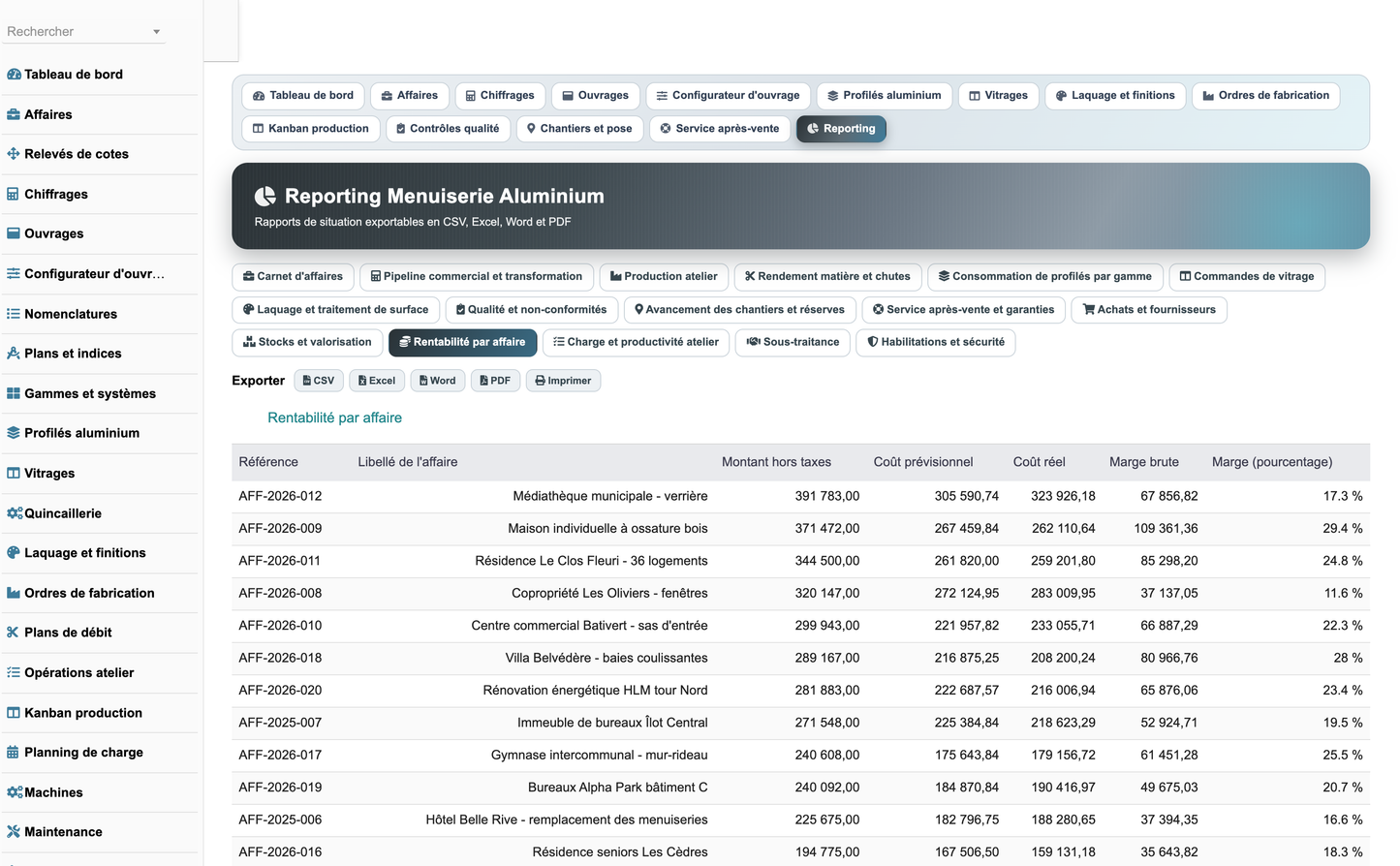
Sixteen situation reports are available from a dedicated menu. Each one can be exported to CSV, Excel and Word, rendered as a landscape PDF, or printed directly. Exports carry correctly encoded accented characters in every format.
|
Report |
Content |
|
Order book |
Business cases with customer, city, status, surface, amount, margin and progress |
|
Sales pipeline |
Volume and value per lifecycle status with the average margin |
|
Workshop production |
Twelve-month history: orders, units, surface, aluminium weight, hours, performance |
|
Material yield |
Cutting plans, bars consumed, useful and offcut length, scrap rate by system |
|
Profile consumption |
Stock, weight per metre and stock value per system and per profile role |
|
Glazing orders |
Volumes, average Ug, solar factor, price per square metre and lead time |
|
Coating |
Colours used, treatment, aspect, quality label, film thickness and unit count |
|
Quality |
Conformity rate per control family plus non-conformity count and non-quality cost |
|
Site progress |
Sites with team leader, units installed, surface, progress and open snags |
|
After-sales |
Ticket volume by type and warranty, average lead time, service level and cost |
|
Purchasing |
Volume, amount, average delivery lead time and receipt conformity per supplier |
|
Stock and valuation |
Quantity, weighted average price, value and alert count per family and location |
|
Profitability |
Amount, planned cost, actual cost, gross margin and margin percentage per business case |
|
Workshop load |
Operations, planned and actual hours, performance and scrap per workstation |
|
Subcontracting |
Volume, amount, turnaround time and conformity per subcontractor and service |
|
Certifications and safety |
Staff certifications with expiry date and remaining days |
5. Native Dolibarr Integration
The module does not duplicate what Dolibarr already does well. Instead, every business object carries a foreign key to the relevant native record, so the standard workflow, numbering, PDF templates and accounting remain in charge.
|
Native module |
How it is used |
|
Third parties |
Customers on business cases, sites, after-sales tickets; suppliers on systems, glazing, hardware, coatings, purchases and subcontracting |
|
Commercial proposals |
Each estimate can be linked to the quotation actually sent to the customer |
|
Sales orders |
Work orders can be linked to the customer order that triggered them |
|
Invoices |
Business case amounts, retention and progress support progress billing |
|
Supplier orders |
Purchase records link to the supplier order raised in Dolibarr |
|
Shipments |
Shipment records link to the native Dolibarr shipment |
|
Interventions |
After-sales tickets link to the native intervention sheet |
|
Projects |
A business case can be attached to a Dolibarr project |
|
Products and services |
Profiles and hardware items can point to a native product for stock and purchasing |
|
Warehouses and stock |
Profiles and stock records can be located in a Dolibarr warehouse |
|
Users |
Account managers, surveyors, draftsmen, operators, inspectors and technicians |
|
Document management |
Drawings, survey photographs and site records are stored in the ECM tree |
6. Configuration and Demonstration Data
A dedicated setup page exposes the trade parameters and the demonstration dataset controls. It is reachable from Setup > Modules > Aluminium Joinery Management.
|
Parameter |
Default |
|
Average aluminium price (euro per kilogram) |
9.40 |
|
Workshop hourly rate |
46 |
|
Installation hourly rate |
38 |
|
Coating price per square metre |
24.00 |
|
Default scrap coefficient |
1.10 |
|
Default margin coefficient |
1.22 |
|
Standard bar length (millimetres) |
6500 |
|
Certification alert (days before expiry) |
60 |
|
Contractual intervention lead time (hours) |
48 |
|
Default reference standard |
NF EN 14351-1 |
6.1 Demonstration dataset
· Install demonstration data - one click loads a complete, realistic and internally consistent dataset spread over the last twelve months: business cases, site surveys, estimates, units, bills of materials, cutting plans, work orders, workshop operations, quality controls, sites, snags, after-sales tickets, purchases, stock, offcuts, shipments, subcontracting, staff and safety records, together with the customers and suppliers they refer to.
· Clear demonstration data - one click removes every record created by the generator, including the third parties, and cascades to any child record the user has since attached to a demonstration parent, so no orphan is left behind.
· Realistic aggregates - the dataset is calibrated so that the dashboard figures read like a real company: a scrap rate around 10 percent, a quality conformity rate around 96 percent, a win rate around 50 percent, machine availability above 90 percent and twelve populated months on every monthly chart.
7. Technical Characteristics
|
Item |
Detail |
|
Technical name |
aluminiumjoinerymanagement |
|
Module number |
534100 |
|
Dependencies |
Third parties (modSociete), Products (modProduct) |
|
Minimum Dolibarr version |
16.0 |
|
Minimum PHP version |
7.1 |
|
Database tables |
28, all multi-entity aware, with schema self-healing on upgrade |
|
Permissions |
29, grouped into nine functional areas plus reporting and administration |
|
Languages |
fr_FR, en_US, es_ES, it_IT, de_DE |
|
Translation keys |
724 per language, all prefixed to avoid cross-module collisions |
|
Licence |
GNU General Public License v3 |
|
Publisher |
DoliResources - www.doliresources.com |
8. Installation
· Step 1 - unzip module_aluminiumjoinerymanagement-1.0.zip into the htdocs/custom directory of the Dolibarr installation.
· Step 2 - enable the module from Setup > Modules, in the Products family.
· Step 3 - open the module setup page to adjust the trade parameters and, optionally, load the demonstration dataset.
© 2026 DoliResources - www.doliresources.com - All rights reserved.


