
Discover powerful Dolibarr extensions designed to automate your business processes
Boilermaking Management turns Dolibarr into a genuine ERP/MES for boilermaking, piping, structural steelwork and welded fabrication companies. It covers the whole trade cycle, from the...
Couldn't load pickup availability


Boilermaking Management turns Dolibarr into a genuine ERP/MES for boilermaking, piping, structural steelwork and welded fabrication companies. It covers the whole trade cycle, from the tender estimated on a cost-per-kilo basis through to the end-of-manufacturing file handed over to the customer and the notified body — with no external software.
The module ships twenty-six business objects, a purpose-built “steel and spark” dashboard, a workshop kanban, a load planning board, an EN 10204 traceability tree and sixteen situation reports exportable to CSV, Excel, Word and PDF. Every screen is translated into French, English, Spanish, Italian and German.
· Boilermaking and welded fabrication workshops (tanks, vessels, silos, hoppers, skids).
· Industrial piping contractors working under EN 13480 or ASME B31.
· Structural steelwork companies certified EN 1090 (EXC2 to EXC4).
· Pressure equipment manufacturers working under CODAP, CODETI or the PED directive.
· Maintenance and on-site erection contractors for process industries.
|
Item |
Value |
|
Business objects |
26 |
|
Permission entries |
35 (11 functional groups × read/write/delete, plus reporting and admin) |
|
Menu entries |
32 left-menu entries plus a dedicated top menu |
|
Dashboard indicators |
4 hero figures, 8 alert tiles, 22 clickable KPIs, 8 charts |
|
Reports |
16, each exportable to CSV, Excel, Word and PDF |
|
Languages |
French, English, Spanish, Italian, German |
|
Database tables |
26 (prefix llx_chd_) |
Each object comes with a searchable list (multi-criteria filters, column selector, sorting, pagination) and a detail card with linked records, notes and history.
Business case (affaire) — Customer, project manager, applicable standard (EN 1090, CODAP, CODETI, EN 13480, ASME VIII), PED risk category, planned and actual tonnage, amount, planned and actual cost, margin, progress and lifecycle status.
Technical estimate — Cost per kilo estimating: total mass, material price per kilo, transformation and scrap coefficients, hours split across cutting, forming, welding, assembly and finishing, weld metres, material / labour / subcontracting / treatment / transport costs, cost price, margin and selling price.
Fabricated work (ouvrage) — Shell, dished end, support skirt, nozzle, manway, walkway, frame or hopper: mark, grade, thickness, overall dimensions, diameter, mass, volume, service pressure and temperature, process fluid and quantity.
Drawing & technical document — Revision index, drawing type (general arrangement, detail, cutting, isometric, layout), file format (DWG, DXF, PDF, STEP), author, issue date, scale, released-for-construction or obsolete status and document-store path.
Bill of material line — Mark, designation, linked stock material, grade, product shape, thickness, dimensions, quantity, unit and total mass, flat pattern and associated weld length.
Raw material — Plates, tubes, sections, angles, flanges and dished ends by family and grade (S235, S355, 304L, 316L, duplex, aluminium): thickness, dimensions, linear or surface mass, stock and reserved quantity, alert threshold, price per kilo, rack location and supplier.
Material certificate / heat — EN 10204 3.1 or 3.2 certificate: heat number, steel mill, receipt date, yield strength, tensile strength, elongation, impact energy, carbon content and carbon equivalent, received mass and assigned marks (mark transfer).
Reusable offcut — Grade, thickness, dimensions, area, mass, valuation, storage bin, creation date and available/consumed status, so the scrap rate can actually be reduced.
Work order — Linked business case and work, quantity, produced quantity, total mass, planned and actual dates, planned and actual hours, priority, progress, manufacturing stage and lifecycle status.
Routing operation — Sequence number, operation type (cutting, rolling, bending, tacking, welding, grinding, drilling, assembly, inspection, finishing), machine, operator, allocated time, time spent and time stamps.
Cutting / nesting plan — Cutting process (laser, plasma, oxy-fuel, shear, waterjet), machine, CNC program, number of sheets and parts, gross and net area, material yield, cut length and scrap mass.
Weld joint (welding book) — Joint mark, joint type, ISO 4063 process, welding position, thickness, diameter, weld length, number of passes, filler metal, shielding gas, preheat temperature, welding date, assigned welder and applicable WPS.
WPS / WPQR — Document type, process, material group, joint type, qualified positions, thickness and diameter ranges, filler metal, shielding gas, certification body, qualification and validity dates.
Welder & qualification — EN ISO 9606 certificate number, qualified processes and positions, thickness and diameter ranges, material groups, certification body, qualification, expiry and prorogation dates, welded metres, individual reject rate and hourly cost.
Welding consumable — Wires, flux-cored wires, TIG rods, electrodes, flux, gases and abrasives: standard, diameter, batch number, drying requirement, stock quantity, alert threshold, unit price, supplier, location and expiry date.
Non-destructive test — Method (VT, PT, MT, UT, RT, leak testing), inspection rate, internal or external inspector, certification level, acceptance criteria, inspection date, result, number and type of defects, report number and cost.
Pressure test — Test type (hydraulic, pneumatic, leak), service and test pressure, hold duration, fluid, temperature, test date, responsible, notified body, result and test-report number.
Non-conformity — Origin, severity, detection date and detector, root cause, corrective and preventive action, responsible, closure date, cost of non-quality and rework hours.
Surface treatment — Treatment type (blasting, metallising, hot-dip galvanising, painting, passivation), preparation grade, paint system, ISO 12944 corrosivity category (C2 to C5-M), number of coats, dry film thickness, RAL colour, treated area, subcontractor, adhesion result and cost.
Machine / production equipment — Laser, plasma, oxy-fuel, press brakes, rolls, tube benders, shears, welding sets, overhead cranes and finishing booths: brand, model, serial number, year, capacity, power, workshop, hourly rate, cumulated hours, utilisation rate, availability and next maintenance date.
Maintenance — Preventive, corrective or statutory intervention: periodicity, planned and completion dates, downtime, technician, service provider, cost and replaced parts.
Site / erection — Site address and city, customer, site manager, number of workers, dates, lifting equipment, erected tonnage, progress, acceptance date and status.
HSE record — Hot-work permit, prevention plan, risk assessment, confined-space permit, certification or near-miss: document and validity dates, risk level, preventive measures, required PPE and number of persons.
Subcontracting — Service type (galvanising, laser cutting, machining, NDT, heat treatment, transport), send and return dates, mass sent out, amount, quality score, incoming inspection and status.
Shipment — Package number and count, gross mass, overall dimensions, carrier, transport type (including abnormal loads), shipment and delivery dates, transport cost and status.
Workshop staff — Trade, workshop, certifications, versatility, hire date, hourly cost, monthly hours and productivity rate.
The dashboard deliberately departs from the classic Dolibarr layout. Its palette — brushed steel greys shading into incandescent orange — echoes the trade itself: hot metal, welding arc and brass. Every tile is a link to the filtered list behind it.
· Tonnage transformed during the current month.
· Number of active business cases (won, in production, being erected).
· Weld conformity rate computed from all recorded non-destructive tests.
· Revenue booked during the current month.
|
Alert |
Meaning |
|
Materials below threshold |
Raw material references whose stock has fallen to or below their alert threshold. |
|
Expired welder qualifications |
Welders whose EN ISO 9606 certificate has lapsed; they are automatically suspended. |
|
Qualifications to renew within 60 days |
Prorogation window, configurable in the module settings. |
|
Late work orders |
Work orders past their planned end date and not yet completed. |
|
Failed non-destructive tests |
Inspections returned as non-conform, requiring joint rework. |
|
Pressure tests to schedule |
Hydraulic or pneumatic tests still pending. |
|
Machine maintenance due |
Preventive or statutory interventions reaching their planned date. |
|
Obsolete drawings in circulation |
Drawings whose revision index has been superseded. |
Workshop production: monthly and yearly tonnage, running and late work orders, workshop hours, material yield, scrap rate and valued work in progress.
Welding and quality: weld metres, active welders, qualifications expiring, weld conformity, open non-conformities, cost of non-quality, average margin and pending tests.
Material and equipment: raw material stock value, low-stock items, offcut value, machine availability, maintenance due and open sites.
· Monthly tonnage produced over a rolling twelve months.
· Tonnage split by material grade.
· Load per machine measured from actual routing times.
· Welding process split by weld metres.
· NDT conformity rate per month.
· Business cases by lifecycle status.
· Top customers by revenue.
· Welder qualification expiry horizon (expired, 30, 90, 180 days and beyond).
The kanban lays work orders out across the eight real manufacturing stages — preparation, cutting, forming, assembly, welding, inspection, finishing and shipped — each column showing the number of orders and the cumulated tonnage. Late orders are highlighted in red.
The planning page projects the weekly load over eight weeks, cross-references machine utilisation with actual routing hours and lists every late work order sorted by due date.
A dedicated Reporting menu offers sixteen situation reports. Every report can be exported to CSV (semicolon separated), Excel, Word and PDF, or printed directly from the browser. Accented characters are preserved in every format.
|
Report |
Content |
|
Production |
Work orders, tonnage, planned vs actual hours and performance, month by month over twelve months. |
|
Business cases |
Amount, planned cost, actual cost, margin and progress for every case, ranked by value. |
|
Material & stock |
Stock quantity, value and alert count grouped by grade and product shape. |
|
Material traceability |
Heat numbers, grades, certificate types, steel mills, received mass, mechanical properties and assigned marks. |
|
Welding |
Number of joints, weld metres, average thickness and passes, grouped by ISO 4063 process. |
|
Welder qualifications |
Certificate numbers, qualified processes, expiry dates, days remaining, welded metres and reject rates. |
|
Non-destructive testing |
Inspection count, conform and non-conform results, conformity rate and cost per method. |
|
Non-quality |
Non-conformity count, cost of non-quality and rework hours grouped by origin and severity. |
|
Material yield |
Cutting plans, sheets, parts, average yield and scrap mass grouped by cutting process. |
|
Machines |
Cumulated hours, utilisation rate and availability per machine and workshop. |
|
Maintenance |
Number of interventions, downtime and cost grouped by maintenance type. |
|
Subcontracting |
Orders, mass sent out, amount and quality score per subcontractor and service type. |
|
Surface treatment |
Treatments, treated area, dry film thickness and cost per treatment type and paint system. |
|
Sites |
Workers, erected tonnage, progress and status for every erection site. |
|
HSE & safety |
Documents and persons covered, grouped by HSE document type and risk level. |
|
Financial |
Revenue, actual cost, gross margin and margin rate, month by month over twelve months. |
The traceability page rebuilds, for any selected business case, the complete chain required by the end-of-manufacturing file:
· Fabricated works with their mark, grade, thickness, mass and quantity.
· Bill-of-material marks with designation, grade, thickness, quantity and total mass.
· Material certificates with heat number, certificate type, steel mill, received mass, yield strength and assigned marks.
· Weld joints with joint mark, process, position, weld length, passes and filler metal.
· Non-destructive tests with method, inspection rate, result, defect count and report number.
· Pressure tests with test type, test pressure, hold duration, result and report number.
Together with the drawings stored in the Dolibarr document manager, the WPS/WPQR records and the welder qualification certificates, this constitutes the documentation package handed over to the customer and to the notified body.
|
Dolibarr module |
Integration |
|
Third parties |
Customers, suppliers and subcontractors are native third parties. |
|
Products |
Raw material references can be linked to a native product for stock movements. |
|
Projects |
A business case can carry a native project for time and budget tracking. |
|
Quotations (Propal) |
A technical estimate can be linked to the quotation issued to the customer. |
|
Customer orders |
A work order can be linked to the customer order it fulfils. |
|
Supplier orders |
Subcontracting records link to the supplier order that covers them. |
|
Invoices |
Business cases follow through to invoicing, closing the margin loop. |
|
Shipments |
Packing records link to native Dolibarr shipments and delivery notes. |
|
Document manager (ECM) |
Drawings, certificates and inspection reports are stored in the ECM. |
|
Users & agenda |
Project managers, operators, inspectors and site managers are Dolibarr users. |
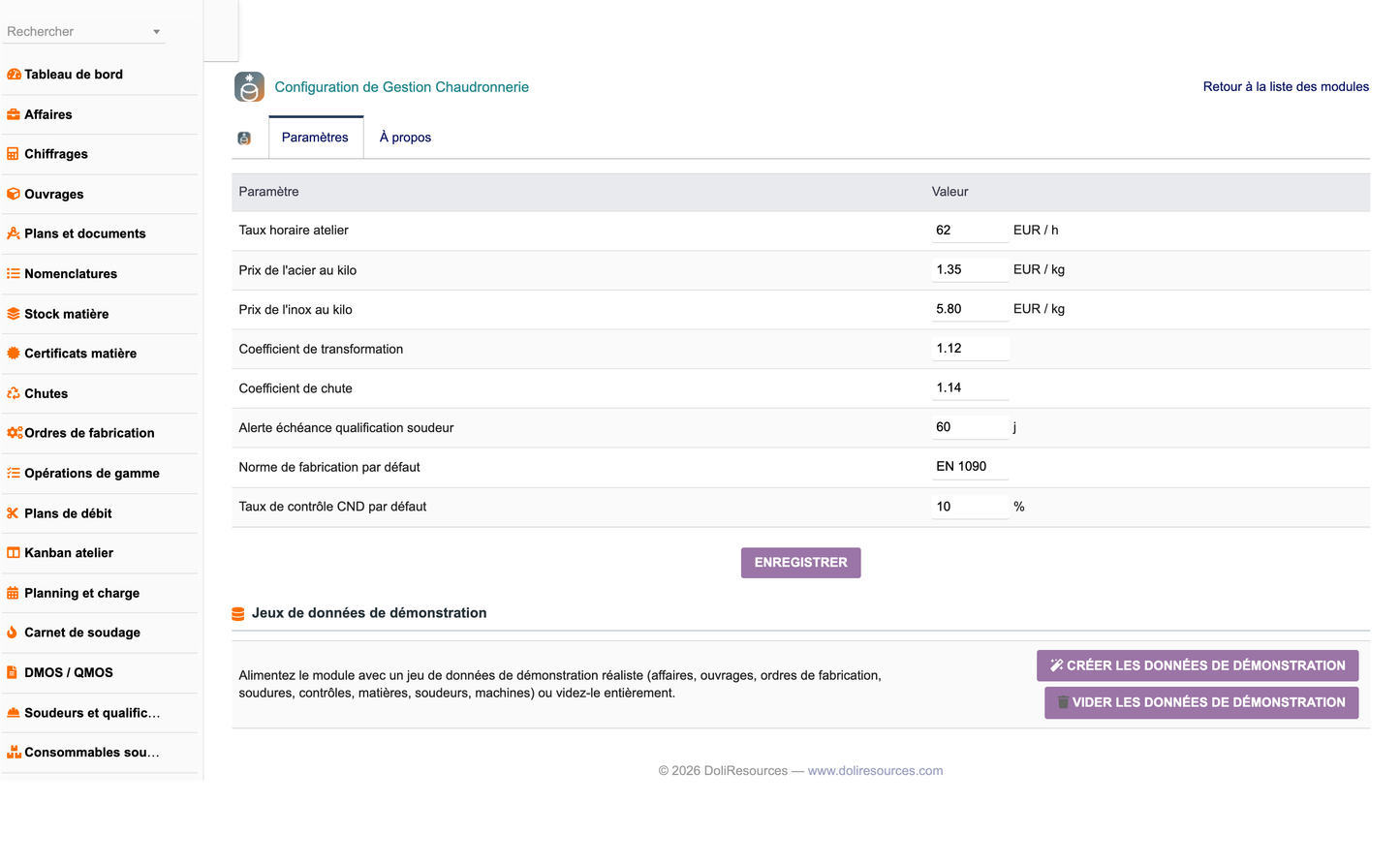
|
Parameter |
Default |
Purpose |
|
Workshop hourly rate |
62 EUR/h |
Labour valuation used by the estimating engine. |
|
Steel price per kilo |
1.35 EUR/kg |
Carbon-steel material cost baseline. |
|
Stainless price per kilo |
5.80 EUR/kg |
Stainless material cost baseline. |
|
Transformation coefficient |
1.12 |
Uplift applied to raw material cost. |
|
Scrap coefficient |
1.14 |
Allowance for offcuts in the estimate. |
|
Welder qualification alert |
60 days |
Lead time before an expiry raises an alert. |
|
Default manufacturing standard |
EN 1090 |
Pre-filled on new business cases. |
|
Default NDT inspection rate |
10 % |
Pre-filled on new inspections. |
The configuration page carries two buttons. “Install demo data” fills the module with a realistic, fully cross-referenced dataset: business cases, estimates, works, drawings, bills of material, raw material, material certificates, offcuts, work orders, routing operations, cutting plans, weld joints, WPS/WPQR, welders, consumables, non-destructive tests, pressure tests, non-conformities, surface treatments, machines, maintenance, sites, HSE records, subcontracting, shipments and workshop staff — plus the customers and suppliers they refer to.
“Remove demo data” wipes the whole dataset, including the native Dolibarr third parties created for the demonstration, and cascades to records the user may have added under a demo parent, so no orphan row is left behind. The dataset is versioned, so an upgrade re-seeds an improved dataset instead of leaving stale demo content in place.
Permissions are granted per functional group with read, write and delete granularity: business cases, design office, material, production, welding, quality, finishing, equipment, sites and HSE, purchasing and logistics, and staff — plus a reporting read permission and a module administration permission. Read and write are granted by default on activation so the module is immediately usable; delete and admin must be granted explicitly.
|
Item |
Value |
|
Technical name |
chaudronneriemanagement |
|
Module number |
533400 |
|
Version |
1.0.0 |
|
Editor |
DoliResources — https://www.doliresources.com |
|
Licence |
GNU GPL v3 or later |
|
Minimum Dolibarr |
16.0 |
|
Minimum PHP |
7.1 |
|
Dependencies |
Third parties (modSociete), Products (modProduct) |
|
Table prefix |
llx_chd_ |
|
Language key prefix |
Chd (every visible key is prefixed to avoid cross-module collisions) |
|
Installation |
Unzip into htdocs/custom/, then enable under Setup > Modules > Products |
Boilermaking Management (Gestion Chaudronnerie) is published by DoliResources and distributed under the GNU General Public License version 3 or later. All rights on the module design, documentation and demonstration content are reserved.
© 2026 DoliResources — www.doliresources.com


