
Discover powerful Dolibarr extensions designed to automate your business processes
Cardiology Practice Management turns Dolibarr into a complete operational information system for a cardiology practice,...
Couldn't load pickup availability


Cardiology Practice Management turns Dolibarr into a complete operational information system for a cardiology practice, centre or network. It covers the entire patient journey — from booking to archiving — so that a cardiologist, a group practice, a cardiovascular centre or a clinic's cardiology department can run its whole activity without a second management application.
The module manages patients and their cardiovascular records, scheduling and admissions, consultations and vital signs, the full range of cardiovascular examinations, chronic follow-up pathways, treatments and prescriptions, medical reports with a validation and signature circuit, teleconsultation, insurance and billing, consumables and biomedical equipment, maintenance, quality and incidents, plus reporting and decision support.
Scope of responsibility
This module is an administrative, organisational and documentary tool. It does not replace — and must never be used to replace — medical diagnosis, prescription, the interpretation of an ECG, an echocardiogram or a Holter recording, cardiovascular risk assessment, therapeutic decision-making, or validation by the cardiologist. The module produces no automatic clinical interpretation: every diagnosis, conclusion and therapeutic decision is entered, validated and signed by a qualified health professional, and the author and timestamp of that validation are persisted.
· Centralise the complete cardiovascular record of every patient in one place.
· Remove double data entry between scheduling, consultation, examination and billing.
· Guarantee traceability: who validated what, and when, on every clinical document.
· Shorten the loop between an examination being performed and its report being signed.
· Give the practice manager a real-time view of activity, capacity and revenue.
· Keep biomedical equipment compliant through planned maintenance and calibration.
· Support multi-site and multi-practitioner organisations on a single instance.
|
Domain |
Coverage |
|
Patients |
Administrative record, cardiovascular record, history, risk factors, allergies |
|
Scheduling |
Appointments, admissions, waiting queue, reminders, cancellations |
|
Consultations |
Typed consultations, vital signs, structured symptoms, clinical examination |
|
Examinations |
ECG, echocardiography, vascular Doppler, Holter ECG, ABPM, stress test, configurable exams |
|
Follow-up |
Chronic pathology pathways, implanted cardiac devices, anticoagulation |
|
Documents |
Prescriptions, medical reports, certificates, referral letters, PDF output |
|
Teleconsultation |
Consent, questionnaire, session record, linked consultation and invoice |
|
Billing |
Care acts, insurers, third-party payment, patient share, payments, unpaid |
|
Logistics |
Consumables with lots and expiry, biomedical equipment, maintenance |
|
Quality |
Incidents, corrective actions, audits, patient satisfaction |
|
Analytics |
Dashboard with 32 indicators, 4 charts, 8 reports, CSV export, REST API |
45 granular permissions are grouped into 15 functional areas. Read and write are granted by default so the module is usable immediately after activation; delete, export and administration are opt-in. The principle of least privilege applies throughout.
|
Role |
Typical permissions |
|
Administrator |
All areas including administration and export |
|
Management |
Read across all areas, reporting, billing |
|
Cardiologist |
Full clinical access including validation and signature |
|
Associate cardiologist |
Clinical access, validation of own results |
|
Locum physician |
Clinical access, no deletion |
|
Nurse |
Patients, vital signs, admissions, examinations preparation |
|
Investigation technician |
Examinations, equipment, consumables |
|
Medical secretary |
Patients, appointments, admissions, documents |
|
Reception agent |
Appointments, admissions, waiting queue |
|
Billing manager |
Care billing, payments, insurers, unpaid |
|
Cashier |
Payments only |
|
Insurance officer |
Insurers, conventions, coverage |
|
Quality manager |
Incidents, audits, satisfaction |
|
Biomedical technician |
Equipment, maintenance, calibration |
|
Accountant |
Billing and payments, read only |
|
External referring physician |
Referrer portal: submitted requests and authorised reports |
|
Patient |
Patient portal: appointments, documents, invoices |
|
Read-only user |
Read access to the areas granted |
The dashboard is titled Cardiology Clinical Pulse Center. Its visual language evokes cardiac rhythm and monitoring: an animated electrocardiogram trace across the header, a cardiovascular red and medical blue palette, green for normal situations, orange for watch items and dark red for urgent ones.
An animated care-pathway strip runs across the top, showing live counts at each of the eight stages: Appointment, Admission, Consultation, Examination, Interpretation, Prescription, Follow-up, Billing.
32 indicators are grouped into six zones:
· Today's activity — appointments, planned consultations, patients waiting, average waiting time, average consultation duration, cancellation rate, no-show rate, revenue.
· Clinical follow-up — patients under follow-up, new patients, completed consultations, teleconsultations, prescriptions issued, pathways requiring early review.
· Cardiovascular examinations — ECGs, echocardiographies, Dopplers, Holters fitted, ABPM, stress tests, results awaiting validation, reports awaiting signature.
· Analytics — 12-month activity, examination breakdown, monitored pathologies, risk factors.
· Billing and collections — monthly revenue, amounts collected, unpaid, average cost per consultation, margin rate.
· Equipment, stock and quality — available equipment, upcoming maintenance, critical stock, open incidents, patient satisfaction.
Indicator design note: every rate divides by the population it actually counts. Cancellation and no-show rates are computed over appointments that have resolved, not over future bookings, and the margin rate ignores acts with no recorded cost price — a missing cost means unknown, not zero.
The patient record holds identity, contact details, emergency contact, general practitioner, referring physician, insurer and membership number, occupation, marital status, blood group, weight, height, automatically computed body mass index, preferred language, mobility, consent, portal access and status.
· Duplicate detection on name and date of birth
· Multi-criteria search across reference, name, town, phone and e-mail
· Modification history and archiving
· Consent tracking and access restriction
· Linkage to a native Dolibarr third party when invoicing requires it
Ten categories of medical history are supported: cardiac history, cardiac surgery, angioplasty, myocardial infarction, stroke, renal disease, vascular disease, thrombosis, hospitalisation and other. Each entry records the event date, the establishment, the practitioner and whether it is a family history.
Ten cardiovascular risk factors are tracked — smoking, hypertension, diabetes, dyslipidaemia, sedentary lifestyle, overweight, family history, stress, unbalanced diet and alcohol consumption — each with a risk level, a measured value and unit where relevant, an assessment date and a controlled flag.
Twelve appointment types and ten statuses cover the full booking lifecycle: requested, to confirm, confirmed, reminder sent, patient arrived, in consultation, completed, no-show, cancelled and postponed. Appointments carry practitioner, room, site, duration, teleconsultation flag, reason, reminder tracking and cancellation reason, and can be filtered by any of these.
Admission records the arrival and admission times, computes the waiting time, and captures the identity, insurance and document checks, the priority level, the room and the assigned practitioner. The waiting queue shows each patient with their scheduled time, arrival time, elapsed wait, consultation type, urgency and status.
Ten consultation types — first consultation, follow-up, cardiovascular prevention, hypertension, heart failure, rhythmology, pre-operative, post-operative, teleconsultation and emergency — progress through seven statuses from draft to closed. Each consultation records the reason, clinical examination, auscultation, diagnostic hypotheses, the diagnosis entered by the cardiologist, patient advice, the follow-up plan, the next appointment date and the billed amount.
Fourteen measurements are captured and historised per consultation: weight, height, computed body mass index, systolic and diastolic pressure, heart rate, oxygen saturation, temperature, respiratory rate, blood glucose, waist circumference and pain score. Values are timestamped so trends can be followed across the patient's history.
The ECG record holds the patient, consultation, device, practitioner, context, recorded heart rate, rhythm, PR interval, QRS duration, QT interval, electrical axis, observations, the cardiologist's conclusion and an attached file. It moves through planned, performed, to interpret, interpreted, validated and archived.
The module never interprets the ECG in place of the cardiologist. The conclusion field is only populated by a qualified professional, and validation records who signed it and when.
Transthoracic, transoesophageal, stress echocardiography and cardiac Doppler are supported. Measurements include ejection fraction, end-diastolic and end-systolic diameters, septum thickness, left atrial volume, aortic root and pulmonary artery pressure, together with free-text descriptions of the valves, the pericardium and the Doppler analysis, and the cardiologist's conclusion.
Arterial, venous, carotid, limb and renal Doppler studies record the explored zone, the side, the indication, stenosis percentage, intima-media thickness, peak velocity and ankle-brachial index, with observations and conclusion.
The Holter workflow runs from prescription and scheduling through fitting, device hand-over, recording, return, import, interpretation, validation and report. The record captures the device and its serial number, fitting and return timestamps, duration, technician, mean, minimum and maximum heart rate, ventricular and supraventricular extrasystoles, atrial fibrillation burden, the patient diary and any incident. Device availability is tracked so a recorder cannot be double-booked.
ABPM records the device, cuff size, fitting and return, number of measurements and the percentage that were valid, mean daytime and night-time systolic and diastolic pressures, nocturnal dipping, systolic load, the patient diary and the conclusion.
Stress testing records the indication, the explicit verification of contraindications, patient consent, the physician, technician, room and modality (treadmill or cycle ergometer), the protocol, resting and maximal heart rate and blood pressure, target heart rate reached, maximum load, metabolic equivalents, exercise duration, the reason for stopping, symptoms during the test, ST segment changes, the recovery phase and the conclusion. The module ensures traceability and takes no automatic medical decision.
Configurable pathways cover arterial hypertension, heart failure, coronary artery disease, rhythm disorders, atrial fibrillation, valvular disease, cardiomyopathy, vascular disease, secondary prevention and post-operative follow-up. Each pathway tracks the severity stage, therapeutic target, review frequency, last and next review dates, hospitalisations and status.
Implanted cardiac devices — pacemakers, implantable defibrillators, implantable monitors and resynchronisation devices — are tracked with manufacturer, model, serial number, implantation date, establishment, implanting physician, side, battery level and next check date.
Treatment lines record the medicinal product, therapeutic class (nine classes including beta blockers, ACE inhibitors, angiotensin receptor blockers, diuretics, statins, anticoagulants, antiplatelet agents, calcium channel blockers and antiarrhythmics), the dosage as entered, pharmaceutical form, frequency, route, start and end dates, indication and status. Anticoagulant therapy carries an INR target and its own monitoring. The module never generates a dosage decision.
Five prescription types are supported: drug prescriptions, examination requests, laboratory work-ups, medical certificates and medical letters. Each carries a validity date, renewability, renewal count and a status from draft through signed and delivered. Prescriptions are validated and signed by an authorised professional.
Eight report templates are provided — consultation, ECG, echocardiography, Doppler, Holter, ABPM, stress test and letter to the general practitioner. Reports follow a controlled circuit:
Draft → To review → To validate → Validated → Signed → Sent → Archived
· Customisable templates with dynamic variables
· Version history on every report
· Locking once validated, with traced corrections
· PDF generation and secure sending
Teleconsultation covers booking, consent, administrative verification, an external video-conferencing link, deposited documents, a pre-session questionnaire, the session itself, the report, the prescription, the invoice and payment. No sensitive data is ever embedded in an unsecured link.
· View appointments and confirm or cancel within the practice's rules
· Upload documents required before a consultation
· Consult authorised reports and download prescriptions
· View invoices and payments
· Receive reminders
· Send an administrative request and update selected contact details
· Submit an examination or consultation request with attachments
· Follow the status of a submitted request
· Consult and download authorised reports and results
· Review the history of patients referred
· Exchange secure messages with the practice
Insurers, mutual funds and paying organisations are managed with their conventions, negotiated tariffs, coverage rates, ceilings, third-party payment arrangements and required documents. For every act the module records the organisation, membership number, coverage, covered amount, patient share and status.
Care acts, examinations, teleconsultations and certificates are billed with their act code, amount, VAT rate, covered amount, patient share and cost price, and linked to the patient, the consultation, the insurer and the payment. The module integrates with the native Dolibarr quotation, order, invoice, payment, bank and accounting modules.
· Tariffs per practitioner, per site and per convention
· Third-party payment with split settlement between insurer and patient
· Partial payments, unpaid tracking and credit notes
· Cost price and margin per act
Consumables — electrodes, ultrasound gel, ECG paper, cuffs, sensors, cables, hygiene supplies and single-use items — are tracked with unit, quantity in stock, minimum and maximum levels, lot number, expiry date, unit cost and storage location, with low-stock and expiry alerts.
Fourteen equipment families are covered, from electrocardiographs, ultrasound scanners and probes to Holter recorders, ABPM devices, treadmills, cycle ergometers, defibrillators, patient monitors, blood pressure meters, pulse oximeters and teleconsultation stations. Each record holds manufacturer, model, serial number, site, room, installation and service dates, supplier, warranty, contract, purchase cost, number of uses, failures, downtime, next calibration date and status.
Preventive maintenance, corrective maintenance, calibration and technical inspection are planned and tracked with provider, technician, description, parts used, duration, downtime and cost. A maintenance operation can block the equipment and, with it, the slots that depend on it. Availability, failure count, downtime and maintenance cost are derived from these records.
Audits, procedures, controls, non-conformities, corrective and preventive actions, complaints, satisfaction surveys and indicators are managed together. Audits record scope, auditor, conformity and non-conformity counts, a conformity score, findings and an action plan.
Incident records carry a reference, date, reporter, the linked patient, consultation or equipment where authorised, type, severity, description, immediate action, root cause analysis, corrective action, owner, due date, status and closure.
Eight reports are available, each with CSV export and printing:
|
Report |
Content |
|
Monthly activity |
Appointments, consultations, examinations, no-show rate, revenue over 12 months |
|
Examinations |
Volume and pending interpretation per examination family |
|
Practitioners |
Consultations, total and average billed amount per practitioner |
|
Pathologies |
Patients, hospitalisations and alerts per monitored pathology |
|
Billing |
Volume and amounts per payment method |
|
Insurers |
Invoices, covered amounts and patient share per paying organisation |
|
Equipment |
Uses, failures, maintenance operations and cost per device |
|
Quality |
Incidents by type, open versus closed |
The reporting layer supports activity forecasting, cancellation and no-show analysis, waiting-time analysis, practitioner workload, equipment utilisation, consumable forecasting, cost and margin analysis, maintenance forecasting and chronic patient monitoring. Every recommendation is explainable and reviewable; the module never generates an automatic medical diagnosis.
A secured REST API exposes all 33 resources with list, read, create, update and delete operations, plus a consolidated statistics endpoint. Requests authenticate with a Dolibarr API key and are subject to the same granular permissions as the user interface.
|
Method |
Route |
|
GET |
/api/index.php/cardiologypractice/{resource} |
|
GET |
/api/index.php/cardiologypractice/{resource}/{id} |
|
POST |
/api/index.php/cardiologypractice/{resource} |
|
PUT |
/api/index.php/cardiologypractice/{resource}/{id} |
|
DELETE |
/api/index.php/cardiologypractice/{resource}/{id} |
|
GET |
/api/index.php/cardiologypractice/stats |
Resources include patients, practitioners, referrers, insurances, appointments, admissions, consultations, vitals, symptoms, ecgs, echocardiographies, dopplers, holters, abpms, stresstests, followups, devices, treatments, prescriptions, reports, teleconsultations, invoices, payments, consumables, equipments, maintenances, incidents and audits.
Pagination, sorting and universal-search filtering are supported. Sort fields are whitelisted against the real table columns before reaching SQL. An invalid API key returns 401 and an unknown resource returns 404.
· Prepared statements and systematic escaping on every query
· CSRF tokens on all forms; XSS protection on all rendered values
· 45 granular permissions enforcing least privilege
· Locking of validated and signed documents; report versioning
· Validation traceability (author and timestamp) on consultations, examinations, prescriptions and reports
· No sensitive data in URL parameters or in logs
· Multi-entity isolation via an entity column on all 33 tables
· Controlled downloads and permission-gated exports
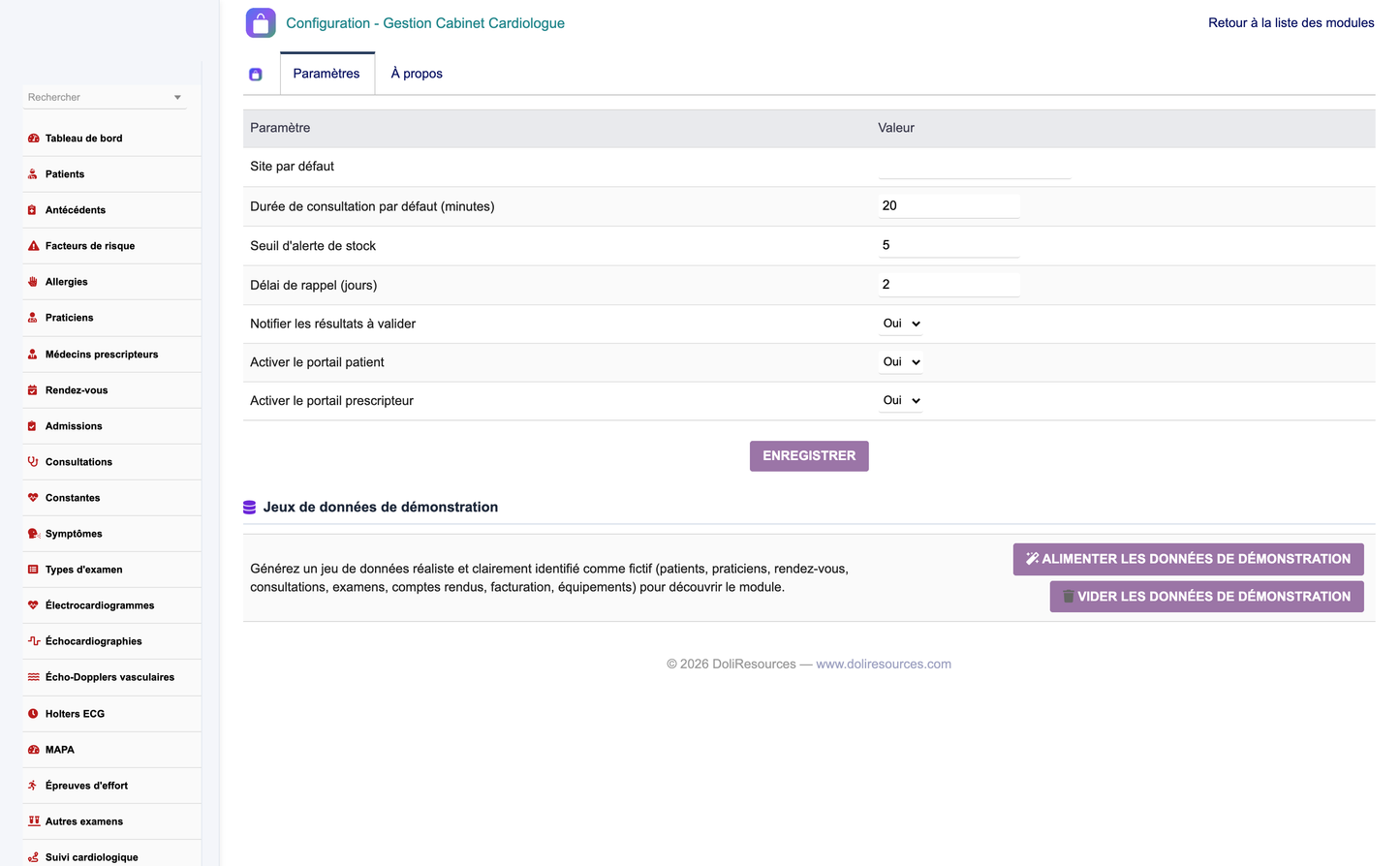
The configuration page offers two actions. Install demo data generates a complete, internally consistent practice: 90 patients, 9 practitioners, 8 referring physicians, 6 paying organisations, 411 appointments, 363 consultations with vital signs and symptoms, cardiovascular examinations spread across twelve months, prescriptions, treatments, reports, invoices and their settlements, consumables, 14 equipment items with maintenance history, incidents and audits.
Remove demo data deletes only rows tagged with the technical marker CARDIODEMO, cascading to records a user created underneath a demonstration parent, and never touches real data. All generated data is explicitly fictitious.
· Deploy cardiologypractice/ into htdocs/custom/, or install module_cardiologypractice-1.0.zip from Home → Setup → Modules → Deploy external module.
· Enable the module in Setup → Modules.
· Open the module configuration page and optionally install the demo dataset.
· Assign permissions to user groups.
Activation creates the 33 business tables, the 45 permissions and the menus, and self-heals the schema: a column introduced in a later release is applied automatically by ALTER TABLE, so upgrades are non-destructive.
Cardiology Practice Management — Gestion Cabinet Cardiologue
Published by DoliResources — www.doliresources.com
Copyright © DoliResources


