
Discover powerful Dolibarr extensions designed to automate your business processes
Cement Plant Management transforms Dolibarr ERP/CRM into a dedicated, industrial-grade platform for running an entire cement manufacturing unit — from raw-material sourcing at the...
Couldn't load pickup availability


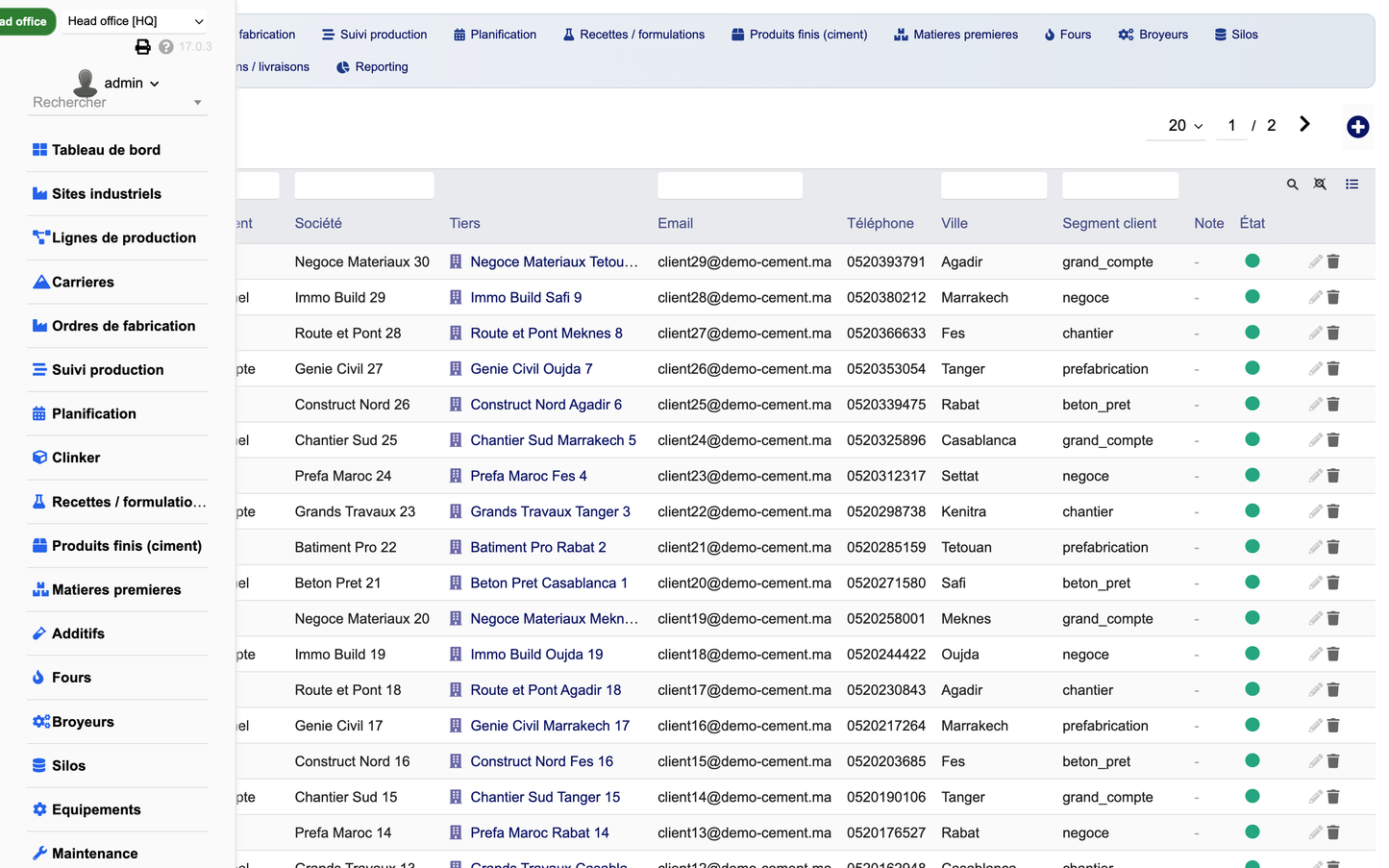
Cement Plant Management transforms Dolibarr ERP/CRM into a dedicated, industrial-grade platform for running an entire cement manufacturing unit — from raw-material sourcing at the quarry to the delivery of the finished product to the customer. It unifies production, process equipment, quality, laboratory, maintenance, energy, environment, health & safety (HSE), stock, logistics and sales into a single, coherent, real-time management solution.
The module is built entirely with an object-oriented architecture that follows the official Dolibarr development standards and PHP/MySQL best practices. Every commercial operation (third parties, products, stock, purchase and sales orders, shipments, invoices, payments) reuses the native Dolibarr objects, guaranteeing seamless integration, data consistency and long-term maintainability. The result is a commercial-quality product ready for distribution by DoliResources.
· 28 dedicated business objects: covering the full cement production value chain
· Real-time control-tower dashboard: with KPI cards, interactive charts and industrial alerts
· Complete GPAO / MES engine: manufacturing orders, recipes/formulations, kilns, mills, clinker and silos
· Integrated laboratory & quality: chemical/physical tests, controls, non-conformities and corrective actions
· Equipment, maintenance & energy management: availability, downtime, preventive/corrective maintenance and consumption tracking
· HSE & environmental compliance: incidents, safety and CO₂ / dust / discharge monitoring
· Weighbridge & logistics: double weighing, delivery notes, shipments and transport
· Full reporting & Business Intelligence: exportable to PDF, Excel, CSV and print
· Native Dolibarr integration: third parties, products, stock, orders, shipments, invoices and DMS
· Five languages: French, English, Spanish, Italian and German
· One-click demonstration data: generate and remove a full sample dataset
|
Attribute |
Value |
|
Commercial name |
Cement Plant Management (Gestion d’une Unité de Fabrication de Ciment) |
|
Technical name |
cementplantmanagement |
|
Version |
1.0.0 |
|
Publisher |
DoliResources — © 2026 DoliResources |
|
Dolibarr compatibility |
v16, v17, v18, v19, v20, v21, v22, v23+ (forward-compatible) |
|
Minimum PHP |
7.1+ (PHP 8 ready) |
|
Languages |
FR, EN, ES, IT, DE (official Dolibarr langs system) |
|
Database prefix |
llx_cmt_* (28 tables) |
|
Dependencies |
Third Parties (modSociete) + Products/Services (modProduct) |
|
Architecture |
Object-oriented, modular, documented, key-driven generic engine |
The platform is organised around 28 business objects grouped into eight functional areas. Each object provides a full list view (advanced search, multi-criteria filters, sortable and toggleable columns, pagination), a detail card, and — for hub objects — a KPI cockpit and an automatic linked-records panel that surfaces every related record.
Model the physical structure of the cement plant and its supply base.
· Industrial Sites — plants, capacity (t/day), number of lines/kilns/mills, manager, surface, commissioning date — a hub with cockpit and linked records.
· Production Lines — per-site lines with process type (dry/wet), daily capacity, real output, availability and utilisation rates.
· Quarries — supply quarries with main material, reserves, extraction rate, linked supplier, distance and extraction permit tracking.
Manage inputs, formulations and the finished cement catalogue.
· Raw Materials — limestone, clay, gypsum, pozzolana, iron ore, slag, fly ash, chemical correctors — with supplier, quality grade, humidity, density, CaCO₃ content, stock levels/value and linked Dolibarr product.
· Additives — grinding aids and additives with type, dosage, supplier, stock and value.
· Recipes / Formulations — cement formulations (hub) with version, clinker %, gypsum %, additive %, Blaine fineness, theoretical yield and theoretical cost, validation and active flag.
· Recipe Components — the itemised composition lines of each recipe (material or additive, proportion, quantity, unit and line cost).
· Finished Products (CEM I–V) — the cement catalogue (hub): cement type, strength class (32.5 / 42.5 / 52.5), composition, 28-day strength, packaging, certification, cost, sale price and stock.
Drive and trace the manufacturing of clinker and cement.
· Manufacturing Orders (MO) — the production hub: product, recipe, site, line, kiln, mill, planned/real dates, quantity and produced quantity, priority, production phase, progress, and a full industrial cost breakdown (material, energy, labour, overhead) with total cost, sale price and margin. Linkable to a native Dolibarr order and project.
· Clinker — clinker batches with kiln, silo, batch number, produced and stock tonnage, quality indicators (LSF, free lime, C₃S) and unit cost.
· Industrial Journal — a chronological activity log of production events tied to orders, sites and equipment.
Manage the core cement-making equipment and storage.
· Kilns — rotary/pre-calciner kilns (hub): capacity (t/day), temperature, fuel type and consumption, clinker produced, run/stop hours, availability and utilisation rates, state and maintenance schedule.
· Mills — raw and cement mills (hub): capacity (t/h), power, specific consumption (kWh/t), output, Blaine fineness, availability, utilisation and maintenance.
· Silos — storage silos: content type, stored product, capacity, current level (tonnes and %), min/max thresholds and state.
· Equipment Park — conveyors, crushers, baggers, loaders, trucks, generators and more (hub): type, brand, model, serial number, power, run/stop hours, availability, state and maintenance dates.
Ensure product conformity and full traceability.
· Quality Controls — controls (hub) on orders, products or materials: control type, result, quality score, checked/OK/KO counts, controller and checklist.
· Laboratory Tests — chemical and physical analyses: test type, sample, parameter, measured value, specification min/max, result, controller and date (strength, granulometry, humidity, etc.).
· Non-conformities — non-conformities and scrap with type, severity, linked control/order/product, impacted quantity, cost impact, description, corrective action, responsible person and status workflow.
Maximise equipment availability and control consumption and emissions.
· Maintenance — preventive, corrective and curative interventions linked to equipment, kilns or mills: type, planned/done dates, technician, cost, downtime and next due date.
· Energy Consumption — electricity, gas, coal, petcoke, fuel and water: per-site/line quantity, unit price, total cost and CO₂ with period and date.
· Environment — emissions monitoring (CO₂, dust, discharges, waste): measured value vs. regulatory threshold, compliance status and measurement date.
· HSE / Safety — incidents and accidents: type, severity, site, location, person involved, days lost, actions taken and status workflow.
Track material flows and the delivery of finished products.
· Stock Movements — inbound/outbound/transfer movements for materials, products, additives, silos and warehouses, with quantity, value and date — synchronised with native Dolibarr stock.
· Shipments / Deliveries — finished-product shipments: client, product, transporter, truck plate, driver, delivery note, destination, transport cost and status — linkable to a native Dolibarr shipment.
· Weighbridge (Weighing) — double weighing: tare, gross and net weight, bridge, operator and timestamp, linked to the shipment and product.
Manage the customers and suppliers of the plant, wired to native Dolibarr third parties.
· Clients — customer records with type, company, segment, contact details and link to the Dolibarr third party.
· Suppliers — supplier records with type, supplied material, contract reference, contact details and link to the Dolibarr third party.
· Automations & Alerts — a rule engine (with daily cron) that closes completed orders, updates progress, and raises alerts for late orders, low stock, breakdowns, critical non-conformities, due maintenance, full silos and open HSE incidents.
A brand-new dashboard delivers a real-time cockpit view of the whole plant, using a dedicated cement visual identity: concrete grey, industrial blue, safety orange, performance green, white and anthracite. It combines interactive widgets, KPI cards, real-time charts, industrial gauges, alerts and process cards in a fully responsive layout.
The dashboard surfaces, among others:
· Daily, monthly and yearly production; clinker produced; cement produced
· Number of manufacturing orders and overall yield
· Line availability rate; kiln and mill utilisation rates
· Raw-material, clinker, cement and additive stock levels
· Customer orders and deliveries; revenue
· Electricity, gas and fuel consumption; CO₂ emissions
· Production cost, gross margin and energy cost
· Maintenance interventions; open HSE incidents; quality conformity rate
· Production trend and production by cement type
· Equipment utilisation and availability
· Energy-consumption trend
· Cost breakdown (material / energy / labour / overhead)
· Stock evolution (clinker / cement)
· Quality conformity rate
A dedicated alert band highlights late manufacturing orders, low material stock, equipment breakdowns, critical non-conformities, maintenance due, saturated silos and open HSE incidents — so operators act on exceptions immediately.
A comprehensive reporting hub covers every dimension of the plant. Each report can be filtered by site, line, product, client, supplier and period, and exported to PDF, Excel and CSV or sent to print.
|
Report family |
Contents |
|
Production |
daily, weekly, monthly and yearly production; clinker output |
|
Quality |
controls, laboratory analyses, non-conformities and certifications |
|
Stock |
raw materials, clinker, finished products and stock alerts; silos |
|
Maintenance |
preventive, corrective and equipment availability |
|
Energy |
electricity, gas, water and fuels |
|
Environment |
CO₂, dust and discharge monitoring |
|
Commercial |
quotes, orders, invoices and deliveries |
|
Financial |
production costs, margins, profitability and revenue |
|
HSE |
accidents, incidents and audits |
All commercial and logistics operations rely exclusively on native Dolibarr objects, so the module enriches — rather than duplicates — the ERP. It integrates with:
· Third parties and contacts
· Products, services and stock; warehouses
· Purchases and suppliers
· Quotes, customer orders and shipments
· Invoices, payments and bank
· Accounting
· Projects and interventions
· Agenda and e-mails
· Contracts and the Document Management System (DMS/GED)
· Manufacturing / GPAO modules where available
The module follows the natural Quote → Order → Manufacturing Order → Production → Delivery → Invoice flow, and hub cards expose a linked-records panel plus quick links to the related native documents.
The module adheres to Dolibarr security best practices:
· CSRF protection on all state-changing actions (token validation)
· XSS protection through systematic output escaping
· Prepared / escaped SQL queries throughout
· Granular permission model with 11 right groups (production, technical, equipment, maintenance, quality, stock, energy, HSE, logistics, automation, reporting) — read, write and delete per group
· Full logging (syslog) and activity journal for auditability
· Multi-company (MultiCompany) compatibility via entity-scoped data
· Modern, responsive interface for desktop, tablet and mobile
· Advanced search, dynamic tables and multi-criteria filters
· Kanban board for the production pipeline (drag & drop across phases)
· Interactive widgets, badges and professional icons
· Column show/hide selector and persistent filters on every list
· Consistent in-page tab bar with left-menu synchronisation
· Dark-mode friendly styling
A dedicated administration page lets administrators configure general parameters (default currency, overhead rate, VAT rate), and manage demonstration data with two one-click buttons:
· Load demonstration data: generates a full, coherent sample dataset — sites, lines, quarries, raw materials, recipes, products, manufacturing orders, kilns, mills, clinker, silos, equipment, maintenance, quality controls, laboratory tests, energy records, HSE incidents and shipments, together with native demo third parties and products.
· Remove demonstration data: safely deletes only the data created by the module, leaving the rest of the Dolibarr installation untouched.
The dataset uses a versioned guard so an improved demo can be re-seeded on upgrade, and the purge is data-safe (it removes only records tagged with the module’s import key).
The module respects the official Dolibarr module architecture (class/, core/, admin/, sql/, langs/, css/, js/, img/, lib/) and ships a clean, documented, modular and easily maintainable codebase. A generic, key-driven engine powers the list and card pages for all objects, avoiding code duplication, while a schema self-heal routine keeps tables up to date across upgrades.
· Object-oriented, PSR-aligned PHP with full docblocks
· Native Dolibarr APIs and CommonObject inheritance
· 28 SQL tables with indexes, entity scoping and import-key tagging
· Optimised queries and rounded computed KPIs for performance
· Verified installation and clean, data-safe uninstallation
Cement Plant Management — a complete cement-plant ERP solution by DoliResources.


