
Discover powerful Dolibarr extensions designed to automate your business processes
Chemical Plant Management turns Dolibarr into a genuine ERP/MES dedicated to the chemical process industry. It covers the entire value...
Couldn't load pickup availability


Chemical Plant Management turns Dolibarr into a genuine ERP/MES dedicated to the chemical process industry. It covers the entire value chain of a chemical manufacturing site — from the reception of a raw material with its CAS number and REACH registration, through formulation, batch production, laboratory release and regulatory compliance, down to the ADR shipment of the finished product. The module removes the need for any additional specialist software: formulation systems, LIMS, CMMS, EHS registers and chemical compliance databases are all replaced by native Dolibarr objects that interoperate with quotations, orders, invoices, shipments, stock, projects and documents.
· Technical name: chemicalplantmanagement — module number 535600
· 27 business objects, 26 granular permissions, 31 menu entries
· 5 languages: French, English, Italian, German, Spanish (559 fully prefixed translation keys)
· Purpose-built “Reactor & Molecule” cockpit with 26 drill-down KPIs, 8 alert tiles, an 8-column process kanban, 8 charts and 4 performance gauges
· 16 situation reports, each exportable to CSV, Excel, Word and print/PDF
· Built-in demonstration dataset covering twelve full months, installable and removable from the configuration page in one click
· Compatible with Dolibarr 16 to 23 and PHP 7.4 to 8.3, licensed under GPL v3
· Chemical raw materials with full regulatory identity: CAS number, EC/EINECS number, REACH registration number, chemical family (solvent, acid, base, monomer, polymer, catalyst, surfactant, salt, filler, additive).
· CLP/GHS classification: hazard class, GHS pictograms, H hazard statements and P precautionary statements recorded directly on the material record.
· Physico-chemical data: physical state, purity, density, flash point, boiling point and pH.
· Safety-driven storage management: chemical incompatibilities, storage class and storage temperature, SVHC and SEVESO flags that automatically feed the regulatory alerts.
· Stock level, alert threshold, shelf life and unit cost, with a link to the native Dolibarr product.
· Qualified suppliers linked to native third parties, carrying ISO 9001, ISO 14001 and Responsible Care certifications, lead time, OTIF rate, quality rating, approval status and last audit date.
· Purchases and goods receipts with supplier batch number, ordered versus received quantity, certificate of analysis tracking, incoming inspection result and quarantine flag, linked to the native supplier order.
· Catalogue of finished chemical products: family, range, physical form, concentration, pH, viscosity, density, shelf life, default packaging, UN number and ADR class.
· Versioned formulas and recipes with a lifecycle status (draft, validated, obsolete) and an effective date.
· Process type per formula: batch, continuous, semi-continuous, synthesis, blending or formulation.
· Target values used as the laboratory reference: pH, viscosity, density and purity.
· Weight-based bill of materials: material, process phase, quantity in kilograms, weight percentage, addition order, addition temperature and time, line cost and operating instruction.
· Automatic cost per kilogram derived from the bill of materials.
· Production batches carrying batch number, formula, product, reactor, operator, shift team, planned and actual dates.
· Yield calculated from the theoretical versus actually produced quantity.
· Eight-stage production flow: Planned, Charging, Reaction, Post-treatment, Awaiting laboratory, Released, Packed, Shipped.
· Process steps recording the unit operation (charging, reaction, distillation, filtration, neutralization, drying, milling, packing) with target versus actual temperature, pressure, pH and stirring speed, duration and deviation flag.
· Upstream and downstream traceability: from the consumed raw material lots to the customer shipment.
· Process equipment park: stirred reactors, distillation columns, heat exchangers, filter presses, dryers, mills, centrifuges and storage tanks, with build material, maximum temperature and pressure, ATEX classification and zone, and regulatory requalification dates.
· Preventive, corrective and regulatory maintenance with criticality, production stoppage flag, parts and labour cost, MTBF and MTTR.
· Utilities and energy metering: steam, nitrogen, compressed air, chilled water, electricity and process water, each with its cost and CO₂ equivalent.
· Analytical specifications defining the parameter, the standardised test method, the unit and the minimum, target and maximum values, with a critical-parameter flag and a control frequency.
· Laboratory analyses linking a batch to a specification, recording the measured value, the instrument, the analyst and the conformity verdict.
· Certificate of analysis (CoA) issuance tracked per batch.
· Sample library holding retention, stability and reference samples with their location, storage temperature and regulatory retention date.
· Non-conformities and CAPA: origin, severity, blocked batch, root cause, cause family (Material, Method, Machine, Environment, Manpower), corrective and preventive action, owner, due date, closure date, cost of poor quality and effectiveness assessment.
· Safety data sheets with version, language, revision date and next review date, CLP classification, GHS pictograms, signal word, H and P statements and customer publication status.
· Regulatory register covering REACH (registration, tonnage band, SVHC), CLP, SEVESO (lower and upper tier), classified installations, ADR and biocides, each with its reference, competent authority and expiry date.
· Process safety and HSE: incidents, near misses, accidents, drills and inspections; work permits (hot work, confined space, electrical lockout, excavation) with validity dates; HAZOP and FMEA risk analyses; lost days and days without accident.
· Hazardous waste management: waste code, quantity, treatment channel (incineration, material recycling, solvent regeneration, physico-chemical treatment, energy recovery, landfill), carrier, final facility, waste tracking slip number, recovery rate and treatment cost.
· Emissions and effluents self-monitoring: atmospheric releases (VOC, NOx, dust) and aqueous effluents (COD, BOD5, suspended solids, pH) compared against their limit values, with exceedance detection and a consolidated CO₂ balance.
· Tanks and bulk storage: stored product, capacity, current level, fill rate, retention capacity, build material, ATEX classification and inspection dates.
· Stock movements: goods in, goods out, transfers and inventories, traced by material and by lot, with source and target location and unit value.
· Packaging catalogue: drums, IBCs, jerrycans, bags, big-bags and road tankers with their tare weight, UN approval and reusability.
· Customer orders linked to the native customer, the chemical product and the allocated batch, carrying the customer's documentary requirements (CoA, SDS) and linked to the native quotation, order and invoice.
· ADR shipments with UN number, ADR class, packing group, tunnel code, limited-quantity flag, gross weight, carrier, ADR-trained driver confirmation and safety adviser.
· Staff records with job position, shift team, workshop, hire date and qualifications.
· Qualification tracking: ATEX, chemical risk and first-aid certifications with their expiry dates, feeding the cockpit alerts.
· Full cost price breakdown per product and per period: material, labour, energy, depreciation, waste treatment and overheads.
· Cost per kilogram, sale price and resulting margin percentage, with twelve months of history.
The dashboard deliberately departs from the classic Dolibarr layout. It uses a chemical-industry colour charter — industrial cyan, reactive teal and violet over a charcoal plant base, with amber and red reserved for hazard signalling.
· Hero band with four headline figures: tonnage produced this month, average yield, laboratory conformity rate and days without accident.
· Alert belt of eight tiles: materials below threshold, batches awaiting the laboratory, safety data sheets to review, regulatory deadlines, expired qualifications, overdue maintenance, tanks near saturation and open non-conformities. Every tile turns hot as soon as its counter is non-zero.
· Grid of 26 key indicators covering production, formulation, stock, sales, laboratory, maintenance, energy and environment. Every tile is clickable and opens the corresponding filtered list.
· Eight-column process kanban showing the number of batches and the tonnage in each stage of the flow.
· Eight charts over twelve full months: monthly production, yield by formula, laboratory conformity, non-conformity Pareto, utility consumption, VOC emissions, waste by treatment channel and cost price by product family.
· Four performance gauges: reactor utilisation, average tank fill, operational availability and laboratory conformity.
The Reporting menu delivers sixteen situation reports. Each one offers CSV, Excel, Word and print/PDF export; non-HTML exports are decoded so that accented characters are never leaked as HTML entities into the file.
|
Report |
Content |
|
Revenue & margin |
Turnover, quantities, cost per kilogram and margin by product family. |
|
Production & yields |
Twelve months of batches, produced quantity, average yield and total cost. |
|
Batch traceability |
Batches with their formula, product, process steps and conforming analyses. |
|
Material balance |
Raw materials with CAS number, stock, received and consumed quantities. |
|
Quality control |
Analyses grouped by parameter and test method with the conformity rate. |
|
Certificates of analysis |
Released batches with their analysis count, conformity rate and CoA status. |
|
Non-conformities & cost of poor quality |
Cause families, severity, closure rate and quality cost. |
|
Stock, tanks and valuation |
Tanks with capacity, current level, fill rate and status. |
|
Purchasing & supplier performance |
Suppliers with order volume, lead time, OTIF rate and approval. |
|
Detailed cost prices |
Full cost breakdown per product with cost per kilogram and margin. |
|
Maintenance & availability |
Equipment with utilisation, interventions, downtime, MTBF and cost. |
|
HSE report |
Events by type and workshop with lost days and severity. |
|
Regulatory register |
REACH, CLP, SEVESO, classified installations, ADR and biocides with expiry dates. |
|
Waste & tracking slips |
Waste by treatment channel and code, with recovery rate and cost. |
|
Emissions & effluents |
Measured versus limit values per parameter with exceedance count. |
|
Energy & CO₂ report |
Consumption, cost and CO₂ emissions per utility. |
The module is not an isolated silo: every business object carries the relevant native foreign keys and renders clickable links to the standard Dolibarr records.
· Third parties — suppliers and customers are real Dolibarr companies.
· Products & services — raw materials and finished chemical products each map to a native product.
· Quotations, customer orders and invoices — linked from the chemical customer order.
· Supplier orders — linked from the purchase and goods receipt record.
· Shipments — linked from the ADR shipment record.
· Warehouses and stock — referenced by the stock movement record.
· Projects, users, document management and the agenda are equally available.
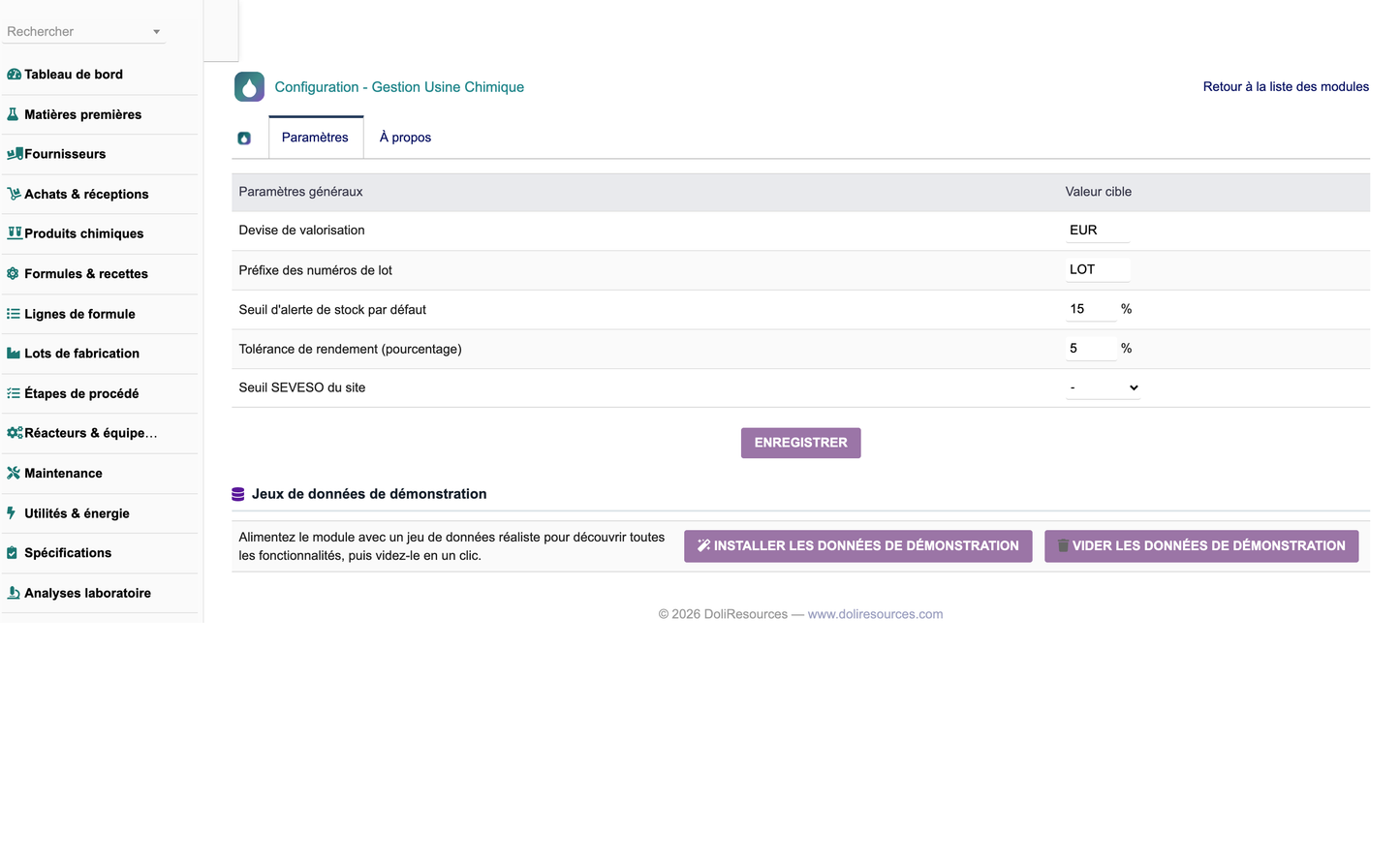
· General settings: valuation currency, batch number prefix, default stock alert threshold, yield tolerance and the site SEVESO tier.
· “Install demonstration data” button: populates the module with a realistic dataset covering twelve full months — 16 raw materials, 10 suppliers, 10 formulas, 10 products, 96 production batches, 358 laboratory analyses, 24 regulatory records and the matching purchases, shipments, waste, emissions and cost records, plus the native companies, products and orders they reference.
· “Clear demonstration data” button: removes the complete dataset, cascading to any child record created under a demonstration parent and deleting the native objects the seeder created.
· The dataset is versioned, so an upgrade of the module re-seeds an improved demonstration set automatically.
Twenty-six granular permissions are organised into eight functional groups — formulation, production, quality, stock, purchasing, sales, maintenance and HSE — each with read, write and delete rights, plus reporting access and module administration. Read and write are granted by default on activation so the module is immediately usable, while delete and administration remain closed.
Chemical Plant Management — Version 1.0
Published by DoliResources
www.doliresources.com
© 2026 DoliResources — All rights reserved


