
Discover powerful Dolibarr extensions designed to automate your business processes
Gestion Cartonnerie turns Dolibarr into a complete ERP for a corrugated packaging plant. It covers the entire value chain of...
Couldn't load pickup availability


Gestion Cartonnerie turns Dolibarr into a complete ERP for a corrugated packaging plant. It covers the entire value chain of a carton factory, from purchasing paper reels to despatching pallets of finished boxes, so that the company no longer needs any separate specialised software.
The production flow modelled by the module is the following:
· Paper reel purchasing and reception (grade, grammage, width, supplier lot, moisture, certification)
· Corrugator runs producing the corrugated board
· Conversion: slitting, die-cutting, creasing, rotary die-cutting
· Flexographic printing
· Gluing, stitching and flat folding
· Quality control: ECT, BCT, Cobb, RCT, Mullen burst, moisture, grammage, dimensional and visual checks
· Palletising and finished goods stock
· Despatch, invoicing and waste recycling
The target user is a small or medium sized corrugated packaging manufacturer producing regular slotted containers, die-cut boxes, trays, inner fitments, cardboard point-of-sale displays and pallet interlayers, which currently runs its operations on spreadsheets.
|
Item |
Value |
|
Technical name |
cartonneriemanagement |
|
Object prefix |
ctn |
|
Module number |
537000 |
|
Version |
1.0.0 |
|
Business objects |
20 |
|
Database tables |
20 |
|
Permission groups |
8 (23 individual rights) |
|
Menu entries |
1 top menu + 23 left menu entries |
|
Dashboard indicators |
28 KPIs across 6 zones |
|
Dashboard charts |
6 |
|
Reports |
10, each with CSV / Excel / Word / PDF export |
|
Languages |
French, English, Spanish, Italian, German |
|
Dolibarr compatibility |
16.0 and above |
|
PHP compatibility |
7.1 to 8.x |
|
Publisher |
DoliResources - www.doliresources.com |
|
Licence |
GPL v3 |
Raw material is tracked reel by reel, which is the only level at which a corrugated plant can reconcile tonnage purchased against tonnage sold.
· Paper reels: reel reference, paper grade (Kraftliner, Testliner, Fluting, White Top, coated), grammage in g/m2, width, diameter, core, net weight, remaining weight, running length.
· Supplier traceability: paper supplier, supplier lot number, FSC or PEFC certification, recycled fibre content, moisture at reception, cost per kilo, warehouse slot.
· Reel status: in stock, on the machine, consumed or scrapped.
· Paper suppliers: a dedicated record backed by a native Dolibarr third party, holding the grades supplied, average lead time, average price per ton, service rate, quality score, annual tonnage, certification and incoterm.
· Corrugator runs: run reference, machine, start and end date and time, shift (morning, afternoon, night), responsible operator, working width, average speed in m/min.
· Output measurement: linear meters, surface produced in square meters, weight produced.
· Performance: waste rate, downtime in minutes, main downtime reason, OEE of the run.
· Corrugated boards: flute type (A, B, C, E, F, BC double, EB double, AAA triple), paper composition (outer liner / fluting / inner liner), total grammage, thickness, sheet format, unit surface, theoretical ECT in kN/m, quantity produced and available, cost per square meter.
· Packaging articles described with their FEFCO code (0201, 0203, 0300, 0427, 0713 and so on) and packaging type: regular slotted container, die-cut box, tray, lid, inner fitment, interlayer, point-of-sale display, punnet.
· Geometry: internal length, width and height, flat dimensions, computed developed surface.
· Printing: number of colours and printing type (direct flexo, preprint, laminated offset, unprinted).
· Logistics data: unit weight, quantity per pallet, quantity per bundle.
· Commercials: sale price per thousand, cost price per thousand and resulting margin.
· Each article points at a native Dolibarr product so it can be quoted, ordered and invoiced.
Cutting dies and printing plates represent a significant asset and a recurring source of downtime when they reach end of life unnoticed. The module tracks them individually.
· Tool type: flat cutting die, rotary die, flexo plate, counter die, ejector, creasing cylinder.
· Associated article, owner customer (native third party), tool manufacturer, creation date and acquisition cost.
· Strokes performed against maximum strokes, giving an automatically computed wear rate.
· Last refurbishment date, storage slot, rebilling flag and tool status.
· Dashboard alerts on toolings approaching end of life.
· Work orders linking customer, article, board, tooling, machine, and optionally the originating Dolibarr sales order and quotation.
· Quantities: ordered, launched, produced, conforming and scrapped.
· Scheduling: launch date, due date, actual completion date, priority, progress percentage, planned versus actual hours, actual cost and amount excluding tax.
· Status lifecycle: planned, running, suspended, done, closed, cancelled, with automatic late-order detection.
· Routing operations: sequence, operation type (slitting, die-cutting, flexo printing, creasing, gluing, stitching, palletising), machine, operator, input and output quantities, waste quantity, setup time and run time separated.
· Print jobs: printing machine, number of colours, ink references and ink consumed in kilos, plates used, setup sheets lost during make-ready, printing speed.
· Print quality: registration check, colour density measurement, proof approval.
· Conversion operations: conversion type, machine, input and output quantities, waste rate, theoretical versus actual rate, downtime.
The quality module implements the standard corrugated test plan, with a tolerance band per test and an automatically computed conformity verdict.
|
Test |
Unit |
Purpose |
|
ECT |
kN/m |
Edge crush resistance of the board |
|
BCT |
daN |
Box compression test on the finished case |
|
Cobb |
g/m2 |
Water absorption of the liner |
|
RCT |
N |
Ring crush test |
|
Mullen burst |
kPa |
Bursting strength |
|
Moisture |
percent |
Moisture content of paper and board |
|
Grammage |
g/m2 |
Basis weight check |
|
Thickness |
mm |
Caliper check |
|
Dimensional |
mm |
Dimensional conformity of the finished box |
|
Visual |
score |
Print and appearance inspection |
· Each control records the measured value, the lower and upper tolerance limits, the conformity verdict, the inspector, the date and the decision (accepted, concession, scrap).
· Non-conformities and customer claims: origin (internal, customer, supplier), severity, root cause and cause family following the 5M method, corrective and preventive actions, owner, cost of poor quality, impacted quantity, opening and closing dates.
· Aggregated indicators: conformity rate, scrap rate, cost of poor quality, customer PPM.
· Machine fleet: corrugator, printer-slotters, flat and rotary die-cutters, folder-gluer, slitter, strapping machine, palletiser.
· Machine data: type, manufacturer, year built, maximum width, nominal rate, number of colours, workshop, criticality, acquisition value, running hours.
· Performance: OEE and operational availability rate, absorbing planned maintenance, cleaning and format changeovers.
· Maintenance: preventive, corrective and predictive interventions, planned and actual dates, downtime, technician, parts used, cost, periodicity and next due date.
· Dashboard alerts on overdue preventive maintenance and on machines in breakdown.
· Finished goods stock per article and per native Dolibarr warehouse, with slot, available and reserved quantities, number of pallets, alert threshold, rotation in days and valuation.
· Shipments and palletising: number of pallets, pallet type (EUR, EUR2, one-way), number of bundles, gross weight, pallet height, stretch wrapping, carrier, tracking number, incoterm, transport cost, despatch and delivery dates.
· Optional link to a native Dolibarr shipment.
· Waste tracked by origin (corrugator, die-cutting, printing, gluing, customer return) and by type (board offcuts, paper, ink, glue, film).
· Weight in kilos per period, destination (paper recycling, internal shredding, energy recovery, landfill), recycling rate.
· Economic valuation: buyback price per ton and resulting revenue.
· Environmental indicators: recycling rate, share of recycled material and CO2 avoided.
· Technical costings breaking down the price of a box: material cost per square meter applied to the developed surface, conversion cost, amortised tooling cost, printing cost, logistics cost, overheads and target margin, giving a computed price per thousand.
· The offered price per thousand can be adjusted by the sales representative, and the costing can feed a native Dolibarr commercial proposal.
· Costing status: to be quoted, quoted, sent, won, lost, feeding the win rate indicator.
· Customer 360 view: segment (food, e-commerce, industry, wine and spirits, pharmaceutical, logistics), cumulated revenue, tonnage, surface produced, number of work orders, average lead time, OTIF service rate, non-conformity rate, outstanding balance and toolings held.
· Frame contracts and call-offs: committed annual volume, consumed volume, remaining volume, negotiated price per thousand, paper index and price revision periodicity.
The dashboard is deliberately different from a standard Dolibarr home page. It is designed as an industrial cockpit using the colours of the trade: deep kraft brown, corrugated amber and recycling green on a cream paper background. The hero banner carries a repeating arc pattern evoking the flute seen on the edge of a corrugated board.
· Hero banner with the four headline figures of the month: surface produced, tonnage, revenue and conformity rate.
· Clickable alert tiles: reels below threshold, late work orders, non-conforming controls, overdue maintenance, toolings to refurbish, critical finished goods stock. Tiles turn green, orange or red depending on the count.
· Six KPI zones: Production, Quality, Material and environment, Sales, Logistics, Machines and maintenance.
· Six charts and four operational tables.
· An in-page tab bar giving one-click access to every screen of the module.
|
Zone |
Indicators |
|
Production |
Surface produced this month, tonnage produced, work orders in progress, late work orders, average corrugator OEE, linear meters today |
|
Quality |
Conformity rate, open non-conformities, cost of poor quality, scrap rate |
|
Material and environment |
Reel stock in tons, material yield, waste rate, waste recycling rate, recycled material share, CO2 avoided |
|
Sales |
Revenue this month, margin this month, pending costings, quotation win rate, OTIF service rate |
|
Logistics |
Pallets in stock, shipments today, late shipments, critical stock |
|
Machines and maintenance |
Machines down, overdue preventive maintenance, toolings near end of life |
· Surface produced over the last 12 rolling months (bar chart).
· Production split by flute type (pie chart).
· Monthly quality conformity rate (line chart).
· Revenue split by customer segment (pie chart).
· Top 10 produced articles (bar chart).
· Load per machine (bar chart).
A dedicated Reporting menu provides ten situation reports. Every report accepts a date range filter and can be exported to CSV, Excel, Word and PDF. All exports are produced in real UTF-8 so that accented characters are preserved.
|
Report |
Content |
|
Production |
Work orders, quantities, surfaces, tonnage, scrap and scrap rate by month |
|
Corrugator |
Runs, linear meters, surface, average speed, waste rate, downtime and OEE by month |
|
Quality |
Controls and conformity rate by test type, with average measured value |
|
Material |
Reels, total and remaining weight, average cost per kilo and recycled content by grade |
|
Machines |
OEE, availability, running hours, maintenance count and cost per machine |
|
Tooling |
Strokes performed against maximum, wear rate and status, sorted by wear |
|
Sales |
Customers, revenue, tonnage, work orders, OTIF and non-conformity rate by segment |
|
Logistics |
Shipments, pallets, gross weight, transport cost and late shipments by carrier |
|
Environment |
Waste weight, recycling rate, recovery revenue and CO2 avoided by origin and type |
|
Finance |
Revenue, actual cost, margin rate, cost of poor quality and waste revenue by month |
The module deliberately does not reimplement anything Dolibarr already provides. It links to the native modules instead:
|
Native module |
Usage in Gestion Cartonnerie |
|
Third parties |
Customers, paper suppliers and carriers |
|
Products and services |
Every packaging article points at a native product |
|
Commercial proposals |
A technical costing feeds a native quotation |
|
Sales orders |
A work order is attached to a native customer order |
|
Customer invoices |
Invoicing of completed work orders and of tooling |
|
Supplier orders and invoices |
Paper reel purchasing |
|
Stocks and warehouses |
Finished goods stock and reel storage |
|
Shipments |
Native shipment linked to the palletising record |
|
Projects |
Packaging development projects |
|
Agenda and events |
Work order milestones and maintenance due dates |
|
Users |
Operators, inspectors, technicians and managers |
|
ECM and documents |
Cutting plans, printing proofs and material certificates |
Permissions are organised into eight functional groups. Read and write are granted by default on activation so the module is immediately usable; delete and administration are not granted by default.
|
Group |
Scope |
|
Material |
Paper suppliers and paper reels |
|
Production |
Corrugator runs, boards, work orders, routing, printing, conversion |
|
Catalogue |
Packaging articles and tooling |
|
Quality |
Quality controls and non-conformities |
|
Maintenance |
Machines and maintenance interventions |
|
Logistics |
Finished goods stock, shipments and waste |
|
Sales |
Costings, customer 360 records and frame contracts |
|
Reporting |
Access to the ten reports (read only) |
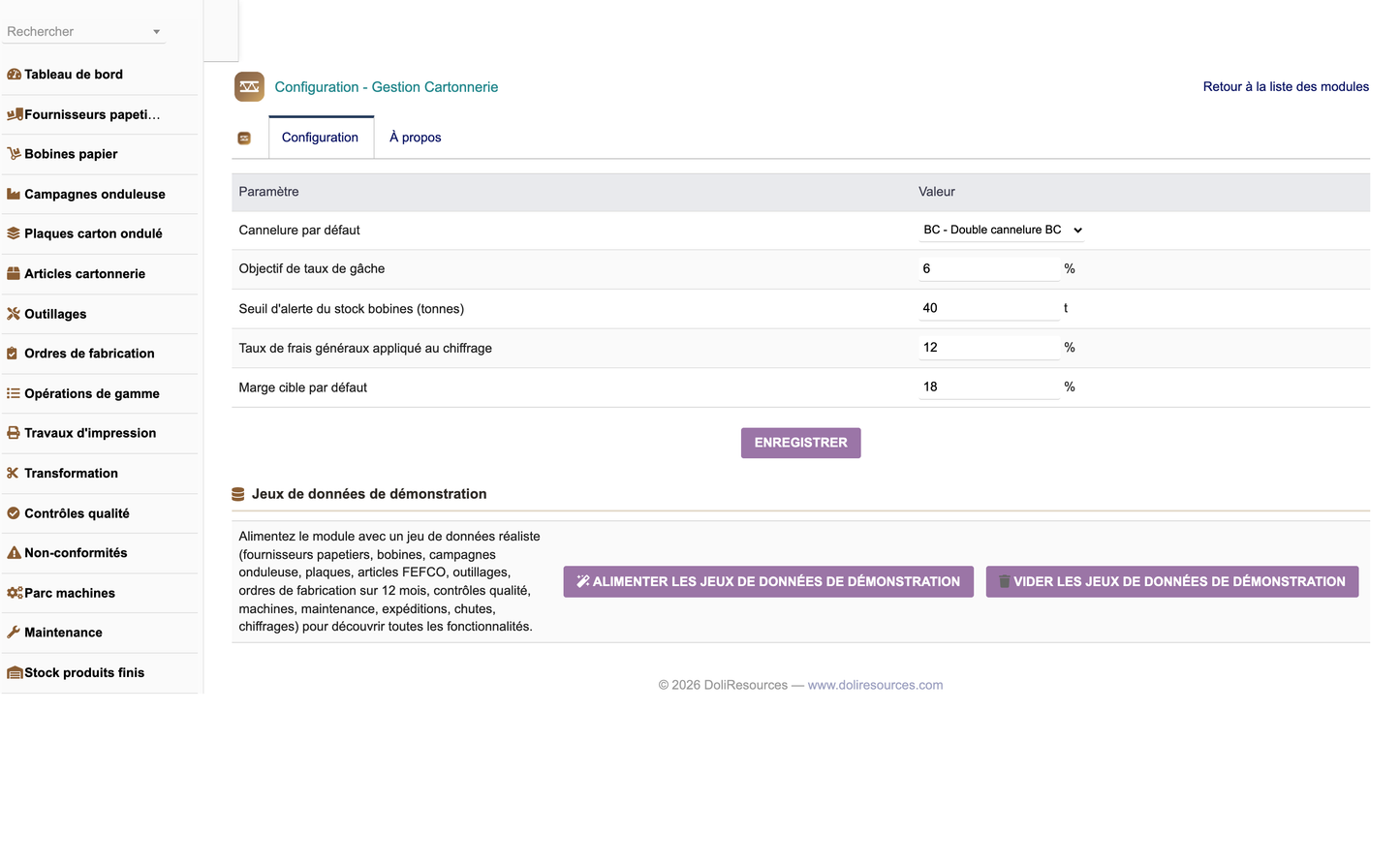
The module configuration page provides two buttons controlling a complete demonstration dataset spread over twelve rolling months, so that every KPI, chart and report is immediately meaningful on a fresh installation.
· Install demonstration data: creates paper suppliers, reels, corrugator runs, boards, FEFCO articles, toolings, work orders with their routing operations, print jobs, conversion operations, quality controls, non-conformities, machines, maintenance interventions, finished goods stock, shipments, waste records, costings, customer 360 records and frame contracts, together with the matching native third parties and products.
· Remove demonstration data: purges the whole dataset, including the native objects it created and any records the user added underneath a demonstration parent, after confirmation.
· The dataset is realistic rather than merely present: quality measurements are drawn inside their own tolerance band with an explicit small reject rate, giving a plant-level conformity around 96 percent, and all twelve months of every monthly chart are populated.
|
Parameter |
Purpose |
Default |
|
Default flute type |
Flute proposed when creating a board |
BC |
|
Waste rate target |
Threshold above which the waste KPI turns orange |
6 percent |
|
Reel stock alert threshold |
Minimum reel stock in tons |
40 t |
|
Overhead rate |
Overheads applied in the costing engine |
12 percent |
|
Default target margin |
Target margin applied in the costing engine |
18 percent |
· All business objects extend Dolibarr CommonObject and implement create, fetch, fetchAll, update, delete, getNomUrl and getLibStatut.
· Generic list engine with multi-criteria search, sorting, pagination and a column show/hide selector; generic card engine with tabs, creation, editing, deletion and linked records.
· Schema self-healing on activation: missing columns are added automatically on upgrade, since Dolibarr only ever creates tables and never alters them.
· Multi-entity aware; compatible with PHP 8; every source file passes php -l.
· Font Awesome 5 icons only, matching the icon set shipped with Dolibarr.
· Every user-visible translation key is module-prefixed to avoid collisions with other installed modules, and is re-asserted on each page of the module.
· Copyright header on every source file.
· Deploy the archive module_cartonneriemanagement-1.0.zip through Home, Setup, Modules, Deploy an external module.
· Alternatively, unzip the cartonneriemanagement folder into the custom directory of the Dolibarr installation.
· Enable the module Gestion Cartonnerie in the module list.
· The demonstration dataset is generated automatically on first activation.
Gestion Cartonnerie 1.0.0 — © 2026 DoliResources — www.doliresources.com


