
Discover powerful Dolibarr extensions designed to automate your business processes
Dam & Reservoir Lifecycle Management is an ERP module that turns Dolibarr into a professional solution for managing the full lifecycle of dams and reservoirs...
Couldn't load pickup availability


Dam & Reservoir Lifecycle Management is an ERP module that turns Dolibarr into a professional solution for managing the full lifecycle of dams and reservoirs — from studies and construction to operation, monitoring, safety, maintenance, water-resource management, risk prevention and emergency response. Built for dam owners, operators, engineering offices and hydraulic authorities, the module consolidates asset records, hydrological data, instrumentation readings, inspections and interventions within a single, coherent system, fully integrated with Dolibarr's third parties, projects, purchasing, contracts and accounting.
The module structures the complete chain of dam engineering and operation activities: asset and reservoir inventories, hydrology and geotechnics, dam safety auscultation, hydromechanical and electromechanical equipment, hydropower, irrigation and water supply, environmental and sediment management, maintenance (CMMS), incident and risk management, emergency planning and regulatory reporting. It is designed to support both day-to-day operations and the rigorous traceability required by dam-safety regulations.
Editor: DoliResources (www.doliresources.com). Technical requirements: Dolibarr 16–23, PHP 8 or higher, MySQL/MariaDB.
Provides a structured, hierarchical register of the entire hydraulic estate, organising dams, reservoirs and watersheds into a single asset tree. Each asset carries its administrative, technical and geographic attributes, giving operators a consolidated view of the portfolio and its interdependencies.
· Hierarchical organisation of dams, reservoirs and watersheds with parent/child relationships
· Centralised asset repository with unique identifiers, ownership and administrative status
· Geographic positioning of each asset and grouping by region, river basin or operating unit
· Consolidated portfolio dashboards with key figures per dam and per basin
· Full history and traceability of every asset record and change
Maintains a complete technical file for every structure, covering all dam typologies and their defining characteristics. The records capture identification, geometry, structural details and the regulatory safety class used to drive surveillance and reporting obligations.
· Support for gravity, arch, buttress, embankment, earth-fill, rockfill, mixed and mobile dams
· Identification data: name, code, owner, operator, commissioning date and regulatory references
· Geometry: crest length, dam height, base width, crest elevation and foundation level
· Structural description: body, foundation, watertightness, drainage and appurtenant works
· Regulatory safety class and associated surveillance and reporting obligations
Manages the water bodies impounded by each dam, describing their capacity and operating levels. The module records the full stage relationship of each reservoir so that levels, volumes and filling rates can be tracked continuously.
· Characteristic levels: normal operating level, maximum level, minimum drawdown and flood level
· Volumes: total, useful (live) and dead storage capacity
· Real-time filling rate and current stored volume
· Height–volume and height–surface curves for accurate volume computation
· Surface area, shoreline and morphological attributes of each water body
Characterises the catchment areas that feed each reservoir, providing the hydrological context for inflow forecasting and water-balance calculations. Hydrometric stations are linked to their watershed for continuous monitoring of the contributing area.
· Watershed area, morphology and land-use characteristics
· Rainfall records and average annual precipitation
· Runoff coefficients and estimated natural inflow
· Associated hydrometric and rain-gauge stations
· Links between watersheds, reservoirs and downstream structures
Centralises all engineering studies produced during the design, review and re-assessment of a dam. Each study follows a validation workflow ensuring that technical documents are reviewed, approved and archived with full traceability.
· Hydrological, hydraulic, geological, geotechnical, seismic and structural studies
· Dam-break (rupture) studies and downstream flood-wave analyses
· Study lifecycle with draft, review, validation and approval stages
· Document management with versions, authors and attached deliverables
· Linkage of studies to the dam, reservoir and related interventions
Captures and analyses the hydrological data governing reservoir operation, from rainfall and river flows to floods and droughts. Time series can be imported and exported for integration with external hydrological systems and modelling tools.
· Rainfall, river flows, reservoir inflows, floods and drought records
· Management of gauging and hydrometric stations
· Time-series storage with configurable measurement steps
· Statistical indicators, extremes and seasonal profiles
· CSV import and export of hydrological series
Documents the geological and geotechnical conditions of the dam site and its foundation. Investigation data and installed instruments are recorded to support seepage, stability and settlement analyses.
· Boreholes, core logs and lithological descriptions
· Piezometers, inclinometers and installed geotechnical instruments
· Permeability, watertightness and grouting curtain data
· Foundation characterisation and geological cross-sections
· Links between geotechnical data, instrumentation and auscultation
Supports the construction phase and the critical first-filling of the reservoir, when the dam and foundation are loaded for the first time. The module enforces a staged impoundment protocol with enhanced surveillance at each level.
· Construction phases, milestones and progress tracking
· Staged first-impoundment protocol with defined filling steps and hold levels
· Enhanced surveillance frequency during first filling
· Correlation of instrumentation readings with reservoir level
· Records of observations, thresholds and decisions at each filling stage
Provides geospatial and building-information capabilities to visualise and model dams without relying on any paid mapping service. Assets can be geolocated, layered and linked to BIM models for a complete digital representation of the structure.
· Geolocation of dams, reservoirs, structures and instruments
· Configurable map layers and thematic overlays
· Import and export of GeoJSON and KML data
· Links to BIM / IFC models of the structures
· No paid map service required for basic geospatial visualisation
Manages the day-to-day operation of the dam according to its operating rules, including level management and gate manoeuvres. A digital logbook (main courante) records all operational events and shift-team activity for full traceability.
· Operating rules and target-level curves by season
· Level management and controlled gate manoeuvres
· Digital logbook (main courante) of operational events
· Shift teams, rosters and handover records
· Traceability of every manoeuvre and operating decision
Tracks reservoir levels and volumes over time and reconciles them through a physical water balance. The stock is computed from inflows, releases and losses so that any discrepancy can be detected and investigated.
· Level and volume registers with time-stamped readings
· Automatic volume computation from height–volume curves
· Water balance: stock = initial + inflows − releases − losses
· Detection of anomalies and unexplained variations
· Historical trend charts of levels and volumes
Records every inflow to and release from the reservoir, providing the components of the water balance. All abstraction and discharge purposes are itemised, from turbining and irrigation to reserved flow and losses.
· Releases for turbining, irrigation and drinking-water supply
· Reserved (ecological) flow and regulatory minimum discharge
· Evaporation and seepage losses
· Inflow records from watersheds and upstream structures
· Consolidated inflow/outflow balance per period
Manages flood events from detection through gate operation and alerting. Vigilance thresholds trigger predefined manoeuvres and notifications to protect the structure and downstream areas.
· Flood-event records with hydrographs and peak values
· Configurable vigilance and alert thresholds
· Gate-operation sequences during flood routing
· Automatic alerts and notifications
· Identification and management of downstream exposed zones
Supports the management of water shortages through deficit tracking, restrictions and usage prioritisation. Scenarios can be modelled to anticipate low-water situations and allocate resources accordingly.
· Deficit tracking against operating and reserve levels
· Restriction levels and drought-management measures
· Usage priorities among competing demands
· Drought scenarios and what-if simulations
· Records of restriction decisions and their duration
Delivers the core dam-safety surveillance function, collecting and analysing auscultation measurements against defined thresholds. Trends are charted and anomalies flagged to support early detection of abnormal behaviour.
· Displacements, settlements and joint-opening measurements
· Pore pressures, uplift and seepage / leakage flow monitoring
· Configurable alert and alarm thresholds per instrument
· Automatic anomaly detection and flagging
· Trend charts and correlation with reservoir level and temperature
Manages the complete park of monitoring instruments installed on and around the dam. Each device is inventoried, geolocated, QR-coded and tracked through its calibration lifecycle.
· Piezometers, pendulums, extensometers and inclinometers
· Flowmeters, thermometers and additional sensor types
· QR codes for field identification and quick data capture
· Calibration schedules, certificates and validity tracking
· Instrument location, measurement history and status
Plans and records all categories of dam inspection, from routine visual checks to regulatory safety reviews. Findings are documented and linked to any defects or interventions they generate.
· Routine, annual and detailed technical inspections
· Post-flood, post-earthquake, underwater and gallery inspections
· Periodic regulatory safety reviews
· Findings, ratings and photographic evidence
· Links between inspection findings, defects and work orders
Registers and follows the pathologies affecting the structure and its equipment. Each defect is characterised, located and monitored through to resolution.
· Concrete cracking, seepage and settlement
· Sliding, deformation and internal erosion (piping)
· Equipment and appurtenant-works defects
· Severity rating, location and evolution over time
· Linkage to inspections, monitoring data and corrective works
Inventories and manages the hydromechanical gates and outlets that control water passage. Each item is documented with its characteristics, condition and maintenance history.
· Segment (radial), wagon (fixed-wheel) and butterfly gates
· Valves, bottom outlets and low-level discharge works
· Intakes, hoists and lifting mechanisms
· Trash screens and protection devices
· Technical characteristics, condition and maintenance history
Manages the electrical and mechanical equipment powering and automating the dam's operations. The inventory supports maintenance planning and reliability tracking for critical systems.
· Transformers, motors and variable-speed drives
· Diesel generator sets and UPS / backup power
· Pumps and auxiliary mechanical systems
· Automation, control and SCADA-related equipment
· Ratings, condition and maintenance records
Covers the hydroelectric production assets and their performance. Generation, availability and energy sold are tracked to support production reporting and profitability analysis.
· Powerhouses, turbines and alternators
· Penstocks and water-conveyance equipment
· Energy production and generation records
· Availability, load factor and performance indicators
· Energy sold and revenue tracking
Manages the distribution of water to irrigation and supply beneficiaries. Allocations, schedules and delivered volumes are linked to Dolibarr third parties and contracts for billing and follow-up.
· Beneficiary register and water-right allocations
· Delivery schedules and rotation planning
· Delivered volumes and consumption tracking
· Links to Dolibarr third parties and contracts
· Basis for billing and allocation reconciliation
Monitors the physico-chemical quality of the reservoir water through sampling campaigns and threshold-based alerts. Results are stored to track trends and support environmental compliance.
· Temperature, pH, turbidity and dissolved oxygen
· Sampling campaigns and laboratory results
· Configurable quality thresholds and alerts
· Trend analysis of quality parameters
· Support for environmental and regulatory compliance
Addresses the environmental obligations attached to dam operation, including ecological flows and biodiversity. Action plans structure the measures taken to protect the aquatic environment.
· Reserved (ecological) flow monitoring and compliance
· Biodiversity and aquatic-habitat follow-up
· Sediment and continuity management
· Protected zones and environmental constraints
· Environmental action plans and their follow-up
Tracks reservoir siltation through bathymetric campaigns and capacity analysis. The loss of useful storage over time is quantified to inform dredging and management decisions.
· Bathymetric survey campaigns and results
· Siltation (sedimentation) rate computation
· Lost and remaining useful capacity
· Trend analysis of storage capacity over time
· Support for dredging and sediment-management planning
Provides full computerised maintenance management for all dam equipment. Preventive, corrective, conditional and predictive strategies are supported, with plans, parts, costs and reliability indicators.
· Preventive, corrective, conditional and predictive maintenance
· Maintenance plans and recurring schedules
· Spare parts, consumables and stock consumption
· Cost tracking per equipment and intervention
· Reliability indicators such as MTBF and MTTR
Manages the complete lifecycle of maintenance and repair interventions. Each work order captures labour, parts and evidence, and can be handled from a mobile interface in the field.
· Full intervention lifecycle from request to closure
· Time logging and labour tracking
· Parts and materials consumption
· Before/after photographs and documentation
· Mobile-friendly interface for field teams
Records operational incidents affecting the dam and escalates them according to their severity. The register ensures that every abnormal event is tracked through to resolution.
· Leaks, abnormal flows and seepage events
· Gate and pump failures and equipment breakdowns
· Power loss and electromechanical faults
· Seismic events and external hazards
· Escalation, notification and resolution tracking
Assesses and prioritises risks using a structured probability × gravity × exposure approach. Downstream population exposure is taken into account to determine overall risk levels.
· Risk matrix combining probability, gravity and exposure
· Downstream population and exposed-asset assessment
· Risk levels and prioritisation
· Mitigation measures and residual-risk tracking
· Links between risks, defects and emergency plans
Structures the emergency preparedness of the dam through defined plans, contacts and reflex sheets. Plans cover the full range of alert, intervention and evacuation scenarios.
· Alert, intervention and rescue plans
· Flood, dam-break and evacuation plans
· Emergency contacts and organisational responsibilities
· Reflex sheets and predefined response actions
· Availability and versioning of emergency documentation
Plans and evaluates emergency exercises to test the effectiveness of the dam's emergency plans. Scenarios, participants and findings are recorded within an annual drill calendar.
· Exercise scenarios and objectives
· Participants and civil-protection involvement
· Timeline and chronology of the exercise
· Findings, lessons learned and corrective actions
· Annual drill calendar and follow-up
Manages the rehabilitation and upgrade works carried out on the dam and its equipment. Each site is followed from planning through execution with full documentation.
· Rehabilitation and structural strengthening works
· Grouting (injections) and sealing / watertightness works
· Gate and equipment replacement
· Dredging and sediment-removal works
· Site planning, progress and documentation
Applies structured quality management to studies, works and interventions. Quality and inspection plans define hold points and tests, with recorded evidence and formal sign-off.
· Quality and inspection plans (ITP)
· Hold points and witness points
· Tests, checks and acceptance criteria
· Evidence, records and non-conformity tracking
· Formal review and sign-off workflow
Manages the health, safety and environmental risks specific to dam operations and works. Permits and incident tracking support a safe working environment in hazardous conditions.
· Hydraulic and drowning risk management
· Confined-space work in galleries and outlets
· Work at height and lifting operations
· Work permits and safety authorisations
· HSE incident recording and follow-up
Provides financial control over the dam estate, comparing budgets with actual costs across dams, equipment and interventions. Margins and invoicing are managed in connection with Dolibarr accounting.
· Budget vs. actual cost tracking
· Costs by dam, equipment and intervention
· Margin analysis and profitability
· Invoicing of services and water deliveries
· Integration with Dolibarr accounting
Generates the full range of operational and regulatory reports required to manage and document the dam. Reports can be exported in multiple formats and distributed by email.
· Asset, hydrological and monitoring reports
· Operations, maintenance and energy reports
· Water-quality, financial and quality/HSE reports
· Export to PDF, Excel and CSV
· Direct distribution of reports by email
Integrates natively with the core Dolibarr modules to reuse existing data and processes. Dam activities are connected to third parties, purchasing, contracts and accounting for a unified ERP experience.
· Third parties, products and projects
· Purchase orders, supplier invoices and customer invoices
· Contracts and service agreements
· Agenda / calendar for events and interventions
· ECM document management and accounting
Exposes the module's data through a REST API secured by Dolibarr's native authentication and permissions. External systems can read and write dam data in JSON for integration and automation.
· Endpoints for dams, reservoirs and levels
· Endpoints for equipment, instruments and measures
· Endpoints for inspections and interventions
· Dolibarr authentication and permission enforcement
· JSON request and response format
Protects the module with granular permissions and a complete audit trail, supporting multi-entity deployments. The interface is available in five languages for international use.
· Granular, role-based permissions
· CSRF protection on all forms and actions
· Audit trail of user actions and data changes
· Multi-entity (multi-company) support
· Available in French, English, Italian, German and Spanish
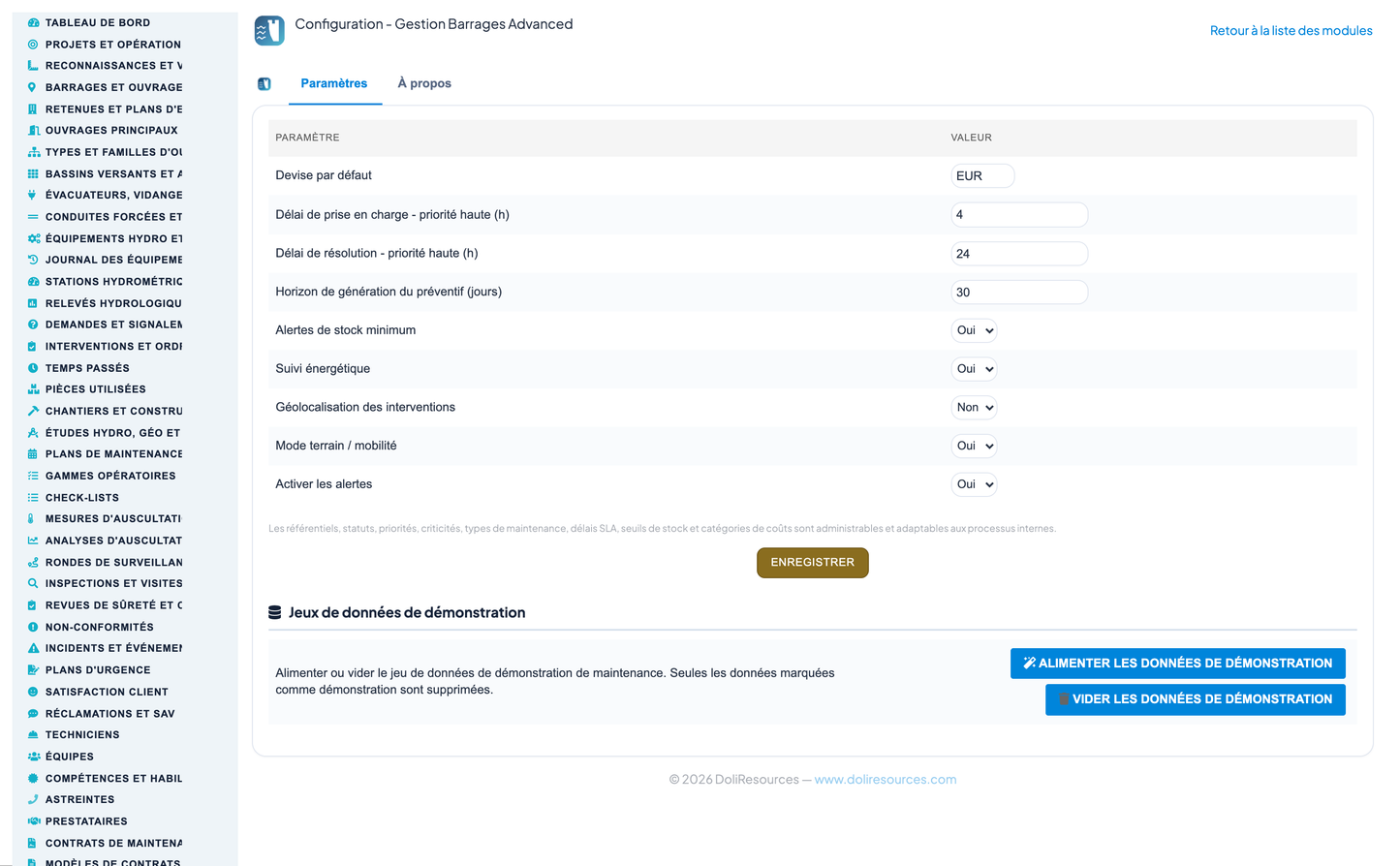
Includes a realistic demonstration dataset that can be loaded and removed in a single click. This lets evaluators explore every feature with representative data and reset the environment safely.
· One-click seeding of a realistic demonstration dataset
· Representative dams, reservoirs, instruments and interventions
· Safe, complete purge of demonstration data
· Ideal for evaluation, training and demonstrations
· No impact on production records
Delivered as a standard installable package with complete documentation and illustrations. Deployment follows Dolibarr's standard custom-module process for quick activation.
· Installable ZIP package
· Training manual provided as a French PDF
· Screenshots illustrating the main features
· Deployment to htdocs/custom
· Activation through Dolibarr's module setup


