
Discover powerful Dolibarr extensions designed to automate your business processes
1. Module Overview
Date Palm Grove Management turns Dolibarr into a complete operating system for...
Couldn't load pickup availability


1. Module Overview
Date Palm Grove Management turns Dolibarr into a complete operating system for a date-producing estate. It covers the whole cycle from the land title to the invoice of the sold lot: estates and mapped plots, production blocks, an individual palm tree registry with QR codes, a date variety dictionary, budgeted growing campaigns, planned crop operations, water resources and irrigation networks, fertilisation and fertigation, pollen collection and pollination, pruning and upkeep, plant-health surveillance, plant protection treatments with pre-harvest intervals, laboratory analyses, harvest, production lots, grading, quality control, packing, stock, equipment and maintenance, workforce and timesheets, suppliers, customers, sales, agricultural cost accounting, certifications, audits, an alert engine, a decision dashboard, a reporting centre and a REST API.
The module is published by DoliResources. It installs as a standard Dolibarr custom module, never modifies a single core file, and integrates with the native third-party, contact, product, stock, warehouse, project, proposal, order, invoice, supplier, agenda and document modules.
The module is a management, planning and traceability tool. It replaces neither agronomic advice, nor official plant-health diagnosis, nor any decision reserved to an authorised professional. No treatment recommendation is ever produced automatically.
2. Business Objectives
A date palm grove is run on three constraints that ordinary farm software handles poorly: the production unit is an individual tree that lives for decades, water is the dominant and most regulated cost, and the sold product must be traceable back to the tree that bore it.
This module addresses the three directly.
· Know the estate to the individual tree: 48 business objects, from the land title down to a single palm and its own history of pruning, fertilisation, irrigation and pollination.
· Control water: planned versus delivered volume on every irrigation run, energy and water cost, water efficiency, cubic metres per kilogram produced, and automatic over-consumption alerts.
· Protect the crop: a disease and pest dictionary covering Bayoud, red palm weevil, white scale, Boufaroua, date moth and Khamedj, geolocated diagnoses, and treatments whose pre-harvest interval is inherited from the product used.
· Prove the origin: a two-way traceability chain from the customer back to the palm tree and its treatments, ready to present at a certification audit.
· Know the real cost: sixteen analytical cost families, cost per kilogram and per hectare, margin per plot and per campaign.
3. Target Users
· Family and corporate date-producing estates.
· Agricultural cooperatives and producer groupings.
· Large farming estates operating several sites.
· Packing and grading stations sourcing from multiple growers.
· Exporters who must document origin and plant-protection history.
· Agricultural development agencies and research stations.
4. Key Features at a Glance
· 48 business objects in 11 functional zones, each with list, card, search, filters, sorting, column chooser, mass actions and export.
· 155 granular permissions across 47 functional right groups.
· A dedicated dashboard with 40 indicators, 12 charts, an alert strip, an intervention calendar and a plot overview, filterable by estate and by campaign.
· A plot map rendered locally as SVG, with no call to any external mapping service.
· A full two-way traceability chain for every production lot.
· A responsive field interface for phones and tablets, with QR scanning.
· A reporting centre of 10 report families with CSV, Excel and PDF export.
· A REST API over all 48 objects plus a consolidated reporting route.
· Five shipped languages with 1,707 translated keys each.
· A demonstration dataset of roughly 3,800 coherent rows, installable and removable in one click.
5. Farm and Estate Management
The estate is the root of the whole module. Every plot, block, palm tree, water resource, warehouse, item of equipment, worker, team, certification and campaign hangs off it.
· Identity: reference, name, legal name, owner, farmer, manager.
· Location: full address, town, province, region, country, GPS coordinates.
· Land: total, farmed and idle area, land tenure, cadastral reference, property type, start of farming.
· Links to native Dolibarr objects: third party, warehouse and project.
· Live counters of plots and palm trees, kept consistent with the rows actually present.
6. Plot Management
The plot carries the complete agronomic profile and the cultivation setup, which is what makes yield comparisons between plots meaningful.
· Soil: nature, texture, pH, salinity, organic matter content, water holding capacity, drainage quality, date of the last soil test.
· Terrain: area, GPS coordinates, optional polygon outline, altitude, slope, exposure.
· Cultivation: dominant variety, planting density, spacing, year planted, average age.
· Census: total palms, productive and unproductive, male and female.
· Operation: irrigation system, water source, yield level, plant-health level and status.
· The three synthesis indicators are the ones that colour the map view.
7. Palm Tree Registry
Every palm tree is a record in its own right, which is what distinguishes this module from plot-level farm software.
· Identification: reference, QR code, barcode, row, position on the row, slot code, GPS coordinates.
· Genetics: sex, variety, sub-variety, plant origin, propagation type.
· Life cycle: planting date, age, first production date, physiological state, height, trunk diameter, number of offshoots.
· Follow-up: dates of the last pruning, fertilisation, irrigation, pollination and intervention.
· Health: state, detected disease, detected pest, risk level.
· Economics: forecast yield, actual yield, number of harvests, cumulated cost.
· Twelve statuses covering the whole life cycle, from young plant to uprooted and replaced.
· The QR code opens the tree record directly from a phone through the field interface.
8. Growing Campaigns and Crop Operations
The campaign is the annual steering unit; the activity is the unit of work.
· The campaign groups the activities, irrigation, fertilisation, pollination, harvests, lots, costs, sales and timesheets of one season, and compares target against actual production, forecast against actual cost, and computes margin and water consumed.
· 29 activity types are covered, from soil preparation and planting to bagging, tying, wind protection, maturity monitoring, grading and quality control.
· Each activity carries its planned and actual dates, duration, priority, responsible person, team, equipment, input consumed, quantity, forecast and actual cost, progress rate, outcome and supervisor validation.
· Production objectives are tracked as a target value against an achieved value with an automatic gap.
9. Irrigation and Water Resources
Water is the dominant cost of a date palm grove and the most regulated resource; the module treats it as a first-class subject.
· Eleven water resource types: well, borehole, basin, hill reservoir, collective network, khettara, canal, tank, recycled, desalinated and rainwater, each with capacity, depth, flow, level, quality, salinity, pH, conductivity, cost per cubic metre, annual quota and consumption.
· Irrigation networks and sectors: pumping stations, main and secondary lines, dripper networks, valve blocks, filtration and fertigation units, water meters, with nominal flow, pressure, dripper count and unit flow, pipe length and efficiency.
· Every irrigation run records the planned volume, the delivered volume, the gap, the flow, the method, the weather, soil moisture before and after, energy consumed, and both the water and energy cost.
· Meter and probe readings with previous value, delta and anomaly flag.
· Connected field sensors: soil moisture, temperature, humidity, rainfall, wind, water level, flow, pressure, leaf wetness, salinity and solar radiation, over LoRaWAN, Sigfox, NB-IoT, Wi-Fi, Zigbee, Modbus or MQTT.
10. Fertilisation and Fertigation
· An input catalogue covering mineral and organic fertilisers, amendments, trace elements, fertigation products, plant protection products, biocontrol, growth stimulants and adjuvants, with NPK content, approval number, recommended dose, re-entry interval, pre-harvest interval, unit price, organic-farming eligibility and stock threshold.
· Each fertilisation records the plot, the input, the supplier lot number, the recommended and applied dose, the application method, the area, the number of palms, the total quantity and cost, the technician and the weather conditions.
· Ten application methods, from broadcast spreading to fertigation, foliar spray and trunk injection.
· Plan versus actual comparison, consumption and cost per plot and per palm, stock control and minimum-stock alerts.
11. Pollination
Pollination determines the harvest, and is given a dedicated sub-module because its quality is measurable and comparable.
· Pollen batches: source male palm, collection date, quantity collected and available, germination rate, quality, storage mode and temperature, expiry date.
· Pollination operations: female palm, pollen batch used, method, number of bunches treated, dose, number of passes, operator and cost.
· Six pollination methods, from manual dusting and male strand insertion to mechanical blowers, pollen capsules and drone spraying.
· The fruit set rate obtained is recorded afterwards and feeds the dashboard and the per-plot success chart, allowing two pollen sources to be compared objectively.
12. Pruning, Thinning and Upkeep
· Eleven upkeep operation types: dry frond pruning, offshoot removal, trunk cleaning, bunch thinning, bunch limiting, bunch tying, bunch bagging, wind protection, soil upkeep, weeding and plot cleaning.
· Each operation records the plot, the palm, the operator, the team, the equipment, the duration, the number of palms treated, fronds cut and bunches kept, the waste produced and its destination.
· Seven waste destinations, including composting, shredding, animal feed, biomass recovery and craft use.
13. Plant-Health Monitoring
The plant-health chain runs from the dictionary to the observation, then to the treatment and its efficacy control.
· A disease and pest dictionary covering the real threats of the palm grove: Bayoud, red palm weevil, white scale insect, Boufaroua, date moth, Khamedj, black scorch, leaf spot, bunch fading, root rot, termites, nitrogen and iron deficiency, water, salinity and heat stress.
· Each dictionary entry states the threat family, the propagation mode, the favourable period, the prevention measures and the recommended treatment, and flags quarantine and notifiable organisms.
· Diagnoses record the date, plot, palm, observer, observed symptom, suspected and confirmed disease, severity, spread level, number of palms affected and GPS coordinates.
· Eight diagnosis statuses, from reported to quarantined, resolved and closed.
· Major and critical diagnoses raise a critical alert automatically.
14. Plant Protection Treatments
· Each treatment is attached to the diagnosis that motivated it.
· It records the product, its active substance, supplier, lot number and expiry date, the dose, the spray volume, the treated area and number of palms, the method, the operator, the equipment, and the temperature, wind and humidity at the time of application.
· The pre-harvest and re-entry intervals are inherited from the product used and cannot diverge from its record. The module computes the date from which harvesting the plot is allowed again.
· Observed efficacy is recorded at the post-treatment control, making two control strategies objectively comparable.
15. Laboratory Analyses
· Eight analysis types: soil, water, foliar, fruit, microbiological, residue, quality and pollen.
· Each analysis records the laboratory, the sampling, sending and result dates, the sample code, and the plot, water source or lot analysed.
· Parameters are recorded as lines, each with its measured value, unit, reference range and conformity verdict, so a non-conform parameter is visible on its own.
· The analysis conformity is rolled up from its parameters, and a non-conform analysis raises an alert.
16. Harvest Management
· Each harvest operation records the campaign, plot, variety, date, team, number of palms harvested, number of bunches, gross and net weight, losses, maturity stage and harvest method.
· Five maturity stages following the recognised Arabic terminology: Kimri, Khalal, Rutab, Tamar and overripe.
· Seven harvest methods, from manual climbing and ladders to lift platforms, rope lowering, net collection and mechanical harvesting.
· Yield per palm and per hectare are computed automatically, along with the four cost items: labour, equipment, transport and total.
· Every validated harvest creates a production lot carrying a unique traceability number.
17. Lot Traceability
The lot is the pivot of the whole traceability model.
· Each lot carries its number, QR code, harvest, campaign, estate, plot, variety, the palms concerned, gross and net weight, quality grade, size grade, humidity, sugar content, warehouse and storage slot, best-before date and applicable certifications.
· Upstream, the chain walks back from the lot to the harvest, the plot, the palms, and then to every treatment, fertilisation, irrigation and analysis that touched them, and on to the inputs and their suppliers.
· Downstream, it follows the product through grading, quality control, packing and its outbound lot number, then the sale, the destination and the customer.
· A dedicated screen presents the whole chain on one page, which is what an auditor or a recall procedure requires.
· A PDF traceability certificate can be generated for any lot.
18. Grading, Sizing and Quality Control
· Nine post-harvest operation types: reception, weighing, sorting, cleaning, drying, post-harvest treatment, sizing, grading and quality control.
· The grading split records the premium, extra, category 1, category 2, industrial and reject weights, and reconciles them against the input weight.
· First-grade rate, reject rate, grading yield and estimated commercial value are computed automatically.
· Quality control records the sample weight, size grade, average unit weight, colour, texture, maturity, humidity, sugar content, defect, damage and insect rates, homogeneity, the resulting grade, a conformity verdict and a score out of one hundred.
19. Packing
· Each packing operation links the input lot, the packaging used and optionally a native Dolibarr product, and records the line, the team, the input weight, the unit weight, the number of units produced, the output weight and the losses.
· It generates the label code, the barcode and the outbound lot number, and computes the best-before date.
· Ten packaging types, from bulk crates and trays to bags, cartons, gift boxes, premium packs and woven palm-leaf baskets, with material, recyclability, unit price and stock threshold.
20. Stock Management
· Nine storage location types: field shed, grading station, cold room, dry store, packing unit, quarantine zone, input store, packaging store and fuel store, with capacity, occupancy, temperature and humidity.
· Ten stock families: raw, graded and packed dates, packaging, fertilisers, plant protection products, spare parts, fuel, consumables and equipment.
· Each stock line carries available, reserved and alert quantities, unit and total value, lot number, expiry date and storage slot.
· Nine movement types: entry, exit, transfer, inventory, correction, reservation, release, loss and destruction, each traced to its origin document.
· Minimum-stock and expiry alerts feed the dashboard automatically.
21. Sales Integration
· Customers are described by family, target market, country, preferred varieties and required certifications, and linked to a native Dolibarr third party.
· Each sale links a lot to a customer and records the channel, the quantity, the unit price, the amounts excluding and including tax, the production cost, the margin and the margin rate, the incoterm, the destination and the shipment date.
· The sale carries links to a native Dolibarr commercial proposal, order and invoice, so the commercial chain continues in the standard Dolibarr modules.
· Seven sales channels, from direct sale and wholesale to export, cooperative delivery, online store, farm shop and season contract.
22. Cost Accounting
Agricultural cost accounting is what turns activity data into a decision.
· Sixteen cost families: labour, water, electricity, fuel, fertilisers, treatments, consumables, packaging, maintenance, depreciation, transport, subcontracting, analyses, certifications, overheads and insurance.
· Each cost line is attached to a campaign, estate and plot, and optionally to a variety, an activity or a lot, with a forecast amount, an actual amount and the gap.
· Six allocation keys: per hectare, per palm, per kilogram, per plot, per campaign, or direct.
· Cost per kilogram and cost per hectare are computed on every line, and margin is reconciled against the sales of the same campaign.
23. Equipment and Maintenance
· Seventeen equipment types, from tractors, pumps, generators and sprayers to lift platforms, filtration and fertigation units, scales, grading and packing lines, cold room units and dryers.
· Each item records brand, model, serial number, purchase date and cost, supplier, warranty end, location, hour and kilometre counters, fuel type, next maintenance date, maintenance interval, annual depreciation, hourly cost and availability.
· Six maintenance types and fourteen work categories, with planned and actual dates, downtime, parts used and their cost, labour cost, counter reading and next due reading.
· Fuel and energy consumption is tracked per item of equipment, with quantity, unit price and total cost.
24. Workforce Management
· Workers are described by contract type (permanent, seasonal, daily, apprentice, subcontractor, family help, temporary) and by job role, among sixteen agricultural roles from farm manager and agronomist to irrigator, pollinator, pruner, harvester, sorter, packer and storekeeper.
· Teams are typed by speciality and carry their member count, leader and hourly cost.
· Timesheets record regular and overtime hours, the quantity achieved, the resulting productivity, the hourly rate and the total cost, per worker, per activity and per plot.
· Absences are recorded with their reason and excluded from productivity.
25. Certifications and Compliance
· Twelve certification types, including organic farming, GlobalG.A.P., HACCP, ISO 22000, ISO 9001, BRC, IFS, origin labels, fair trade, export licences and customer specifications.
· Each certification records the body, the certificate number, the covered estate and plot, the validity dates, the scope, the non-conformity count, the corrective actions and the annual cost.
· Audits are typed and scoped over thirteen areas, and record the auditor, the findings split between major and minor, a score, a conformity verdict, an action plan and a closure date.
· Certifications approaching expiry raise an alert well before the deadline.
26. Dashboard
The dashboard is deliberately different from the standard Dolibarr boxes: it is a single operational screen, not a list of widgets.
· An alert strip of ten clickable tiles, each opening the matching filtered list.
· Forty indicators grouped in six zones: estate and planting, current campaign, water and irrigation, plant health, harvest and quality, costs and profitability.
· Twelve charts, each covering a full rolling twelve months so a quiet month is a zero bar and never a hole in the axis.
· An intervention calendar showing the next seven days, and a plot overview ranked by production.
· Two global filters, by estate and by campaign, that recompute the whole screen consistently.
· Every ratio compares the same population on both sides, so an achievement rate is never distorted by aggregating several seasons against one.
27. Reporting
· Ten report families: estate and structure, production and yields, irrigation and water, plant health and treatments, fertilisation, workforce and productivity, harvest, quality and lots, costs, margins and profitability, stock and movements, and equipment and maintenance.
· Three filters shared by every report: period, estate and campaign, preserved when moving between reports.
· An automatic total row on every numeric and monetary column.
· Export to CSV (semicolon-separated, UTF-8 with BOM so Excel opens it correctly), to Excel and to landscape PDF, with the same content and no HTML entity leakage.
28. Multilingual Support
The interface ships fully translated in French, English, Spanish, Italian and German, with 1,707 keys per language.
No visible text is hard-coded in PHP or JavaScript. Every key is prefixed so it cannot be overridden by another installed module, and every label is re-asserted on each module page so the module's own wording always wins.
The translation covers not only the interface but the whole agronomic vocabulary: 895 controlled codes across 108 vocabularies, from soil natures and irrigation methods to maturity stages, diseases, pests, packaging formats and cost families.
29. Demonstration Data
· The setup page carries two distinct buttons: fill and purge.
· The dataset creates roughly 3,800 coherent rows over a rolling twelve-month window: two estates, six plots, more than fourteen hundred individually tracked palm trees, eight date varieties, four campaigns, irrigation, fertilisation, pollination, plant-health monitoring, analyses, harvests, lots, grading, quality, packing, stock, equipment, maintenance, teams, timesheets, suppliers, customers, sales, costs, certifications, audits and alerts.
· The data is agronomically plausible, not merely present: yields sit between 60 and 100 kg per productive palm per year, water efficiency and first-grade rates fall in credible bands, every monthly chart is fully populated and every workflow stage carries rows.
· Every generated row carries a technical marker. The purge removes only those rows and never touches real data, and reinstalling produces the same totals rather than doubling them.
30. Security
· Permission checked on every page, for every one of the 48 objects, through a right group declared by the module descriptor.
· CSRF tokens on every form and on every state-changing link.
· All SQL values escaped or cast; sort fields validated against the real columns of the table.
· All output escaped; export cells escaped with the format-appropriate function so accents survive and no entity leaks.
· Read and write granted by default so the module is usable on activation; deletion, validation, cost visibility, export, demonstration-data management and administration all off by default.
· The map is rendered locally: no coordinate of the estate is sent to any external service.
· No password, API key or credential is hard-coded anywhere in the module.
31. Technical Architecture
· A standard Dolibarr custom module: no core file is modified, and all extension happens through the descriptor, hooks, triggers and the module_parts mechanism.
· 48 business classes extending CommonObject, each with its own table, index set and REST routes.
· 48 tables prefixed llx_palmeraie_, each carrying the standard Dolibarr base columns plus an import_key used to identify demonstration rows.
· A schema self-heal that adds any column missing from an existing table on upgrade, so a version change never loses data and never requires a manual migration.
· A generic list and card engine driven by an object registry, so every object gets the same search, filters, sorting, column chooser and export behaviour.
· A controlled-vocabulary layer shared by the seeder, the renderer and the language files from a single source, making a raw stored code structurally unable to reach the screen.
· A scheduled job producing the daily agronomic alerts, idempotent by design so a daily run never floods the alert register.
32. Dolibarr Integration
· Third parties and contacts: estates, suppliers, customers and laboratories.
· Products and stock: inputs, packaging and finished goods, with native warehouses.
· Commercial proposals, orders and invoices: reachable from every lot sale.
· Projects: an estate can be attached to a Dolibarr project.
· Agenda: an event can be created for every planned activity.
· Documents: the standard document manager stores the files attached to each record.
· Users and groups: the permission system, with 155 granular rights.
· Api module: the REST layer, authenticated with the standard DOLAPIKEY header.
· Scheduled jobs: the daily alert engine.
· Home page: a module widget showing the key figures of the day.
33. Installation Procedure
· Requirements: Dolibarr 16.0 or later (validated on 17.0.3), PHP 7.1 or later (validated on PHP 8), MySQL 5.7+ or MariaDB 10.3+, and the native Third Parties and Products modules.
· Upload module_palmeraie-1.0.zip through Setup, Modules, Deploy external module.
· Activate Date Palm Grove Management in the Products family.
· Activation creates the 48 tables and their indexes, inserts the 155 permissions, the menus and the configuration constants, prepares the document directory and installs the demonstration dataset.
· Set the alert thresholds and units on the module setup page, grant the permissions to the user groups, enable the scheduled alert job, and purge the demonstration data before going live.
· Upgrading is done by deploying the new archive and reactivating the module; existing data is preserved and new columns are added automatically.
34. Deliverables
· module_palmeraie-1.0.zip, the installable module.
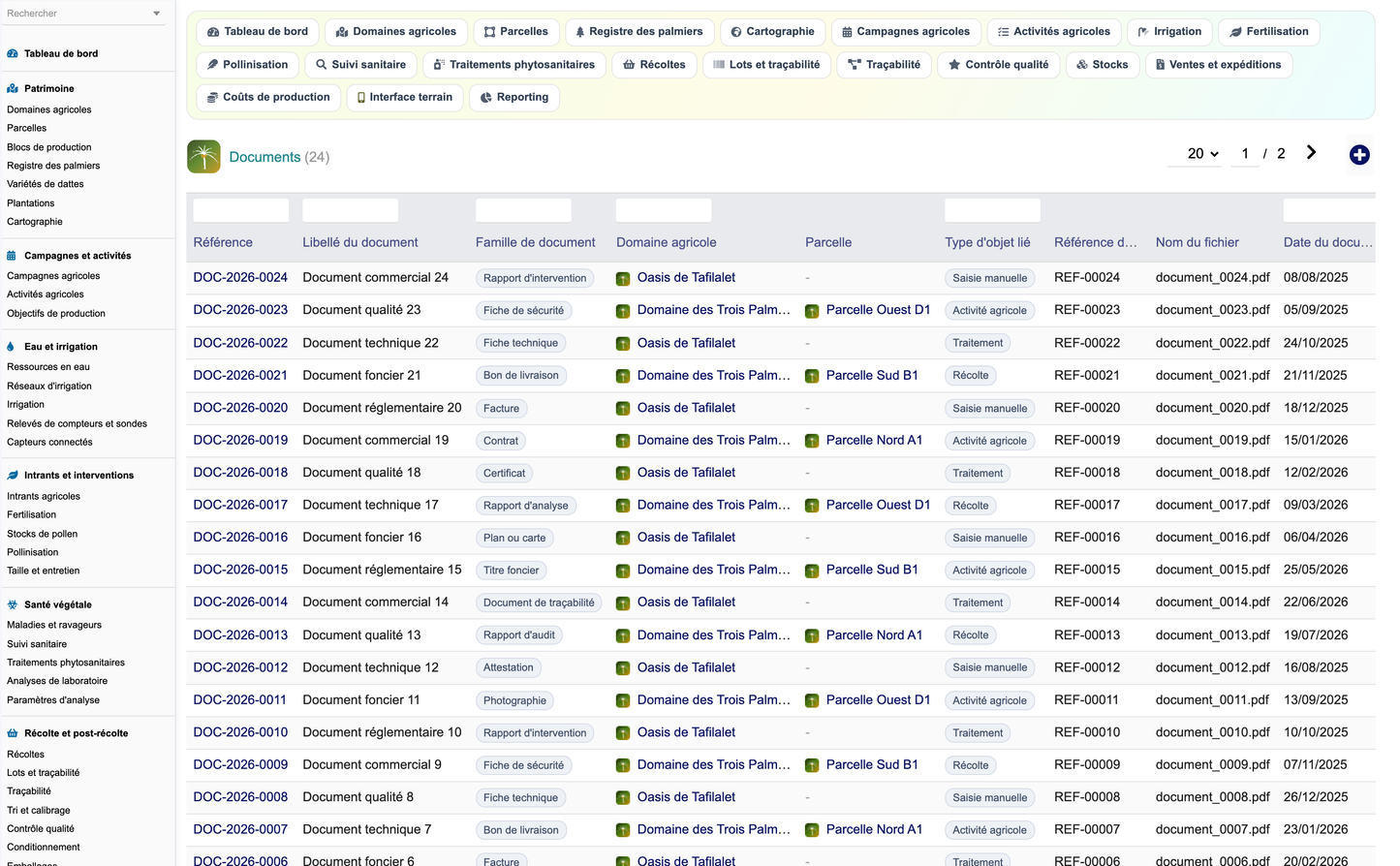
· A Screenshots folder with 68 high-resolution captures covering the dashboard, every functional zone, the record cards, the map, the traceability chain, the reporting centre, the setup page and the mobile view.
· Manuel_Formation_Gestion_Palmeraie_FR.pdf, a 55-page illustrated French user and training manual.
· Palmeraie_Management_Module_Detailed_Features_EN.docx, this document.
· README_FR.md and README_EN.md, the functional overviews.
· INSTALL.md, the installation and upgrade procedure.
· DATABASE_SCHEMA.md, the full schema with relations and the controlled vocabularies.
· API_DOCUMENTATION.md, the REST reference.
· TEST_REPORT.md, the results of the verification campaign.
· KNOWN_LIMITATIONS.md, an explicit statement of what the version does not do.
· CHANGELOG.md and LICENSE.txt.
Appendix: business objects
48 objects, 153 coded columns sharing 108 controlled vocabularies.
|
Object |
Table |
Fields |
|
Paldomaine |
llx_palmeraie_domaine |
29 |
|
Palparcelle |
llx_palmeraie_parcelle |
36 |
|
Palbloc |
llx_palmeraie_bloc |
11 |
|
Palpalmier |
llx_palmeraie_palmier |
38 |
|
Palvariete |
llx_palmeraie_variete |
25 |
|
Palplantation |
llx_palmeraie_plantation |
17 |
|
Palcertification |
llx_palmeraie_certification |
16 |
|
Palcampagne |
llx_palmeraie_campagne |
20 |
|
Palactivite |
llx_palmeraie_activite |
26 |
|
Palobjectif |
llx_palmeraie_objectif |
13 |
|
Palressource |
llx_palmeraie_ressource |
21 |
|
Palreseau |
llx_palmeraie_reseau |
18 |
|
Palirrigation |
llx_palmeraie_irrigation |
23 |
|
Palcompteur |
llx_palmeraie_compteur |
15 |
|
Palintrant |
llx_palmeraie_intrant |
22 |
|
Palfertilisation |
llx_palmeraie_fertilisation |
21 |
|
Palpollen |
llx_palmeraie_pollen |
16 |
|
Palpollinisation |
llx_palmeraie_pollinisation |
16 |
|
Paltaille |
llx_palmeraie_taille |
19 |
|
Palmaladie |
llx_palmeraie_maladie |
14 |
|
Paldiagnostic |
llx_palmeraie_diagnostic |
21 |
|
Paltraitement |
llx_palmeraie_traitement |
30 |
|
Palanalyse |
llx_palmeraie_analyse |
19 |
|
Palparametre |
llx_palmeraie_parametre |
9 |
|
Palrecolte |
llx_palmeraie_recolte |
26 |
|
Pallot |
llx_palmeraie_lot |
24 |
|
Paltri |
llx_palmeraie_tri |
21 |
|
Palqualite |
llx_palmeraie_qualite |
22 |
|
Palconditionnement |
llx_palmeraie_conditionnement |
21 |
|
Palemballage |
llx_palmeraie_emballage |
15 |
|
Palentrepot |
llx_palmeraie_entrepot |
14 |
|
Palstock |
llx_palmeraie_stock |
20 |
|
Palmouvement |
llx_palmeraie_mouvement |
14 |
|
Palequipement |
llx_palmeraie_equipement |
22 |
|
Palmaintenance |
llx_palmeraie_maintenance |
20 |
|
Palcarburant |
llx_palmeraie_carburant |
14 |
|
Palemploye |
llx_palmeraie_employe |
18 |
|
Palequipe |
llx_palmeraie_equipe |
10 |
|
Palpointage |
llx_palmeraie_pointage |
19 |
|
Palfournisseur |
llx_palmeraie_fournisseur |
14 |
|
Palclient |
llx_palmeraie_client |
15 |
|
Palvente |
llx_palmeraie_vente |
22 |
|
Palcout |
llx_palmeraie_cout |
20 |
|
Palaudit |
llx_palmeraie_audit |
17 |
|
Palalerte |
llx_palmeraie_alerte |
18 |
|
Paldocument |
llx_palmeraie_document |
15 |
|
Palmeteo |
llx_palmeraie_meteo |
18 |
|
Palcapteur |
llx_palmeraie_capteur |
21 |
The module is a management, planning and traceability tool. It replaces neither agronomic advice, nor official plant-health diagnosis, nor any decision reserved to an authorised professional.


