
Discover powerful Dolibarr extensions designed to automate your business processes
Dialysis Center Management (Gestion de Centre de Filtration Rénale) is a premium, production-ready module that transforms Dolibarr ERP & CRM...
Couldn't load pickup availability


Dialysis Center Management (Gestion de Centre de Filtration Rénale) is a premium, production-ready module that transforms Dolibarr ERP & CRM into a complete management platform for a haemodialysis / renal filtration centre. It allows a dialysis centre to run its entire activity — medical, nursing, technical, logistical, financial and quality — from a single system, without relying on additional software.
The module follows Dolibarr development standards (MVC architecture, hooks, triggers, permissions, translations) and is compatible with the latest Dolibarr versions (v16 to v23+) and PHP 8.x. It is fully translated into French, English, Italian, German and Spanish, with no hard-coded text.
· 22 interconnected business objects covering the full dialysis workflow.
· Premium medical dashboard with 24+ KPIs and 6 analytical charts.
· Reporting hub with 20 ready-made reports and CSV / Excel / PDF exports.
· 23 fine-grained permission groups; multi-entity (Multicompany) ready.
· One-click demonstration dataset generator and secure purge.
· Automatic clinical, technical and stock alert engine with a daily cron job.
The module is built on a proven, MVC-aligned generic engine. Each business object is described declaratively (fields, types, relations) and drives its SQL schema, its CommonObject-derived PHP class, and its list and card screens.
· MVC & CommonObject: every object extends the native Dolibarr CommonObject class with create/read/update/delete, list, and getNomUrl methods.
· Database: one table per object (llx_dial_<object>), with entity, status, audit columns (date_creation, tms, fk_user_creat/modif) and an import_key for demo tagging.
· Hooks & Triggers: a trigger interface reacts to object events; the module registers into the Dolibarr module_parts (CSS, JS, triggers).
· Permissions: 23 right groups with read / write / delete sub-permissions, enforced on every page and API call.
· Extrafields, REST API, Multicompany, Agenda and ECM are natively supported.
· Schema self-heal: on activation/upgrade, missing columns are added automatically (ALTER TABLE).
· Security: parameterised SQL, CSRF tokens on every form, XSS-safe output escaping, responsive UI.
· Patients — full renal record: patient number, identity, CIN/passport, blood group, allergies, chronic diseases, nephropathy cause, dialysis modality, vascular access, dry weight, serologies (HBV/HCV/HIV), referring nephrologist, treating physician, insurance and payer, patient status.
· Medical files — medical & surgical history, hospitalisations, comorbidities, vaccinations, clinical summary.
· Doctors & nephrologists — referring / external doctors, specialty, RPPS number, fees, contracts.
· Staff — nurses, care assistants, biomedical & maintenance technicians, biologists, pharmacists, medical secretary, medical director, quality manager, with skills, certifications and availability.
· Rooms & buildings — dialysis rooms, boxes, isolation rooms (HBV/HCV), water-treatment room.
· Dialysis stations — chairs / beds / posts with cleaning and disinfection tracking.
· Dialysis machines — manufacturer, model, serial number, warranty, calibration, operating state.
· Maintenance — preventive / corrective / calibration / quality-control, parts, cost, downtime.
· Dialysis protocols — per-patient prescription: modality, frequency, Qb/Qd, dialysate, dialyzer, dry weight, ultrafiltration target, anticoagulation, Kt/V target.
· Appointments & agenda — planning by shift, reminders, waiting management.
· Dialysis sessions — complete pre/per/post vitals (weight, blood pressure, temperature, pulse, flows, ultrafiltration, Kt/V, URR, oxygen saturation), complications, medications administered, validation.
· Biological exams — creatinine, urea, potassium, calcium, phosphorus, sodium, bicarbonate, haemoglobin, haematocrit, albumin, CRP, ferritin, PTH, Kt/V, URR, glycaemia.
· Prescriptions — medication ordonnances and renewals.
· Medications — dialysis-specific drugs (EPO, iron, vitamin D, phosphate binders, anticoagulants…) with lots, expiry and minimum stock.
· Consumables — dialyzers, lines, needles, catheters, concentrates, filters, gloves, disinfectants.
· Insurance funds — CNSS, CNOPS/AMO, RAMED, private insurers, mutual funds, with ceilings and rates.
· Coverage requests — agreement number, period, covered sessions, claimed and reimbursed amounts, status.
· Native quotes, invoices and payments generated from the Dolibarr modules.
· Incidents — adverse events, technical incidents, non-conformities, infections, with severity and actions.
· Corrective / preventive actions (CAPA) — root-cause analysis, action plan, responsible, effectiveness.
· Quality indicators — clinical, technical, hygiene, safety and satisfaction metrics.
· Documents & consents (GED) and automatic alerts.
1. Admission: create the patient record and medical file, capture the nephropathy, modality and vascular access.
2. Prescription: the nephrologist defines a dialysis protocol (frequency, Qb/Qd, dry weight, Kt/V target).
3. Planning: appointments and sessions are scheduled by shift on available stations and machines.
4. Treatment: each session records full vitals and outcomes; incidents are logged if needed.
5. Follow-up: biological exams and quality indicators track the adequacy of dialysis over time.
6. Billing: sessions feed quotes, invoices, coverage requests and payments.
7. Pre-dialysis: weight, blood pressure, temperature and pulse are recorded; the station and machine are assigned.
8. Per-dialysis: blood and dialysate flow, ultrafiltration, anticoagulation and conductivity are monitored.
9. Post-dialysis: post weight and vitals, weight loss, achieved Kt/V and URR, complications and medications given.
10. Validation: the nurse validates the session, which then feeds reporting, quality and billing.
11. Machines carry install date, warranty, last/next maintenance and calibration dates.
12. Preventive and corrective maintenance interventions are logged with parts, cost and downtime.
13. Machine state (operational / down / in maintenance) is surfaced on the dashboard and raises alerts.
14. An incident (adverse event, technical incident, non-conformity, infection) is declared with severity.
15. A corrective or preventive action (CAPA) is opened with a root-cause analysis and an action plan.
16. Effectiveness is verified and quality indicators are updated for the quality management system (QMS).
The module does not duplicate native functionality — it enriches and reuses the Dolibarr ecosystem. All data is interconnected.
|
Dolibarr module |
Usage in the dialysis centre |
|
Third parties (Societe) |
Patients, insurers and suppliers are shared as third parties. |
|
Products & Services |
Dialysis session services, medications and consumables. |
|
Stock & Warehouses |
Pharmacy and consumables inventory, lots and expiry. |
|
Proposals / Quotes |
Care quotes generated from sessions and packages. |
|
Invoices & Payments |
Session and coverage invoicing with payment tracking. |
|
Bank & Accounting |
Financial follow-up and accounting entries. |
|
Projects & Agenda |
Planning, scheduling and multi-shift agenda. |
|
HR / Employees |
Staff linked to Dolibarr users. |
|
ECM / GED |
Patient documents and consents. |
|
REST API & Multicompany |
Programmatic access and multi-entity operation. |
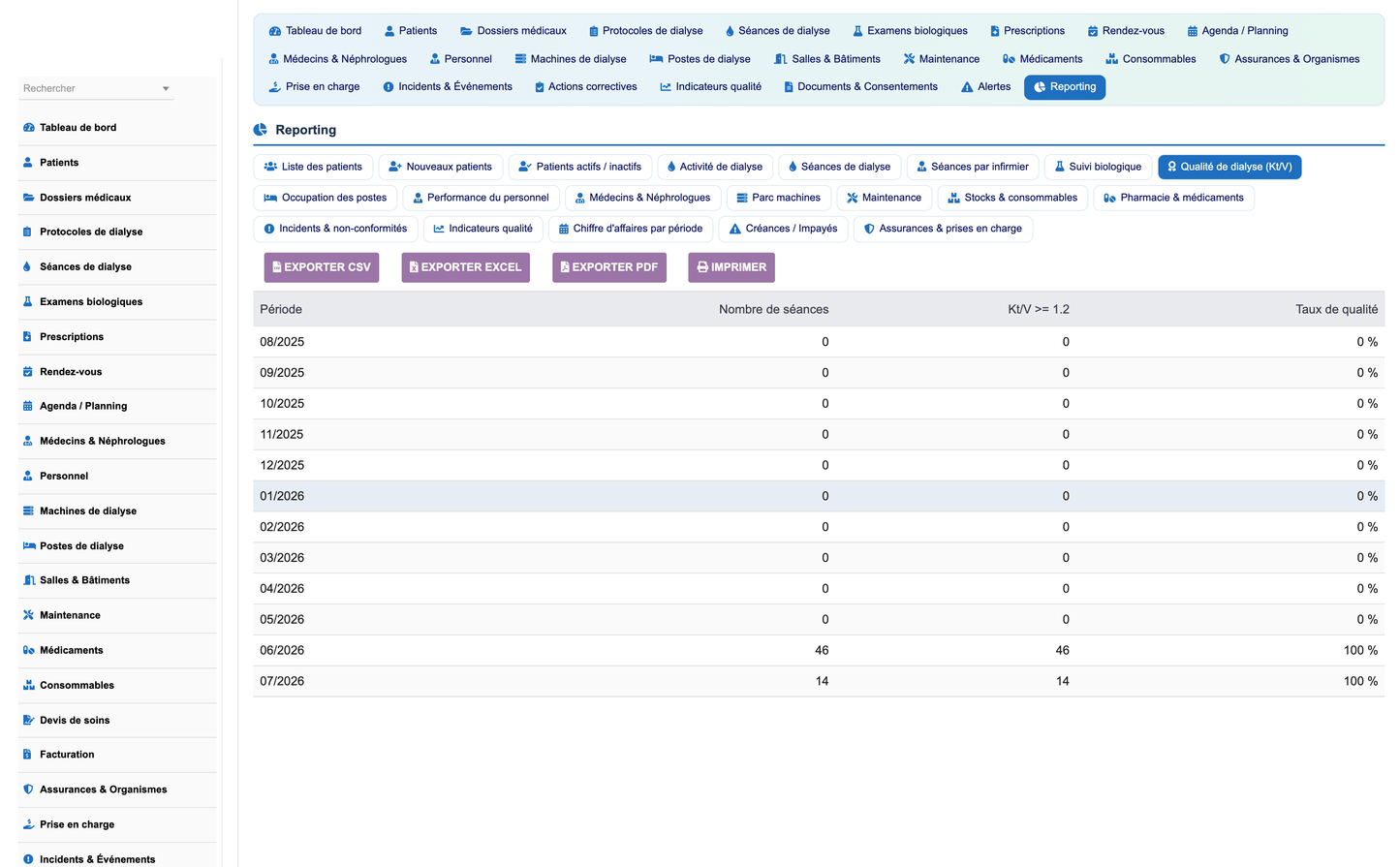
The module ships a consistent, responsive interface with a module left menu, an in-page tab bar and full-width content. Representative screens are shown below.
The reporting hub provides 20 business reports, each with summary KPIs and CSV / Excel / PDF exports:
· Patients list, new patients, active/inactive patients
· Dialysis activity, sessions, sessions by nurse
· Biological follow-up and dialysis quality (Kt/V adequacy)
· Station occupancy, staff performance, doctors
· Machine fleet and maintenance
· Consumables stock and pharmacy / medications
· Incidents and quality indicators
· Revenue by period, receivables / unpaid, insurance & coverage
· 23 permission groups (one per functional area plus reporting) with read / write / delete rights.
· Read and write are granted by default on activation; delete and administration are opt-in.
· CSRF protection on every form, XSS-safe output, parameterised SQL queries.
· Audit trail via creation/modification user and timestamp columns; full traceability.
· Multi-entity isolation through the entity column on every table.
· A haemodialysis centre managing chronic patients on a 3-sessions-per-week schedule.
· A nephrology unit tracking dialysis adequacy (Kt/V, URR) and biological follow-up.
· A biomedical department managing a fleet of dialysis machines and preventive maintenance.
· A quality manager running the QMS: incidents, CAPA and quality indicators.
· An administration handling insurance coverage requests, invoicing and receivables.
· Architecture: Dolibarr MVC, CommonObject, hooks, triggers, extrafields, REST API.
· Compatibility: Dolibarr v16 to v23+, PHP 8.x, MySQL / MariaDB.
· Languages: French, English, Italian, German, Spanish (no hard-coded text).
· Dependencies: Products/Services and Third parties modules (required); Proposals, Invoices, Payments, Bank, Accounting, Agenda, ECM (optional).
· Publisher: DoliResources — www.doliresources.com — GPL v3+ — Version 1.0.


