
Discover powerful Dolibarr extensions designed to automate your business processes
Drilling Company Management (Gestion Entreprise de Forages) is a professional, ready-to-sell vertical ERP module that transforms Dolibarr into a genuine management tool for...
Couldn't load pickup availability


Drilling Company Management (Gestion Entreprise de Forages) is a professional, ready-to-sell vertical ERP module that transforms Dolibarr into a genuine management tool for water-well and borehole drilling companies. It lets users manage the entire lifecycle of their drilling activities — from commercial prospecting and hydrogeological studies, through site works, drilling, well equipping and pumping tests, up to water analysis, maintenance and invoicing — without needing any other software.
The module is built entirely on the official Dolibarr development standards (object-oriented PHP, MySQL, HTML5, CSS3, JavaScript), with a modular, documented and easily maintainable architecture. It natively enriches Dolibarr by reusing its third parties, products, stock, purchases, quotes, orders, invoices, accounting, projects and document management.
The solution is flexible enough to handle every type of drilling activity:
· Drinking-water wells
· Agricultural boreholes
· Industrial boreholes
· Irrigation boreholes
· Exploration drilling
· Piezometers
· Traditional wells
· Borehole rehabilitation
· Pumping tests
· Pump installations
· Hydrogeological works
· Geotechnical drilling studies
|
Attribute |
Value |
|
Commercial name |
Gestion Entreprise de Forages |
|
Technical name |
drillingcompanymanagement |
|
Version |
1.0.0 |
|
Publisher / Copyright |
© 2026 DoliResources |
|
Website |
www.doliresources.com |
|
Dolibarr compatibility |
v16, v17, v18, v19, v20, v21, v22, v23+ |
|
PHP |
7.1 minimum, PHP 8 ready |
|
Languages |
French, English, Italian, German, Spanish |
|
Architecture |
Multi-entity, multi-company, SaaS-ready |
|
Dependencies |
Third parties (modSociete) + Products (modProduct) |
|
Business objects |
24 dedicated objects |
|
Database prefix |
llx_drillingcompany_* |
The module opens on a modern, purpose-built dashboard that departs from the classic Dolibarr look. It uses a dedicated visual identity inspired by drilling and water: deep water blue, aquifer cyan, safety orange, steel grey, earth brown and nature green, with a droplet-and-derrick brand icon.
A row of six premium alert tiles instantly surfaces what needs attention:
· Sites behind schedule
· Permits expiring soon
· Materials below minimum stock
· Equipment maintenance due
· Open HSE events
· Unproductive (dry) boreholes
KPIs are grouped into six colour-coded zones:
|
Zone |
Indicators |
|
Overview |
Projects, active sites, completed sites, field workforce, total budget, revenue, expenses, margin |
|
Drilling & production |
Boreholes drilled, total depth drilled, average depth, average flow rate, productive rate, pumping tests, water analyses |
|
Equipment & fleet |
Available equipment, equipment in maintenance, fleet availability rate, fuel consumed, fuel cost |
|
Procurement & stock |
Materials in stock, critical stock, supplier orders |
|
HSE & Quality |
HSE incidents, open non-conformities |
|
Finance |
Revenue, expenses, project margin, total budget |
The dashboard renders dynamic charts and a live site board:
· Boreholes drilled per month (bar chart)
· Drilling sites breakdown by lifecycle stage (pie chart)
· Revenue evolution over 12 months (bar chart)
· Expense breakdown by category (pie chart)
· Seven-stage site progress board with per-stage counts
· Fully responsive layout (desktop, tablet, mobile) with dark-mode support
The Site Board provides a drag-and-drop Kanban that drives each drilling site through its complete lifecycle. Cards move between columns and the status is saved instantly (AJAX), with no page reload.
The seven lifecycle stages are:
· Prospecting
· Study
· Permit
· Drilling
· Equipping
· Testing
· Handover
Each card shows the site reference, town and a stage-coloured progress bar. The board is mirrored as a compact stage summary on the main dashboard.
The module ships 24 fully-featured business objects, each with list views (multi-criteria search, sorting, show/hide column selector), detail cards, create/edit forms, status workflow and native links.
|
Object |
Purpose & key fields |
|
Drilling projects |
Reference, client, drilling type, GPS coordinates, budget, planned boreholes, dates, project manager, linked native project, progress |
|
Drilling sites |
Chantiers with address, GPS, access conditions, site manager, lifecycle status (Kanban), progress |
|
Campaigns |
Drilling campaigns per site: type, dates, number of boreholes, progress |
|
Timesheets |
Workforce time tracking per site and team |
|
Object |
Purpose & key fields |
|
Hydrogeological studies |
Preliminary studies: type, geologist, aquifer, expected depth & flow, recommendations, attached file |
|
Administrative permits |
Type, issuing authority, administrative reference, issue & expiry dates, status (with expiry alerts) |
|
Boreholes |
Type, GPS, drilling method, diameter, depth, casing, screen, static & dynamic levels, flow rate, water quality, driller, drilling status |
|
Pumping tests |
Step / long-duration / recovery tests: flow, drawdown, duration, specific capacity, date |
|
Water analyses |
Physico-chemical / bacteriological / complete: laboratory, pH, conductivity, nitrate, conformity, sampling date |
|
Pumps |
Model, brand, power (kW), flow, head, installed borehole, install date, status |
|
Object |
Purpose & key fields |
|
Materials |
Casing, screens, gravel pack, cement, bentonite, accessories: category, linked product, supplier, unit, price, stock quantity & minimum |
|
Stock movements |
Inbound / outbound movements by material and site |
|
Suppliers |
Supplier register linked to native third parties, with type and contact details |
|
Procurement |
Supply orders linked to native supplier orders, with amount, dates and status |
|
Object |
Purpose & key fields |
|
Teams |
Site managers, drillers, drilling assistants, mechanics, drivers, electricians: role, headcount, daily cost |
|
Equipment & rigs |
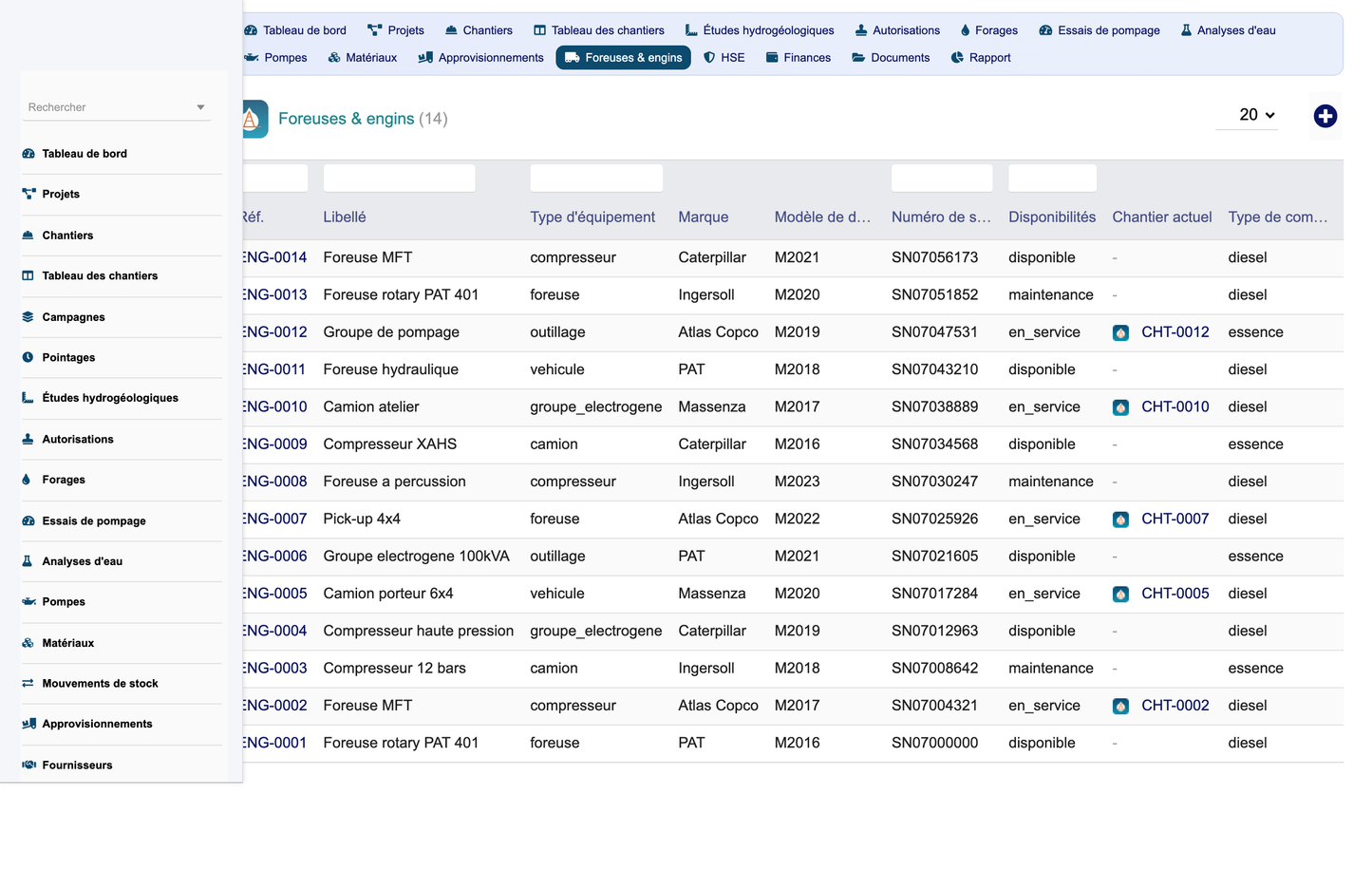
Drilling rigs, trucks, compressors, generators, vehicles, tools: brand, model, serial, availability, fuel type, values, insurance & inspection dates |
|
Maintenance |
Preventive / corrective maintenance per equipment: cost, provider, next date |
|
Fuel consumption |
Fuel logs per equipment and site: litres, cost, odometer/hours |
|
Object |
Purpose & key fields |
|
HSE |
Prevention plans, incidents, accidents, audits, work permits, PPE: severity, event date, description, corrective action |
|
Quality control |
Controls, reserves, non-conformities per borehole: control date, result, status |
|
Document library (GED) |
Drilling reports, studies, analyses, contracts, photos, plans, permits, minutes: type, date, version, keywords, archiving |
|
Finance |
Budgets, expenses, income per project and borehole: category, amount, date, payment mode |
|
Activity journal |
Site visits, meetings, inspections, deliveries, coordination and calls with outcomes |
|
Automation rules |
Trigger-based rules run by a daily cron engine (permit expiry, maintenance due, low stock, site closure, dry boreholes) |
A dedicated Reporting menu delivers 20 situation reports covering the whole business. Every report can be exported to CSV and Excel or printed, and results are correctly localised.
|
# |
Report |
Content |
|
1 |
Boreholes |
Boreholes by type, count, average depth and flow |
|
2 |
Depths |
Depths drilled by site (count, total, average) |
|
3 |
Flows & yields |
Flow and specific capacity per borehole |
|
4 |
Pumping tests |
Tests by type with drawdown and specific capacity |
|
5 |
Water quality |
Analyses by conformity with average pH and conductivity |
|
6 |
Sites |
Sites by lifecycle status with average progress |
|
7 |
Site progress |
Progress and deadlines per site |
|
8 |
Permits |
Permits by status and type |
|
9 |
Equipment |
Fleet by type with purchase value |
|
10 |
Maintenance |
Maintenance by type with cost |
|
11 |
Fuel consumption |
Fuel litres and cost per equipment |
|
12 |
Materials stock |
Stock, minimum and value per material |
|
13 |
Clients |
Projects and budget per client |
|
14 |
Quotes |
Native quotes by status |
|
15 |
Invoices |
Native invoices by status |
|
16 |
Revenue |
Revenue by month |
|
17 |
Expenses |
Expenses by category |
|
18 |
Profitability |
Budget vs. expenses and margin per project |
|
19 |
HSE |
Incidents by type and severity |
|
20 |
Team productivity |
Headcount and cost by team role |
All commercial operations rely on native Dolibarr objects, so the module extends — rather than duplicates — the ERP. Integration points include:
· Third parties and contacts (clients and suppliers)
· Products and services (casing, screens, pumps, gravel, cement…)
· Stock and warehouses
· Purchases and supplier orders
· Quotes (Devis), sales orders (Commandes) and invoices (Factures)
· Payments, banking and accounting
· Projects, agenda and the native document manager (ECM)
The demonstration dataset creates real native third parties, products, projects and validated invoices, so revenue KPIs, quotes and invoice reports are populated out of the box.
An administration page lets managers configure the module and, crucially, manage a realistic demonstration dataset:
· Install demo data — populate a complete demo dataset (6 projects, 12 sites, 60 boreholes, 40 pumping tests, 40 water analyses, studies, permits, equipment, materials, teams, finance and more), and
· Remove demo data — remove every demo record created by the module, safely and without touching real business data.
The seeder is idempotent and version-guarded: it seeds once per dataset version and can be reset cleanly at any time. A default drilling type can also be configured; numbering, PDF templates, notifications and colours follow the standard Dolibarr configuration.
· Modern, elegant and fully responsive design (PC, tablet, mobile)
· Global and multi-criteria search on every list
· Dynamic tables with a show/hide column selector
· Interactive KPI widgets and dynamic charts
· Kanban view of drilling sites and project timelines
· Status badges, modern Font Awesome icons and dark-mode compatibility
· In-page navigation bar kept in sync with the Dolibarr left menu
The module follows Dolibarr security best practices:
· Fine-grained permissions across 17 rights groups (read / write / delete) plus reporting and administration
· CSRF protection and token renewal on all forms and actions
· XSS protection through systematic output escaping
· Prepared / escaped SQL queries
· Full multi-entity (multi-company) isolation
· Event logging and audit-friendly activity journal
The module respects the official Dolibarr module architecture, with an object-oriented, modular and documented codebase:
· class/ — business object classes and engines
· core/modules/ — module descriptor; core/boxes/ — dashboard widget; core/triggers/ — event hooks
· sql/ — table definitions (prefix llx_drillingcompany_) with a self-healing schema updater
· langs/ — FR, EN, IT, DE, ES translation files
· css/ and js/ — drilling visual charter and interactive behaviour
· img/ — module and object icons
· admin/ — setup and about pages; lib/ — shared helpers and object registry
The code avoids duplication through a generic list/card engine driven by an object registry, is optimised for performance, and remains forward-compatible with future Dolibarr versions.
Drilling Company Management is developed and published by DoliResources, which holds all copyrights for the module. It is distributed under the GNU General Public License v3 or later, in line with the Dolibarr ecosystem, and installs directly from the Dolibarr module manager with no additional configuration.
© 2026 DoliResources — www.doliresources.com — Drilling Company Management v1.0.0


