
Discover powerful Dolibarr extensions designed to automate your business processes
1. Module Overview
Dry Networks Management — Advanced...
Couldn't load pickup availability


1. Module Overview
Dry Networks Management — Advanced (technical name: gestionreseauxsecs, module numero 804000) is a complete, native solution that turns Dolibarr into a professional platform for civil-electrical infrastructure contractors who design, build, connect, test, commission and maintain dry networks — as opposed to "wet" networks such as water and sewage. Dry networks cover every underground and overhead utility that carries electricity or signal: low, medium and high-voltage (LV/MV/HV) electrical distribution, public and street lighting, service connections (branchements), telecommunications, telephony, optical fibre, video-protection/CCTV, signalling, access control, low-current/extra-low-voltage (ELV) systems, detection, supervision, gas networks, earthing systems and electric-vehicle charging infrastructure (IRVE) — together with the associated civil works: trenching, duct-laying, chamber and manhole construction, substations, cabinets, lighting columns and cable pulling. The module runs entirely under custom/gestionreseauxsecs/ without modifying the Dolibarr core, and covers the whole project lifecycle across 54 native business objects, 54 dedicated database tables, 49 fine-grained permissions and 5 languages (French, English, Spanish, Italian, German).
2. Business Objectives
The module lets a dry-networks contractor manage its entire activity without any additional software: commercial prospecting and site surveys, engineering studies and design (calculation notes, load balances, voltage-drop calculations, single-line diagrams, synoptics, routing plans, cable schedules), estimating and quoting, work planning, permit and utility-notice management (including DICT declarations before any excavation), site execution and civil works, quality control and testing, as-built documentation, commissioning and handover, invoicing, warranty follow-up, and preventive/corrective maintenance of the delivered networks. It provides full traceability from the first survey to the final as-built record, with cost and margin visibility at every stage.
3. Target Users
· Dry-networks and civil-electrical infrastructure contractors (LV/MV/HV networks, service connections, lighting).
· Public-lighting companies and municipal lighting maintenance operators.
· Telecommunications, telephony and optical-fibre installers and network operators.
· Civil-works firms specialising in trenching, ducting and underground chamber construction.
· Utilities and network operators (electricity distribution, gas, telecom) and their subcontractors.
· Engineering and design offices (bureaux d'études) producing electrical and telecom network studies.
· Inspection bodies and quality-control organisations performing acceptance testing and compliance checks.
4. Supported Dry-Network Activities
· Low, medium and high-voltage (LV/MV/HV) electrical distribution networks.
· Public and street lighting (lighting columns, feeder cabinets, photocells, dimming).
· Service connections (branchements) for electricity, telecom and gas subscribers.
· Telecommunications and telephony networks, copper and structured cabling.
· Optical fibre networks (FTTH/FTTx), splicing chambers and distribution points.
· Video-protection / CCTV networks and urban surveillance infrastructure.
· Traffic and urban signalling networks.
· Access control and low-current / extra-low-voltage (ELV) systems.
· Detection and supervision networks (SCADA-style remote monitoring of dry-network assets).
· Gas distribution networks and related civil works.
· Earthing systems for network infrastructure and substations.
· Electric-vehicle charging infrastructure (IRVE) and associated feeder networks.
· Civil works: trenching, duct-laying, chambers/manholes, substations, cabinets, lighting-column foundations, cable pulling.
5. Dashboard — Dry Networks Control Center
A modern steering dashboard, the Dry Networks Control Center, presents the whole portfolio at a glance: active and completed projects, kilometres of network laid by type (electrical, lighting, telecom, fibre, gas), open work sites, sections in progress vs. completed, pending permits and utility notices, tests scheduled and passed/failed, non-conformities open and closed, interventions today and overdue, revenue and margin by activity, subcontractor workload, equipment availability, stock alerts, HSE incidents, and warranty/maintenance obligations coming due. Interactive charts and global filters (period, customer, project, network type, team, subcontractor) let managers drill down instantly from portfolio level to a single section or node.
6. Project & Business Management
Every engagement is tracked as a project following the full dry-networks lifecycle: prospecting, technical study, design, cost estimate, quotation, planning, permits and utility notices (DICT/DT-DICT and equivalent declarations before excavation), execution, quality control, testing, as-built documentation, handover, invoicing, warranty and maintenance. Each stage carries its own status, responsible team, dates, budget and linked documents, giving full visibility of where a project stands and what remains to be done, with automatic escalation of overdue stages and a consolidated project timeline.
7. Network & Section Management
Networks are modelled hierarchically as Network -> Section -> Node -> Works, matching how dry networks are actually built and operated. A network record groups all sections of a given type (electrical, lighting, telecom, fibre, CCTV, gas, IRVE, etc.) for a project or area. Each section carries its route, length, cable/duct type, depth, capacity and status (planned, trenching, laid, connected, tested, accepted). Nodes represent chambers, cabinets, substations, connection points, lighting columns and splice points, each with its own equipment, connections and history. Works items track civil and electrical operations performed on a section or node, with dates, teams and materials consumed.
8. GIS & Mapping
Every network, section, node and site survey point carries GPS coordinates (latitude/longitude), enabling network routes and assets to be located and visualised on a map directly from the module, with no paid mapping subscription or external GIS dependency required. Coordinates can be captured on site via mobile devices and are stored against sections, nodes, chambers, substations and lighting columns for accurate as-built georeferencing.
9. Design & Engineering Studies
A dedicated engineering module supports the design office through calculation notes, load balances, voltage-drop calculations, single-line diagrams, network synoptics, routing plans and cable schedules. Each study is linked to a project and network, version-controlled, and can be validated before release to the execution teams. Study outputs feed directly into the estimate, the works planning and the as-built documentation, keeping design and construction data consistent throughout the project.
10. Construction Site Management & Site Log
Each work site has a structured record covering location, teams, planning, equipment and materials, with a daily site log (journal de chantier) capturing weather, workforce present, work performed, incidents, deliveries and visitor entries. Site logs provide a chronological, auditable record of execution that supports progress statements, claims management and dispute resolution.
11. Resources, Teams & Certifications
Teams and individual resources (technicians, foremen, engineers, operators) are managed with their skills, electrical habilitations and safety certifications, availability and assignment history. Certification expiry dates are tracked with alerts, and assignment to sensitive works (live electrical work, confined-space entry, working at height) can be restricted to appropriately certified staff.
12. Equipment & Machinery
A dedicated equipment register tracks heavy machinery and specialised tools used on dry-networks sites: excavators, trenchers, winches and cable-pulling machines, compactors, as well as test instruments such as OTDR (optical time-domain reflectometers) for fibre testing and megohmmeters (insulation testers) for electrical circuits. Each item carries identification, ownership/rental status, maintenance and calibration schedule, current location/site assignment and utilisation history.
13. Measurements / Take-off & Progress Statements
Quantities executed on site (metres of trench dug, metres of cable pulled, number of chambers built, number of connections made) are recorded against sections and works items, supporting take-off (métrés) and the generation of progress statements (situations de travaux) for interim billing. Progress is compared against the estimate and the contract quantities to track physical and financial advancement.
14. Procurement & Suppliers
Materials and equipment specific to dry networks (cables, ducts, chambers, cabinets, connectors, lighting columns, fibre patch cords) are managed through a dedicated catalogue integrated with native Dolibarr third parties, purchase requests and supplier orders, so procurement is planned against project needs and lead times.
15. Site Stock
Stock held on site or in project-dedicated storage areas is tracked separately from the central warehouse, with reservations, consumption against works items, returns and replenishment requests, integrated with native Dolibarr stock and warehouse management.
16. Subcontracting
Portions of the works (specific sections, civil works, specialised testing) can be subcontracted, with subcontractor assignment, scope, contract value, planning, progress tracking and invoicing reconciliation, keeping subcontracted activity visible alongside in-house execution.
17. Quality & Controls
Quality control checkpoints are defined per project phase and network type, with checklists, inspection results, responsible inspector and sign-off. Control results feed directly into the non-conformity workflow when a checkpoint fails, ensuring nothing proceeds to the next phase without the required validation.
18. Testing & Measurements
A comprehensive testing module records the technical measurements required to validate dry-networks installations: insulation resistance, earth resistance, continuity, OTDR traces for optical-fibre links, and illuminance measurements for lighting installations. Each test is linked to a section or node, records instrument used, operator, date, measured values against acceptance thresholds, and a pass/fail result that drives acceptance and as-built sign-off.
19. HSE & Permits
Health, safety and environment (HSE) requirements are tracked per site, including permits to work and mandatory utility notices — DICT (Déclaration d'Intention de Commencement de Travaux) and equivalent pre-excavation declarations — with submission dates, responses from utility owners, validity periods and expiry alerts, ensuring excavation and connection works are never started without the required authorisations.
20. Non-Conformities
Non-conformities raised during quality controls, testing or client inspection are logged with severity, affected section/node, root cause, corrective action, responsible party, deadline and closure evidence, driving a structured corrective-action workflow through to verified closure before final acceptance.
21. Interventions
Field interventions — for faults, adjustments, connection requests or incident response — are logged with type, urgency, affected network/section/node, assigned team, timestamps (declaration, dispatch, arrival, resolution) and outcome, giving full traceability of unplanned work on delivered networks.
22. As-Built Documentation (DOE) & Records
On completion, the module compiles the as-built dossier (Dossier des Ouvrages Exécutés / DOE): final routing plans, updated single-line diagrams and synoptics, test and measurement records, equipment and materials used, certificates and photographs, producing the definitive record of what was actually built, as required for hand-over to the client or network owner.
23. Commissioning, Acceptance & Snags
Commissioning combines final testing, provisional acceptance (réception provisoire) with a snag list (réserves), tracked correction of each snag, and definitive acceptance (réception définitive) once all reserves are lifted, formally closing the construction phase and starting the warranty period.
24. Maintenance
Delivered dry networks can be placed under maintenance contracts with preventive maintenance planning (periodic inspection of lighting, cabinets, substations, fibre links) and corrective maintenance triggered by interventions, keeping the same object model used during construction for consistent lifecycle traceability.
25. Reporting
A full reporting menu produces filterable, printable and exportable reports (PDF, Excel, CSV) across three axes: operational (progress, sections completed, tests performed, interventions), financial (revenue, cost, margin by project/network type, progress-statement billing), and quality/HSE (non-conformities, permits, incidents, certifications), with saved filters and templates for recurring reporting needs.
26. Native Dolibarr Integrations
Bidirectional links with native modules: Third parties & contacts, Proposals, Sales & Supplier orders, Customer & Supplier invoices, Products & Services, Stock & Warehouses, Projects & Tasks, Agenda and the Document/ECM store, so quotes, orders, invoices, stock movements, projects and calendar events are created and linked directly from the dry-networks business objects.
27. REST API
A secure REST API exposes projects, networks, sections, nodes, tests, interventions and dashboard data, using native Dolibarr authentication and permissions with per-route access control and logging, allowing field-mobile applications, GIS tools or third-party systems to synchronise with the module.
28. Security & Traceability
49 fine-grained permissions cover every business domain of the module (projects, networks, sections, studies, sites, resources, equipment, procurement, stock, subcontracting, quality, testing, HSE/permits, non-conformities, interventions, as-built documentation, commissioning, maintenance, reporting, administration), mapping to role profiles such as administrator, project manager, design engineer, site foreman, technician, quality/HSE officer and subcontractor. All queries are parameterised, output is escaped, CSRF tokens are enforced and Dolibarr MultiCompany multi-entity operation is respected.
29. Multilingual Support
The module is fully translated into 5 languages — French, English, Spanish, Italian and German — covering menus, labels, forms, dashboard and generated documents, so teams and clients can work in their own language.
30. Demo Data
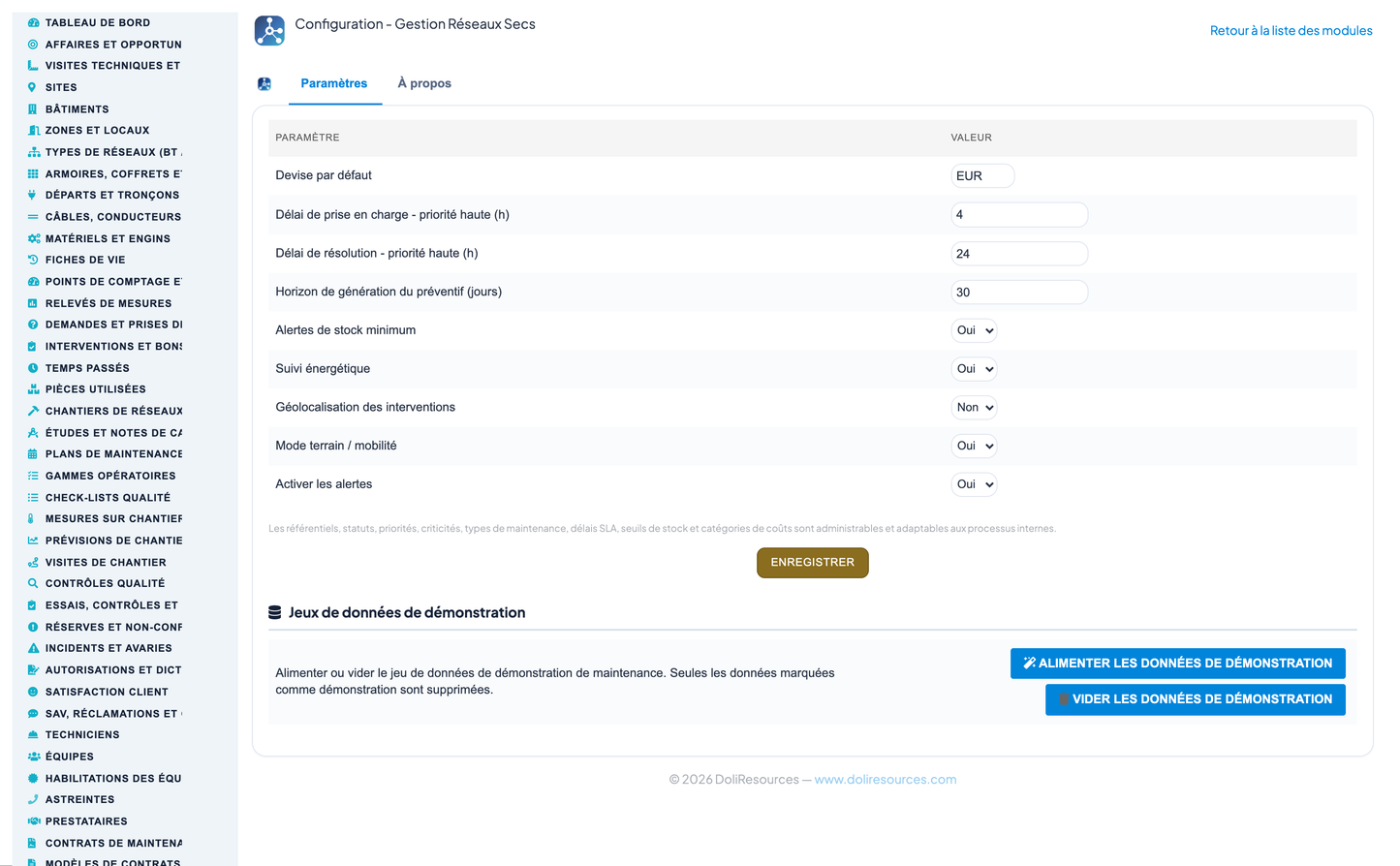
A one-click demo generator seeds a realistic dataset — customers, projects across every lifecycle stage, networks and sections of each supported type, nodes, engineering studies, work sites with site logs, teams and equipment, tests and measurements, permits and utility notices, non-conformities, interventions, as-built dossiers and maintenance contracts — so every feature can be tested immediately. A second button safely removes only the demo-tagged data, with confirmation, permission check and a deletion report.
31. Technical Requirements
· Dolibarr >= 16.0 (architecture designed for forward compatibility across recent versions).
· PHP >= 7.1, fully compatible with PHP 8.x.
· MySQL or MariaDB.
· Depends on native modules Third parties (Societe) and Products.
· 54 dedicated database tables with keys, indexes, entity fields and extrafields support; clean install/uninstall and version migration.
32. Installation Process
· Download module_gestionreseauxsecs-1.0.0.zip.
· In Dolibarr: Home -> Setup -> Modules/Applications -> Deploy/install external module, and upload the ZIP (or unzip into htdocs/custom/).
· Enable 'Gestion Réseaux Secs' in the module list; tables, menus, permissions and demo data are created on activation.
· Configure the module (numbering, units, alerts, API) from its Setup page, then grant the relevant permissions to your users.
33. Deliverables
· The complete gestionreseauxsecs module (54 business objects, 54 tables, 49 permissions, REST API, demo data generator).
· Installable ZIP package ready for deployment on any compatible Dolibarr instance.
· This detailed feature-description document in English (and equivalents in French, Spanish, Italian, German).
· Demo dataset for immediate hands-on evaluation and training.
Gestion Réseaux Secs is developed and published by DoliResources (www.doliresources.com). Copyright © 2026 DoliResources. All rights reserved. Version 1.0.0.


