
Discover powerful Dolibarr extensions designed to automate your business processes
Electronics Management turns Dolibarr ERP/CRM into a complete vertical solution for companies in the electronics sector: distribution...
Couldn't load pickup availability


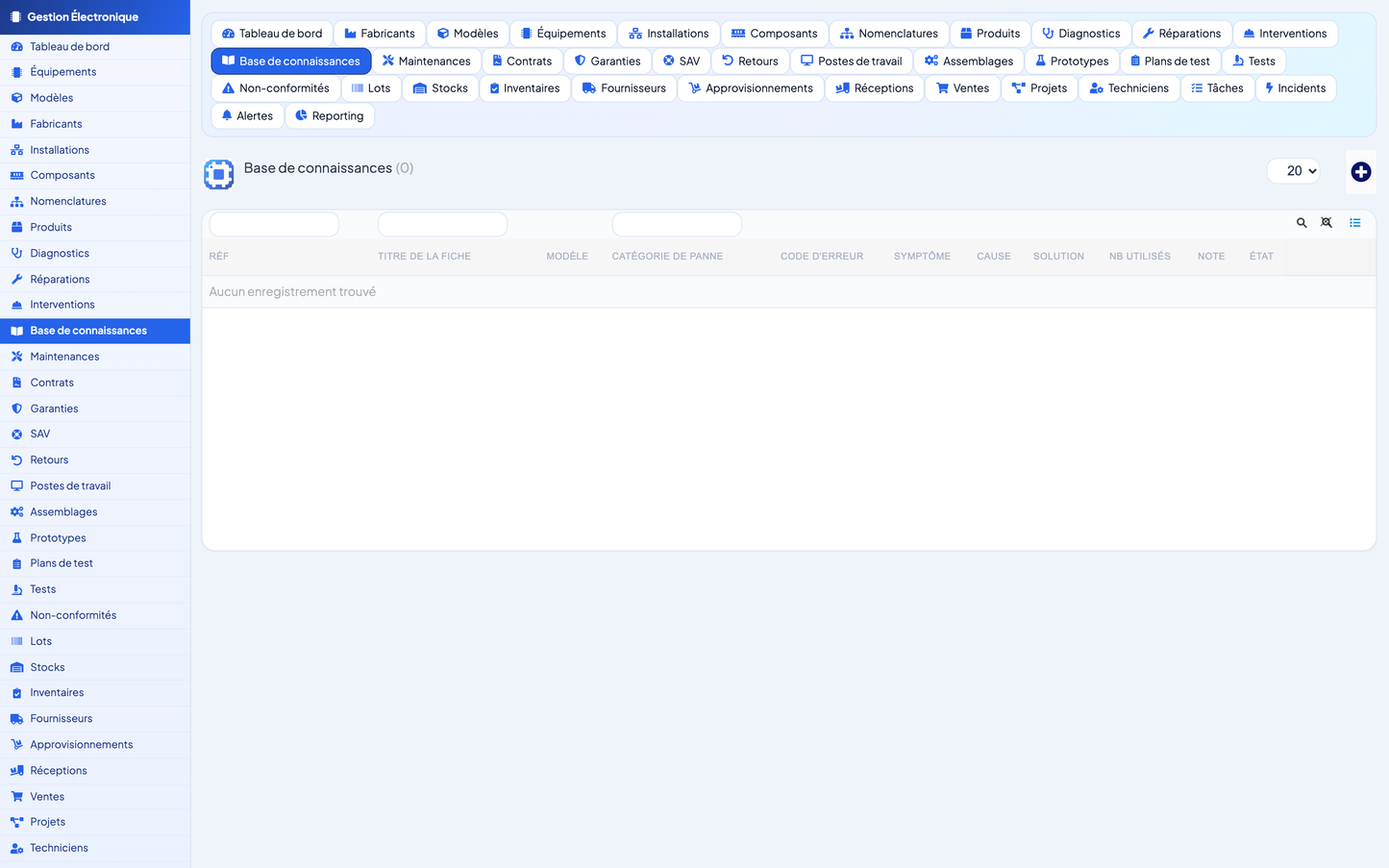
Electronics Management turns Dolibarr ERP/CRM into a complete vertical solution for companies in the electronics sector: distribution of components and equipment, systems integration and installation, board and device repair, equipment maintenance, electronic manufacturing and assembly, prototyping and after-sales service.
The module adds 40 interconnected business objects, a modern "Electronics Control Center" dashboard, a decision-reporting suite, a secure REST API and a realistic demonstration dataset — all natively integrated with Dolibarr's third parties, products, stock, warehouses, projects, orders and invoices. No core modification is required.
· Manage the full lifecycle of electronic equipment, from purchase and installation to maintenance, repair and end of life.
· Reduce equipment downtime through preventive maintenance, service contracts and SLA monitoring.
· Increase after-sales quality and customer satisfaction with structured diagnostics, RMA handling and a knowledge base.
· Give management real-time visibility on operations, finances and performance.
· Electronic component and equipment distributors and retailers.
· Systems integrators and installers (video surveillance, access control, alarms, home automation, networks, telecom, audiovisual).
· Repair shops for boards and electronic devices; equipment maintenance providers.
· Electronic manufacturing / assembly workshops and prototyping / R&D labs.
· After-sales service departments of electronics manufacturers and vendors.
· 40 business objects across 11 functional domains with filterable lists, detailed cards and a 360° view on pivot objects.
· Modern dashboard, decision reporting with CSV export, REST API, five languages, granular permissions and demonstration data.
· Native integration with third parties, products, stock, warehouses, projects, sales documents and accounting.
· Central equipment register with serial numbers, bar/QR codes, manufacturer, brand and model references.
· Status lifecycle (in stock, delivered, installed, in service, in diagnostic, in repair, in maintenance, unavailable, scrapped, sold, returned, archived), criticality, location and referent technician.
· Purchase and commissioning dates, current value, warranty end date, maintenance frequency and next due date.
· 360° equipment view: interventions, maintenance, diagnostics, repairs, warranties, contracts, incidents, tests and cumulative costs.
· Component reference catalogue (resistors, capacitors, inductors, diodes, transistors, ICs, microcontrollers, sensors, relays, connectors, boards, communication modules, power supplies, batteries, displays, cables, antennas, spare parts).
· Electrical and mechanical characteristics, package, stock levels, alert thresholds, obsolescence status and substitutes.
· Multi-version bills of materials (BOM) with lines, quantities, losses, theoretical cost and assembly time; component traceability by lot.
· Customer installations with site, address, GPS coordinates, lead technician, planned/actual dates and installed equipment count.
· Workflow from study and preparation to provisional and final acceptance, punch list (reservations) and closing.
· Technical diagnostics recording symptoms, error codes, fault category, measured vs expected values, conclusion, recommendation and cost/time estimates.
· Reusable knowledge base capitalizing on solved faults by model, error code and symptom.
· Repair files from reception to return with declared fault, diagnostic link, technician, workstation, parts and labor costs, invoiced amount and margin.
· On-site interventions created from a customer, contract, equipment or installation, with planned/actual duration, travel, work done, result and billing status.
· Workshop workstations (repair bench, test bench, SMT line, inspection, calibration) with capacity and status.
· Preventive, corrective, conditional, predictive, regulatory and systematic maintenance with schedules and next-due dates.
· Maintenance contracts with covered equipment, included interventions/hours, SLA, visit frequency, parts inclusion and yearly amount.
· Warranties (manufacturer, supplier, seller, extension, contractual) with conditions, exclusions and expiry alerts.
· Structured SAV tickets with RMA number, channel, priority, decision, warranty coverage, resolution date and satisfaction score.
· Returns / exchanges with reason, product state, decision and refund amount.
· Assembly / production orders with BOM, quantity, workstation, planned vs real time and cost, scrap and status.
· Prototype management with versions, revisions, component count, tests and anomalies.
· Test plans by model with steps, instruments and acceptance criteria.
· Quality tests (electrical, functional, safety, communication, performance, temperature, load, battery, endurance, compliance) with expected/measured values and result.
· Non-conformities with source, severity, cause, corrective action, responsible and due date.
· Multi-warehouse stock with physical/available/reserved quantities, alert thresholds, weighted average price and value.
· Lots and serial numbers with traceability; physical inventories with lines and gap valuation.
· Supplier scoring (quality rate, non-conformity rate, lead time, score) and status.
· Purchase orders (supplies) with lines and receptions with quantity/document controls and anomaly count.
· Customer orders (sales) by type with lines, margin and status; electronic projects with budget, spent, progress and status.
· Bidirectional links with native Dolibarr proposals, orders, invoices and projects.
· Global overview: total/active equipment, in repair/maintenance, under/out of warranty, active contracts, monthly revenue and margin, on-time and first-pass rates, satisfaction.
· Operational control center: today's interventions, repairs in progress, urgent repairs, pending/unassigned diagnostics, available technicians, immobilized equipment, open SAV, ongoing installations, overdue maintenance, late supplies.
· Alerts & risks: critical/open alerts, expiring warranties, contracts to renew, critical stock, unavailable components, non-conform tests, open non-conformities.
· Six charts (interventions per month, equipment by status, revenue per month, faults by category, interventions by type, test results) and quick-action buttons.
· Eight decision reports: equipment status, interventions performance, repairs, contracts, warranties, critical stock, supplier performance and revenue by type — all filterable and CSV-exportable.
· Secure REST endpoints under /api/index.php/gestionelectronique/ for equipments, components, models, installations, diagnostics, repairs, interventions, maintenances, contracts, warranties, savs, tests, stock, suppliers, technicians, sales and a dashboard snapshot.
· Authentication, per-group permissions, pagination and whitelisted sort fields; ready for mobile apps, customer portals, IoT and supervision tools.
· Granular rights by functional group (park, components, diagnostics, maintenance, after-sales, workshop, quality, stock, purchasing, sales, resources) plus reporting and administration.
· CSRF tokens, escaped queries, output escaping, multi-entity control, action logging and delete confirmations.
· Fully translated in French, English, Spanish, Italian and German (about 850 keys per language) through Dolibarr's native translation system; no functional text hard-coded in pages.
· One click loads a realistic, fully interconnected dataset with 13 months of history (equipment, components, BOMs, installations, diagnostics, repairs, interventions, contracts, warranties, SAV, assemblies, tests, stock, sales, projects, technicians).
· A second click safely removes only the demonstration records (marked GELEDEMO), never real company data; the operation is idempotent and permission-protected.
· Dolibarr 16.0 or higher; PHP 7.1 or higher; MySQL/MariaDB (or any Dolibarr-supported database).
· Installs into htdocs/custom and is enabled from the module manager. Depends on Third parties and Products modules. No core modification.
· A single tool to run the whole electronics service business, replacing scattered spreadsheets and niche software.
· Faster diagnostics and repairs, fewer breakdowns, better SLA compliance and higher customer satisfaction.
· Real-time decision-making from an integrated dashboard and reporting suite.
· An integrator tracks every installed device, its warranty and its maintenance contract, and dispatches technicians from the planning.
· A repair shop receives a device, runs a diagnostic, quotes, orders parts, repairs, tests and returns it — with full cost and margin tracking.
· A manufacturer manages BOMs, assembly orders, quality tests and non-conformities, then handles warranty claims through the SAV.
· Manufacturers, models/references, equipment park with serial numbers
· Component catalogue and multi-version bills of materials
· Electronic products and sellable catalogue
· Customer installations with acceptance workflow
· Technical diagnostics and reusable knowledge base
· Repair files, on-site interventions and workshop workstations
· Preventive/corrective maintenance, service contracts and SLA, warranties
· After-sales tickets (RMA), returns and exchanges
· Assembly/production orders, prototyping
· Test plans, quality tests, non-conformities
· Lots and serial traceability, multi-warehouse stock, inventories
· Suppliers, purchase orders, receptions with controls
· Sales orders and electronic projects
· Technicians, planning/tasks, incidents and alerts
· Electronics Control Center dashboard, 8 reports, REST API
· Five languages, granular permissions, demonstration data


