
Discover powerful Dolibarr extensions designed to automate your business processes
Garment Manufacturing Management (French commercial name: "Gestion Confection") is a professional Dolibarr module published by DoliResources. It turns a standard Dolibarr installation into...
Couldn't load pickup availability


Garment Manufacturing Management (French commercial name: "Gestion Confection") is a professional Dolibarr module published by DoliResources. It turns a standard Dolibarr installation into a complete ERP for textile and apparel manufacturing, so that a confection company can run its entire operation without any additional software.
The module covers the full industrial cycle of a garment factory: product development and technical files, bills of materials, manufacturing routes, fabric and trim procurement, production orders, cutting, sewing lines, daily work-in-progress tracking, AQL quality control, subcontracting, finishing and packing, shipping, costing and margin analysis, material stock and workshop staff.
Every object is fully integrated with native Dolibarr modules (Third parties, Products, Stock, Quotations, Sales orders, Invoices, Shipments, Projects, Users and Permissions), so the manufacturing data lives inside the same ERP as the commercial and accounting data.
|
Item |
Value |
|
Technical name |
confectionmanagement |
|
Module number |
530200 |
|
Version |
1.0.0 |
|
Publisher |
DoliResources — www.doliresources.com |
|
Licence |
GNU GPL v3 |
|
Dolibarr compatibility |
16.0 and above |
|
Minimum PHP |
7.1 (PHP 8 compatible) |
|
Languages |
French, English, Spanish, Italian, German |
|
Business objects |
16 fully managed entities |
|
Database tables |
16 dedicated tables (llx_cfx_*) |
|
Permissions |
9 permission groups / 26 individual permissions |
|
Menu entries |
20 (1 top menu + 19 left menu entries) |
The module ships with a purpose-designed dashboard that deliberately breaks from the classic Dolibarr dashboard layout. It uses a textile-inspired colour charter (indigo thread, violet, workshop teal) with a gradient hero banner, rounded KPI cards with coloured accent bars and gradient icon tiles, a horizontal production pipeline and framed chart panels.
· Active production orders — all orders not yet closed or cancelled.
· Pieces produced today — sum of daily output declared on the sewing lines.
· Pieces produced this month — running monthly output.
· Average progress — mean completion percentage of all live orders.
· Late orders — orders past their due date and not finished, highlighted in red.
· Total pieces produced — cumulative output across all orders.
· Pieces still to produce — the outstanding order book in units.
· Production margin — consolidated margin across all production orders.
A horizontal pipeline shows the number of orders and the number of pieces engaged in each manufacturing phase: Planned, Cutting, Sewing, Finishing, Quality control, Shipped, Closed and Cancelled. Each column is colour-coded, with completed work in green and cancelled work in red.
· Production over 14 days — bar chart of daily output, the operational heartbeat of the factory.
· Quality split — donut chart of conform / rework / reject quantities.
· Production by collection — bar chart ranking collections by produced volume.
· Load by workshop — remaining quantity per workshop, to spot bottlenecks.
· Conformity rate — conditional colour: green above 95%, amber above 90%, red below.
· Rework rate — share of production sent back for repair.
· Reject rate — share of production scrapped.
· Line efficiency — average efficiency declared over the current month.
· Material yield — average cutting-room yield, a direct profitability driver.
· Load rate — current load against the declared daily capacity.
· Material stock value — valuation of the fabric and trim inventory.
· Fabric consumed this month — metres cut in the current month.
· Material alerts — materials at or below their alert threshold.
· Unplanned orders — orders still waiting to be launched.
· Open shipments — the logistics backlog.
The model (style) is the technical file of a garment and the starting point of every production run.
· Reference, label, season, collection, category, gender and garment type.
· Ordering party linked to a native Dolibarr third party, with a clickable link to the customer record.
· Size range, colourways, designer, target price and manufacturing lead time.
· Optional link to a native Dolibarr product for the finished article.
· Lifecycle status: draft (development), active (in production), closed (archived) or cancelled.
Each model carries its own bill of materials, listing every fabric, lining and trim required to build one garment.
· Material kind (fabric, lining, trim), label and optional link to a native Dolibarr product.
· Consumption per piece with its unit of measure (m, kg, piece, spool).
· Waste rate expressed as a percentage, applied to the theoretical consumption.
· Unit cost and computed line cost, feeding the material cost of the costing sheet.
· Lines are created directly from the model card with the relation pre-filled.
The manufacturing route describes, step by step, how the garment is made and how long each step takes.
· Sequence number, operation label and work section (cutting, sewing, finishing, control).
· Workstation and machine (flat-lock, overlock, cover-stitch, buttonhole, press, cutting table).
· Standard minute value (SMV) per operation — the basis of labour costing and capacity planning.
· Piece rate for piecework payment schemes.
· Material repository covering fabrics, linings and trims (thread, buttons, zips, labels, elastic).
· Composition, colour, width in centimetres and weight in gsm for every fabric.
· Supplier linked to a native Dolibarr third party, enabling native purchase orders and supplier invoices.
· Unit of measure, unit price, stock quantity, alert threshold and storage location.
· A dedicated stock table tracks available, reserved and alert quantities per item, with an optional link to a native Dolibarr warehouse and a last-movement date.
· Materials at or below the alert threshold are surfaced on the dashboard and in the material report.
The production order is the central document of the module and drives the whole manufacturing chain.
· Reference, model, customer, and optional links to a native Dolibarr quotation and sales order.
· Ordered quantity, produced quantity, size breakdown and colourway.
· Launch date, due date, priority and assigned workshop for planning.
· Production status across eight phases (planned, cutting, sewing, finishing, quality, shipped, closed, cancelled) plus a completion percentage.
· Estimated cost, real cost and margin, consolidated from the costing sheet.
· The order card lists every related record — cutting orders, production tracking, quality controls, subcontracting, finishing, shipments and costing — each with a one-click "add" button that pre-fills the link.
· Cutting order linked to a production order and to a specific material.
· Lay length, number of plies and marker (placement) plan.
· Quantity cut and fabric actually consumed.
· Material yield percentage — reported on the dashboard as a profitability indicator.
· Cutting date and operator for traceability.
· Line reference, label and type (assembly line or modular unit).
· Daily capacity, headcount and supervisor (native Dolibarr user).
· Declared efficiency and current load, used to compute the dashboard load rate.
· Location, allowing several buildings or production sites to be managed.
· Daily record linking a production order, a sewing line, an operation and a date.
· Quantity in, quantity out and work-in-progress quantity, measuring the real flow of the shop floor.
· Hours worked and efficiency percentage, for productivity monitoring by line and by day.
· Today’s output feeds the headline "Pieces produced (day)" KPI.
Quality control follows standard apparel-industry sampling practice.
· Control record linked to a production order, with control type (in-process or final).
· Sample size and AQL (Acceptable Quality Level) applied to the inspection.
· Quantities checked, conform, to rework and rejected, with a computed conformity percentage.
· Main defect observed and final decision (accepted, rework, rejected).
· A defect catalogue classifies each non-conformity by code, label, category (sewing, material, cutting, finishing) and severity (minor, major, critical), with root cause, corrective action and an occurrence counter driving the Pareto report.
· Subcontracting file linked to a subcontractor (native Dolibarr third party) and to a production order.
· Operation outsourced (sewing, embroidery, washing, printing).
· Quantity sent, quantity received back and description of the materials provided.
· Send date, return date, unit make-up price and total cost, feeding the costing sheet.
· Status highlighting outstanding batches that have not yet come back.
· Finishing record linked to a production order, with finishing type (ironing, folding, packing).
· Quantity processed, number of cartons and packing type, preparing the packing list.
· Sewing line, finishing date and operator.
· Shipment linked to a production order and a customer, with an optional link to a native Dolibarr shipment.
· Carrier, tracking number, number of cartons, quantity shipped and total weight.
· Shipment status, ship date and delivery date, enabling on-time-delivery measurement.
The costing sheet consolidates every cost component of a production order and computes the resulting margin.
· Cost breakdown: material, labour, subcontracting, overheads and packaging.
· Total cost and unit cost, computed from the produced quantities.
· Sale price, margin in value and margin percentage.
· Comparison between estimated and real cost at production-order level.
· Operator record with payroll reference, last name, first name and optional link to a Dolibarr user.
· Assignment to a sewing line and declared skill (cutting, sewing, finishing, control).
· Hourly rate feeding the labour cost, and individual efficiency for performance follow-up.
· Hire date.
A dedicated Reporting menu produces situation reports covering the whole activity. Each report is displayed on screen, can be printed (and therefore saved as PDF), and can be exported to CSV, Excel and Word.
|
Report |
Content |
|
Production |
Twelve-month history: number of orders, quantities ordered and produced, and completion rate per month. |
|
Quality |
Twelve-month history: quantities checked, conform, reworked and rejected, with the monthly conformity rate. Months without any control are omitted. |
|
Defects (Pareto) |
Defect catalogue ranked by number of occurrences, with category and severity, to prioritise corrective actions. |
|
Costing |
Per costing sheet: material, labour and subcontracting cost, total cost, margin in value and margin percentage. |
|
Delays |
Live orders sorted by due date, with production status, progress and an on-time / late verdict. |
|
Material stock |
Materials ranked by stock value, with kind, stock quantity, alert threshold and valuation. |
Exports are encoding-safe: accented characters are decoded before being written, so CSV, Excel and Word files never contain HTML entities.
The module is designed to extend Dolibarr rather than duplicate it. Foreign keys point to native records and are rendered as clickable links to the standard Dolibarr cards.
|
Native module |
Integration |
|
Third parties |
Ordering brands, fabric suppliers and subcontractors are native third parties, used by models, materials, production orders, subcontracting and shipments. |
|
Quotations |
A production order can be linked to the quotation it originates from. |
|
Sales orders |
A production order can be linked to the customer order it fulfils. |
|
Invoices |
Delivered production is invoiced through the standard Dolibarr invoicing workflow. |
|
Products / Services |
Models and materials can reference native products for the finished article and the raw materials. |
|
Stock / Warehouses |
Material stock lines can be attached to a native warehouse. |
|
Shipments |
Module shipments can be linked to native Dolibarr shipments. |
|
Purchasing |
Materials carry their supplier, enabling native purchase orders and supplier invoices. |
|
Users & Permissions |
Supervisors and operators map to Dolibarr users; access is controlled by 9 permission groups. |
|
Projects |
Production can be attached to the standard Dolibarr project structure. |
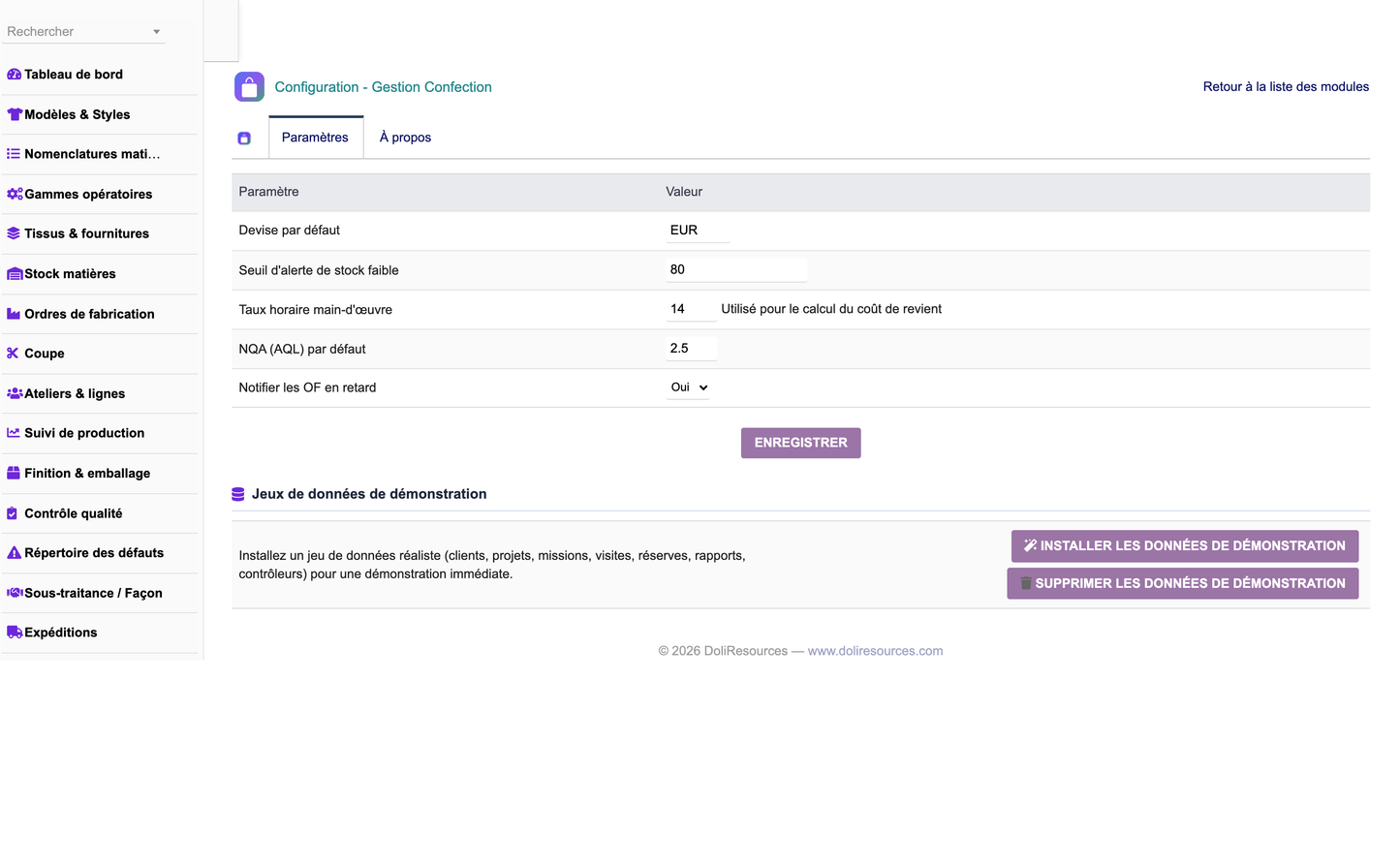
· Default currency used across the module.
· Material low-stock threshold driving the material alerts.
· Hourly labour rate used by the costing engine to value standard minutes.
· Default AQL applied to new quality controls.
· Late-order notification switch.
The configuration screen provides two one-click buttons, so the module can be demonstrated immediately and then reset to a clean state before going live.
· Load demo data — generates a realistic, fully FK-coherent dataset: customers, fabric suppliers and subcontractors (native third parties), models with their bills of materials and manufacturing routes, fabrics and trims, material stock, sewing lines, operators, production orders spread across every phase, cutting orders, daily production tracking, quality controls, subcontracting files, finishing records, shipments and costing sheets. Figures are drawn to be realistic (conformity around 94–98%, efficiency 75–96%, material yield 82–95%), so dashboards, charts and reports are immediately meaningful.
· Purge demo data — removes the complete dataset after confirmation, including the native third parties created by the generator, leaving the database clean.
The dataset is versioned: upgrading the module re-seeds an improved demonstration set automatically, while a production installation that has already been purged is never re-populated behind the user’s back.
· Standard Dolibarr architecture — module descriptor, dedicated SQL tables, permissions, menus, dashboard widget (box) and configuration page.
· Multi-entity aware — every table carries an entity column and all queries are filtered through getEntity().
· Schema self-healing — on activation the module compares each table with its SQL definition and adds any missing column, so upgrades never leave a table behind.
· Five complete languages — French, English, Spanish, Italian and German, with 341 translation keys each.
· Collision-proof labels — navigation keys are uniquely prefixed and the module re-asserts its own translations at render time, so its wording is never overwritten by another installed module.
· Modern list engine — per-column search filters, show/hide column selector, sorting, pagination and status badges on every list.
· Connected record cards — each card shows a KPI cockpit, its child lines and every related record, with pre-linked creation buttons.
· Language-independent enumerations — status and type codes are stored as neutral codes and translated at display time.
· PHP 8 compatible — all 64 PHP source files pass a syntax check, and no literal percent sign is routed through the translation layer.
· GNU GPL v3 licence, with DoliResources copyright headers in every file.
© 2026 DoliResources — www.doliresources.com


