
Discover powerful Dolibarr extensions designed to automate your business processes
Glass Manufacturing Management turns Dolibarr into a genuine glassworks ERP/MES. It covers the complete life cycle of a glass plant,...
Couldn't load pickup availability


Glass Manufacturing Management turns Dolibarr into a genuine glassworks ERP/MES. It covers the complete life cycle of a glass plant, from the vitrifiable batch recipe through to the product shipped on its rack: batching, melting, forming, annealing, secondary processing (tempering, lamination, insulating glazing, decoration) and standard-based quality control.
The module is designed so that a glassworks no longer needs any software outside Dolibarr: no batch spreadsheet, no paper furnace logbook, no separate breakage-tracking application.
|
Trade |
Coverage |
|
Flat glass / float |
Tin bath, ribbon, cutting, thicknesses, coatings |
|
Hollow glass / containers |
IS machines, gobs, moulds, rings, gob weight |
|
Processed glass / glaziery |
Tempering, PVB lamination, double and triple glazing, edgework |
|
Technical / borosilicate glass |
Laboratory ware, thermal shock resistance, ISO 719 |
|
Art glass / blown / crystal |
Pot furnaces, blowing irons, one-off pieces, lead crystal |
· 29 dedicated business objects, each with a searchable list, a column selector and a detail card.
· 32 granular permissions spread over 10 functional groups.
· 36 menu entries plus an in-page tab bar synchronised with the Dolibarr left menu.
· 16 situation reports, each exportable to CSV, Excel, Word and PDF.
· 635 translation keys in 5 languages, all module-prefixed to avoid cross-module collisions.
· A versioned demonstration dataset that can be installed and cleared from the setup page.
· Glass batch recipes: glass family (soda-lime, borosilicate, crystal, opal, technical), weight percentages of silica, soda, lime, alumina, magnesia and other oxides, density, expansion coefficient, refractive index, characteristic temperatures (melting, working, Littleton, annealing), target cullet rate, recipe versioning and validation status.
· Vitrifiable raw materials: silica sand, soda ash, limestone, dolomite, feldspar, sulphate, nitrate, borax, colouring and decolouring oxides. Each material carries its particle size, iron content in ppm, purity, moisture, bulk density, minimum stock, stock in tons, price per ton and lead time.
· Material lots and analyses: full traceability per lot, supplier certificate, chemical analysis (SiO2, Na2O, CaO, Al2O3, Fe2O3), receipt date, conformity flag and quality blocking.
· Cullet: internal or external origin, incorporation rate, sorting by tint, impurity rate and the associated energy saving.
· Furnace fleet: tank furnaces (regenerative and recuperative), electric furnaces and pot furnaces, with daily capacity, tank volume, burner count, refractory type, campaign start date, planned campaign length and refractory wear rate.
· Melting campaigns: nominal versus actual pull, crown, tank, throat and feeder temperatures, gas and electricity consumption, kWh per ton of glass, refining quality and bubbles per kilogram.
· Furnace alerts: temperature drift, end of refractory campaign, abnormal pull.
· Forming lines and machines: IS machine (sections, moulds, rate), float bath, drawing, pressing, blow-blow, press-blow, spinning and casting.
· Work orders across eight stages: batching, melting, forming, annealing, processing, inspection, packaging and shipping, with launched, good and scrapped quantities, planned and actual dates, progress and yield.
· Routings and operations: setup time, unit time, work centre, assigned operator, actual time and load variance.
· Forming records: rate, gob weight, gob temperature, scrap rate at the station, stops and micro-stops, and OEE.
· Moulds and tooling: rings, blank moulds, blow moulds and float moulds, with cycles performed, theoretical service life, wear rate and refurbishment due date.
· Workshop kanban by stage and an eight-week rolling load plan per line.
· Annealing (lehr): cooling curve, soak plateau, cooling rate, residual stress measured with a polariscope and conformity flag.
· Thermal and chemical tempering: surface stress in MPa, fragmentation test (fragment count), flatness and bow, conformity to EN 12150.
· Lamination: PVB, EVA or SGP interlayer, thickness, autoclave cycle (pressure, temperature, duration), optical quality, conformity to EN 14449.
· Insulating glazing: double or triple build-up, spacer (aluminium, warm-edge), fill gas (argon, krypton) and fill rate, Ug value, solar factor g, light transmission, acoustic reduction Rw and conformity to EN 1279.
· Edgework: flat ground, arrised, polished, drilled, notched and bevelled edges.
· Decoration: screen printing, enamelling, sand blasting, acid etching, lacquering, metallising and engraving, with colour count, decorating lehr and adhesion test.
· Standard-based inspections: internal stress, thickness, flatness, dimensions, thermal shock, mechanical strength and light transmission, referencing ISO 719, EN 12150, EN 1279, EN 14449, EN 1096 and EN 572.
· Glass defect catalogue: bubble, seed, stone, cord, string, devitrification, scratch, chip, geometrical and optical defects, each with criticality and zone.
· Non-conformities: opening, root-cause analysis, corrective action, cost of poor quality and recurrence tracking.
· Breakage and scrap: rate per station, per line and per cause, financial valuation and reinjection as internal cullet.
· Finished goods stock by reference, tint, thickness and format, with packaging type (pallet, rack, crate, box), warehouse location and minimum stock.
· Shipments: rack or crate, total weight, square metres, glass carrier, rack deposit and delivery note.
· Rack deposits are valued and tracked until the support is returned.
· Energy and CO2: gas, electricity and oxygen consumption per furnace and period, kWh per ton of glass, CO2 emissions and the energy saving attributable to cullet.
· Maintenance: preventive and corrective work, mould changes, refractory repairs, machine downtime, MTBF, MTTR and maintenance cost.
· Health and safety: incidents, burns, cuts, PPE, cut-resistant glove compliance and safety training.
· Glassworks staff and certifications: furnace operator, blower, hand glassmaker, IS setter, quality inspector and forklift driver.
· Certifications carry an expiry date with an automatic alert, and versatility is tracked per station.
· Business cases linked to native Dolibarr projects.
· Glass estimating: material cost per kg, transformation coefficient, forecast breakage rate, hours per stage, treatments, packaging and transport, producing a cost price, a margin and a selling price.
· Purchasing: native supplier links, supplier orders and goods receipts feeding the material lots.
The dashboard deliberately breaks with the classic Dolibarr layout and evokes glass and the glass furnace. Its palette is built on glass turquoise (#12A5BD), deep glass blue (#0D5B6B), bottle green (#1B6B4A), furnace amber (#E8952D), sand (#D9C8A9) and crystal (#F2F7F9).
· A molten-glass hero band in a turquoise-to-amber gradient, with a frosted-glass edge highlight evoking the cross-section of a pane, carrying four headline figures.
· Eight clickable alert tiles: furnace campaigns near end of life, blocked material lots, pending inspections, open non-conformities, moulds near end of life, certifications to renew, materials below minimum stock and late work orders.
· Four half-circle performance gauges: average OEE, conformity rate, cullet rate and furnace availability.
· Around thirty KPI cards in translucent glassmorphism styling, grouped into four zones and each linking to its filtered list.
· An eight-stage workshop kanban with per-stage counters and tonnage.
· Eight decision charts, all with HTML-decoded legends so accented labels render correctly.
|
# |
Chart |
Type |
|
1 |
Tonnage melted per month (12 months) |
Bars |
|
2 |
Breakdown by glass type |
Pie |
|
3 |
Breakage rate per forming line |
Bars |
|
4 |
Main glass defects |
Bars |
|
5 |
Energy consumption per month (kWh/t) |
Lines |
|
6 |
Revenue per month |
Bars |
|
7 |
Conforming versus non-conforming inspections |
Pie |
|
8 |
Forming line load |
Bars |
The Reporting menu offers sixteen situation reports. Every report can be exported to CSV, Excel and Word, printed to PDF, or sent to the browser print dialog. All exports carry real accented characters (no HTML entities).
|
# |
Report |
|
1 |
Production status per line |
|
2 |
Melting and pull report per furnace |
|
3 |
Glass yield and losses |
|
4 |
Breakage analysis by cause |
|
5 |
Non-conformities and cost of poor quality |
|
6 |
Quality inspections and standard conformity |
|
7 |
Raw material and cullet consumption |
|
8 |
Energy and CO2 report |
|
9 |
Raw material and finished goods stock |
|
10 |
Mould and tooling life cycle |
|
11 |
Furnace campaigns and refractories |
|
12 |
Annealing and tempering log |
|
13 |
Insulating glazing performance |
|
14 |
Shipments and rack deposits |
|
15 |
Staff certifications and expiries |
|
16 |
Profitability per business case |
|
Native module |
Integration |
|
Third parties |
Glass customers, raw material and cullet suppliers |
|
Proposals / quotations |
Linked to the glass estimate |
|
Sales orders |
Linked to business cases and work orders |
|
Customer and supplier invoices |
Glass revenue and material cost |
|
Supplier orders and receipts |
Feed the material lots |
|
Products and services |
Glass catalogue, prices, weights |
|
Stock and warehouses |
Raw materials, finished goods, cullet |
|
Shipments |
Racks and delivery notes |
|
Projects |
Glass business cases |
|
Users |
Furnace operators, blowers, inspectors |
|
ECM / document management |
Drawings, certificates, safety data sheets |
|
Agenda |
Maintenance and certification due dates |
The module ships 29 business objects, each with a full list, a detail card and a permission group.
|
# |
Object |
Purpose |
|
1 |
Business case |
Commercial and technical glass dossier |
|
2 |
Estimate |
Glass cost breakdown and selling price |
|
3 |
Batch recipe |
Glass composition and characteristic temperatures |
|
4 |
Raw material |
Vitrifiable material and its stock |
|
5 |
Material lot |
Receipt traceability and chemical analysis |
|
6 |
Cullet |
Internal and external cullet |
|
7 |
Furnace |
Glass furnace and its campaign |
|
8 |
Melting record |
Pull, temperatures and energy |
|
9 |
Glass product |
Catalogue reference |
|
10 |
Mould |
Tooling and cycle count |
|
11 |
Forming line |
Machine, rate and OEE |
|
12 |
Work order |
Eight-stage production order |
|
13 |
Routing |
Operation sequence per product |
|
14 |
Operation |
Routing step with planned and actual time |
|
15 |
Forming record |
Rate, gob weight and scrap |
|
16 |
Annealing |
Lehr curve and residual stress |
|
17 |
Tempering |
Surface stress and fragmentation |
|
18 |
Lamination |
Interlayer and autoclave cycle |
|
19 |
Insulating glazing |
Ug, solar factor and Rw |
|
20 |
Decoration |
Decor and edgework |
|
21 |
Inspection |
Standard-based quality control |
|
22 |
Defect |
Glass defect and non-conformity |
|
23 |
Breakage |
Breakage, scrap and valuation |
|
24 |
Maintenance |
Preventive and corrective work |
|
25 |
Stock |
Finished goods and packaging |
|
26 |
Shipment |
Racks, carrier and deposit |
|
27 |
Energy |
Consumption, kWh/t and CO2 |
|
28 |
Staff |
Glassworks staff and certifications |
|
29 |
Safety |
HSE events |
Rights are granted per functional group, with read, create/modify and delete actions. Read and write are granted by default so the module is usable immediately after activation; delete and administration are not.
|
Group |
Scope |
|
affaire |
Business cases and estimates |
|
composition |
Batch recipes, raw materials, lots and cullet |
|
fusion |
Furnaces, melting records and energy |
|
produit |
Glass products, moulds and routings |
|
production |
Forming lines, work orders and forming records |
|
transformation |
Annealing, tempering, lamination, glazing, decoration |
|
qualite |
Inspections, defects and breakage |
|
moyens |
Maintenance |
|
logistique |
Finished goods stock and shipments |
|
rh |
Glassworks staff and HSE |
|
reporting |
Access to the sixteen reports |
|
admin |
Module administration |
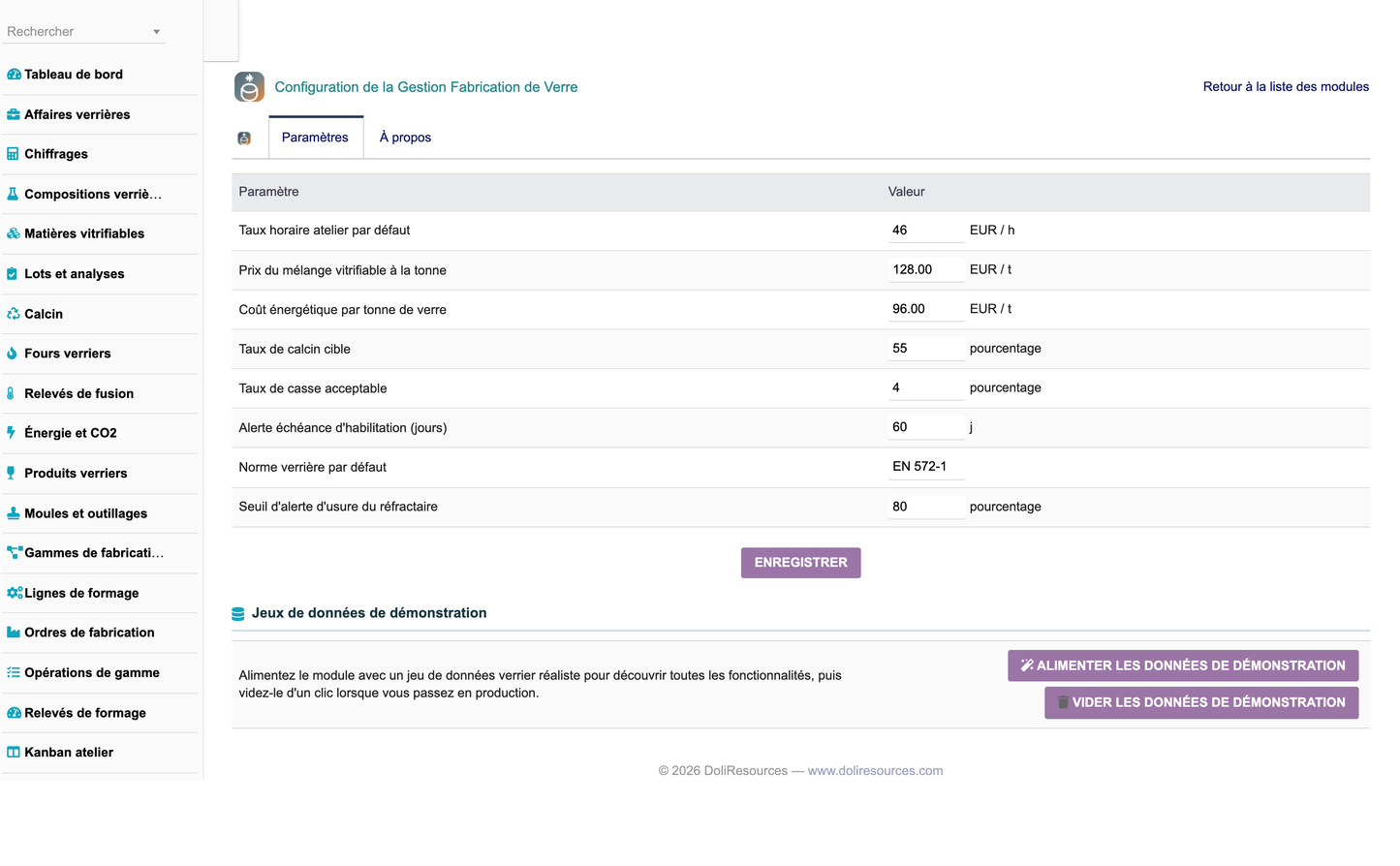
The module setup page carries two buttons that let an evaluator explore every feature with meaningful content and then return to a clean database before going live.
· "Install demonstration data" generates a complete, realistic and FK-coherent glassworks dataset: furnaces in campaign, twelve full months of melting and energy history, work orders spread across the eight stages, inspections that are around 95% conforming, a realistic breakage rate, native Dolibarr customers and suppliers, and a handful of certifications close to expiry so the alert tiles are meaningful.
· "Clear demonstration data" purges the whole dataset by import key, cascading to child records that a user may have created on a demo parent, and removes the native third parties and products the generator created.
· The dataset is versioned, so upgrading the module regenerates an improved dataset rather than silently keeping the old one.
The seeded data is validated against the exact aggregates the dashboard prints, not merely against row counts. For example the CO2 figure is derived from the melting records so that the plant ratio stays at a physically correct 0.52 tonne of CO2 per tonne of glass.
|
Parameter |
Default |
|
Default workshop hourly rate |
46 EUR/h |
|
Batch price per ton |
128.00 EUR/t |
|
Energy cost per ton of glass |
96.00 EUR/t |
|
Target cullet rate |
55 percent |
|
Acceptable breakage rate |
4 percent |
|
Certification expiry alert |
60 days |
|
Default glass standard |
EN 572-1 |
|
Refractory wear alert threshold |
80 percent |
· Full multilingual support in French, English, Italian, German and Spanish, with every key prefixed so that no label can be overwritten by another installed module.
· A ForceLabels helper re-asserts the module's own translations on every page, guaranteeing that the module wording always wins on its own screens.
· Automatic schema self-healing on upgrade: missing columns are added rather than silently absent.
· Font Awesome 5 icon set only, so no icon renders as an empty box.
· Searchable columns and a column show/hide selector on every list.
· An in-page tab bar that keeps the Dolibarr left menu in sync through both globals and session state.
· Module-unique menu positions and URLs so activation never collides with another installed module.
· GPL v3 licence.
© 2026 DoliResources — www.doliresources.com


