
Discover powerful Dolibarr extensions designed to automate your business processes
1. Product Overview
Hardware Store, Tools, DIY &...
Couldn't load pickup availability


1. Product Overview
Hardware Store, Tools, DIY & Industrial-Supplies Management (technical name: gestionquincaillerie) is a complete, native solution that turns Dolibarr into a professional business platform for hardware stores, tool shops, DIY stores, builders' merchants, industrial-supply distributors and multi-store hardware networks. It runs entirely under custom/gestionquincaillerie/ without modifying the Dolibarr core, is built on 34 dedicated business objects and 34 database tables, and ships in 5 languages (French, English, Spanish, Italian, German). It integrates natively with Third Parties (Societe) and Products, and complements Stocks, Orders, Invoices, Shipments, Projects, Contracts and Agenda.
2. Business Objectives
The module lets a hardware business manage its entire operation without any external trade software: multi-banner and multi-region organisation, store and warehouse management, aisle/department merchandising (fasteners, plumbing, electrical, tools, paint, hardware, gardening, PPE), product catalogue with technical attributes, manufacturer and supplier references, central purchasing, commercial and rental contracts, tenders, procurement, demand forecasting, replenishment, goods receiving, multi-warehouse stock, inventories, professional tiered pricing, promotions, coupons, loyalty, a 360° customer view for both trade and retail customers, sales and tickets, POS registers, counter pickup and click & collect, site delivery and routes, lots and serial numbers, warranty tracking, after-sales service and repairs, tool rental, product recalls and safety, shrinkage and losses, returns, logistics and transport, staff, a modern dashboard and decision-oriented reporting.
3. Target Users
· Retail and professional hardware stores (quincailleries de détail et professionnelles)
· DIY and home-improvement stores (magasins de bricolage)
· Tool shops and power-tool retailers
· Builders' merchants and construction-supply outlets
· Wholesalers and distributors of industrial supplies
· Plumbing, electrical, paint, locksmithing, fastening and PPE specialists
· Buying groups (central purchasing) and multi-branch / multi-warehouse networks
· B2B and B2C resellers, and online hardware shops
4. Main Features
· Modern hardware-store control-tower dashboard with 22 KPIs and 4 analytical charts
· Enriched technical product catalogue with families, brands, manufacturer and supplier references, units, packaging and warranty
· Multi-warehouse stock, locations, replenishment, forecasting, inventories and valuation
· Full procurement workflow: suppliers, contracts, tenders, purchase orders, receipts
· Sales, POS registers, counter pickup, click & collect, site delivery and routes
· Professional & retail customers, loyalty, promotions, coupons and tiered pricing
· Lots and serial numbers, warranty tracking, after-sales service and tool rental
· Decision-oriented reporting with CSV export, plus a secured REST-ready object model
5. Product Catalogue
The catalogue is organised by hardware family — fasteners & bolts, fixings & anchors, plumbing, sanitary & heating, electrical, hand tools, power tools, paint & chemicals, building hardware, locksmithing, gardening & power equipment, and safety & PPE. Each article carries an internal reference, manufacturer and supplier references, EAN barcode, aisle reference, brand and brand type, material/finish, packaging, unit, buy/sell price, margin rate, VAT rate, origin/maker and warranty duration.
6. Units, Packaging & Assortments
Articles are sold and stocked in the units the hardware trade actually uses — piece, box, carton, pallet, roll, bag, pack, metre, square metre, kilogram, litre, pair, set and kit. Ranges and assortments group articles by family, season and store format so each outlet carries the right selection.
7. Supplier & Manufacturer Management
Suppliers are typed as wholesaler, manufacturer, importer, distributor or local supplier, with supplied categories, lead time, minimum order, franco threshold, service rate, certifications and a dedicated buyer. A supplier-performance view surfaces service level, lead time and franco to support sourcing decisions.
8. Procurement & Receiving
The purchasing workflow covers demand, tenders, supplier comparison, purchase orders, transport, receiving, quality control and stock put-away, with partial receipts and conformity tracking. Receipts record expected vs received quantities, dock, conformity and status.
9. Stock, Locations & Inventories
Stock is managed across multiple warehouses and stores with available, reserved and alert quantities, physical locations, rotation and coverage. Replenishment computes minimum/maximum, safety stock, reorder point and suggested quantities. Inventories support rolling, general, department and lot counts with theoretical vs counted value and gap analysis.
10. Sales, POS & Delivery
Sales are recorded per store, register and channel (counter, pickup, site delivery, online, wholesale/B2B) with items, totals, margin and payment method. POS register sessions track opening float, sales, cash, tickets and variance. Counter pickup, click & collect, site delivery and delivery routes complete the fulfilment chain.
11. Professional Customers & Job Sites
The 360° customer view covers both trade accounts (artisans, construction firms, local authorities) and retail customers, with segment, favourite store and department, visit count, total spent, average basket and churn risk. Loyalty accounts track tier, points earned/spent and balance. Contracts can be commercial or rental agreements linked to a supplier or customer.
12. Warranty, After-Sales & Rental
Lots and serial numbers carry warranty end dates, so warranties expiring soon and expired warranties are surfaced on the dashboard. After-sales dossiers cover repair, exchange, manufacturer warranty, diagnostic and refund cases, with resolution status and technician. Tool-rental and maintenance are managed through the contract object with start/end dates and amounts.
13. Promotions, Coupons & Loyalty
Promotions run by period, product, department, store and channel with budget, supplier funding, revenue and margin. Coupons support percentage, amount, free-product and free-delivery types with usage limits. Loyalty tiers (bronze, silver, gold, platinum) reward both trade and retail customers.
14. Recalls, Shrinkage & Returns
Product recalls track cause, severity, affected lots and stores for safety-critical items (electrical defects, missing safety notices, CE non-conformity, battery overheating). Shrinkage captures loss, breakage, theft, destruction, donation and obsolescence. Returns cover refund, exchange, credit and warranty with reason and status.
15. Reporting & Business Intelligence
Eight decision-oriented reports cover sales, top products, customers, stock, suppliers, shrinkage, promotions and finance, each exportable to CSV and printable. The dashboard adds sales evolution, sales by department, top products and payment-method breakdown charts.
16. Security & Permissions
The module ships eleven fine-grained permission groups (network, catalogue, suppliers, purchasing, stock, pricing, customers, sales, quality/after-sales, logistics, reporting) with read/write/delete rights. All pages check permissions, escape output, validate input and use the multi-entity model, so the module is MultiCompany-ready.
17. Demo Data
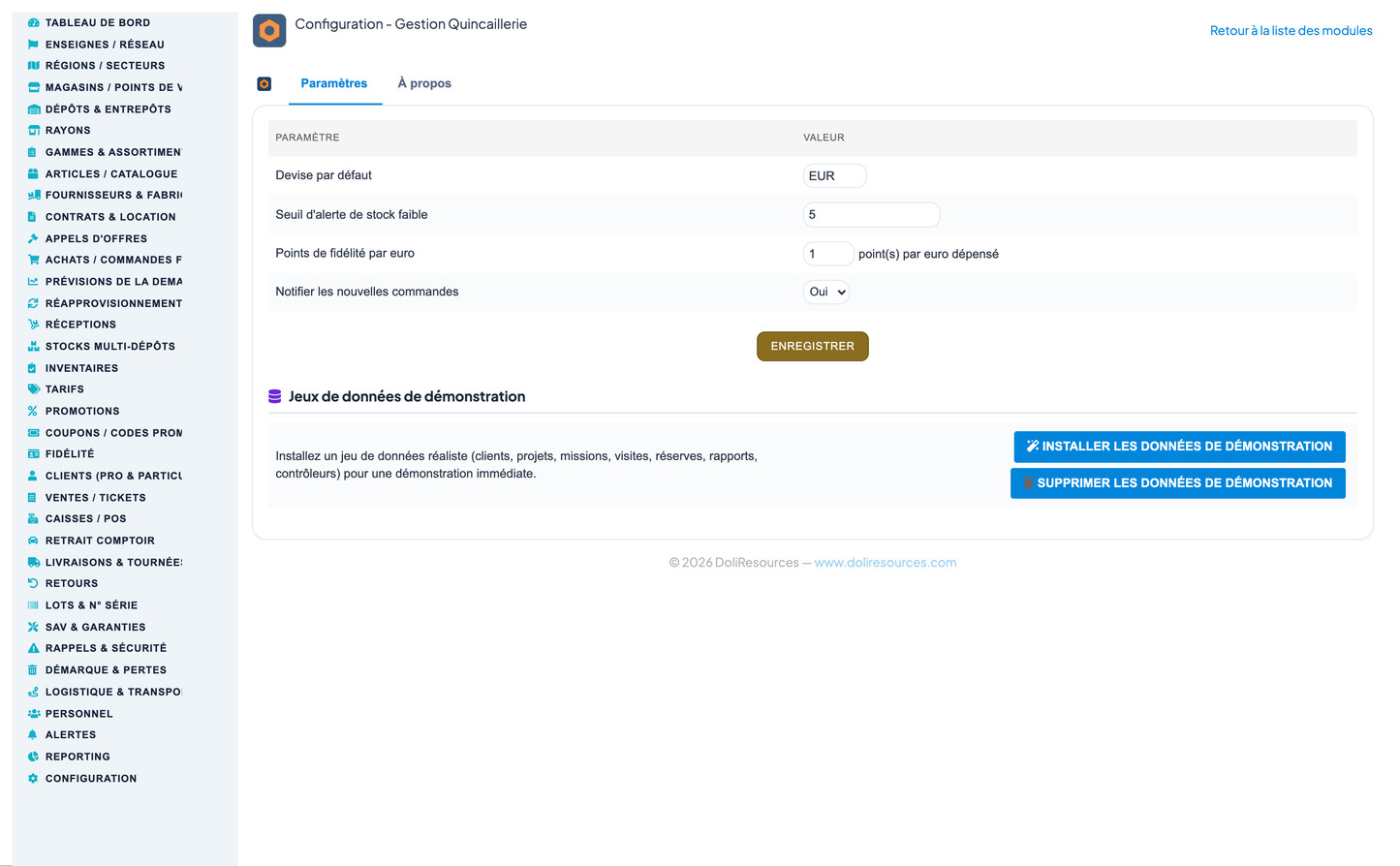
A one-click demonstration dataset creates a realistic, FK-coherent hardware business (banner, regions, 4 stores, 2 warehouses, 48 departments, 45 articles, 10 suppliers, purchases, receipts, 45 stock lines, 476 sales tickets over 12 months, loyalty, promotions, lots, after-sales dossiers, recalls, staff and alerts). All demo rows are tagged and can be removed safely without touching real data.
18. Technical Architecture & Database
The module follows Dolibarr standards: a descriptor (module number 864000), 34 CommonObject classes, 34 llx_gqc_* tables with entity, indexes, author, dates, status and import key, generic list/card engines, a shared helper library, five language files, a schema self-heal routine, an admin setup page and a KPI box. It depends only on modSociete and modProduct and requires PHP 7.1+ and Dolibarr 16+.
19. Installation & Configuration
Install the module_gestionquincaillerie-1.0.zip archive from Home > Setup > Modules, activate the module, review permissions, then optionally load the demonstration dataset from the module setup page. Tables, menus, permissions and demo data are created automatically on activation.
20. Copyright Information
Gestion Quincaillerie is published by DoliResources (www.doliresources.com). Copyright © 2026 DoliResources. All rights reserved. Distributed under the GNU GPL v3 licence, consistent with the Dolibarr ERP/CRM ecosystem.


