
Discover powerful Dolibarr extensions designed to automate your business processes
HR Performance Evaluation Management (technical name gestionevaluationsrh) is a comprehensive Human Resources suite that extends Dolibarr ERP with a full talent-management, performance-evaluation and career-development...
Couldn't load pickup availability


HR Performance Evaluation Management (technical name gestionevaluationsrh) is a comprehensive Human Resources suite that extends Dolibarr ERP with a full talent-management, performance-evaluation and career-development platform. It transforms Dolibarr into a modern HR information system while remaining a well-behaved add-on: it installs under htdocs/custom/, uses its own llx_gerh_* database tables, and never modifies Dolibarr core files.
The module covers the complete employee lifecycle — from referential setup (job families, departments, positions, skills) through recruitment and onboarding, into recurring performance evaluations, 360-degree feedback, goal setting, competency and potential assessment, calibration and 9-Box talent review, and finally career planning, succession, mobility, training and development actions. All of this activity feeds a real-time analytics layer branded the "Performance & Growth Compass".
|
Attribute |
Value |
|
Commercial name |
DoliResources – HR Performance Evaluation Management |
|
French commercial name |
DoliResources – Gestion des Évaluations RH |
|
Technical name |
gestionevaluationsrh |
|
Version |
1.0.0 |
|
Module family |
Human Resources (hr) |
|
Module numero |
924000 |
|
Descriptor class |
modGestionEvaluationsRh |
|
Rights class |
gestionevaluationsrh |
|
Table prefix |
llx_gerh_* |
|
Function / object prefix |
gerh |
|
Publisher / Author |
DoliResources |
|
Website |
https://www.doliresources.com |
|
License |
GNU GPL v3 or later |
|
Dolibarr compatibility |
16 → 23 |
|
PHP compatibility |
7.1 → 8.x |
|
Dependencies |
Société (Third parties), User |
|
Business objects / tables |
35 |
|
Permissions (rights) |
26 |
|
Languages |
French, English, Spanish, Italian, German (719 keys each) |
· 35 business objects — a single coherent HR data model, from job families to AI recommendations.
· Performance & Growth Compass — one global HR evaluation index plus eight axis indices.
· 9-Box talent review — an interactive Performance × Potential matrix built into the dashboard.
· Nine-report reporting suite — CSV and Excel exports for every strategic HR dimension.
· Full REST API — rights-guarded endpoints under /api/index.php/gestionevaluationsrh/.
· Multilingual — five languages shipped, 719 translation keys each.
· Purgeable demo data — one click to populate, one click to remove, guarded by a constant.
The module is designed to help HR departments and line managers move from scattered spreadsheets to a single, auditable and data-driven talent process. Its business objectives are:
· Centralize the employee record — one place for skills, certifications, objectives, evaluations, feedback and career history.
· Standardize evaluation cycles — reusable templates and campaigns so every employee is assessed on a consistent, fair basis.
· Make performance measurable — quantified scores, weighted evaluation lines, goal progress tracking and axis indices.
· Identify and grow talent — potential assessment, 9-Box calibration, succession planning and individual development plans.
· Reduce turnover risk — engagement tracking, talent-risk records and proactive HR alerts.
· Give leadership real dashboards — an executive HR cockpit with ~30 KPI cards and 12-month trends.
· Support decisions with data — nine exportable reports and an AI-recommendation object for guided next-best actions.
The module serves every actor in the HR value chain, with rights-based access ensuring each role sees only what it needs.
|
Persona |
Primary use of the module |
|
HR Director / CHRO |
Reads the Performance & Growth Compass, monitors global and axis indices, drives calibration and succession strategy. |
|
HR Business Partner |
Manages campaigns, evaluation templates, talent reviews and action plans for a business unit. |
|
Recruiter / Talent Acquisition |
Handles candidates, applications, recruitment pipelines and onboarding. |
|
Line / People Manager |
Runs manager assessments, sets objectives, conducts interviews and provides feedback for their team. |
|
Learning & Development Officer |
Manages training catalogs, sessions, registrations, coaching and mentoring. |
|
Employee |
Completes self-assessments, tracks personal objectives and development plans. |
|
Executive / Analyst |
Consumes dashboards and reports (read/reporting rights) without editing HR records. |
Evaluation campaigns organize appraisal activity into time-boxed, population-scoped cycles. Rather than creating evaluations one by one, HR launches a campaign that targets a population (a department, a job family, or the whole company) over a defined period and evaluation type.
· The evaluation type (annual review, mid-year, probation, project, 360-degree).
· The reference period (date range) and due dates that drive HR alerts.
· The target population, resolved through departments, job families and positions.
· The evaluation template applied to every participant for comparability.
· The workflow status of each generated evaluation, from draft to validated.
Each evaluation created within a campaign is a first-class gerhevaluation object carrying its own eval_type, eval_date, status and scores, while its detail lines (gerhevaluationline) hold the per-criterion ratings. Campaign progress is surfaced on the dashboard so HR can see completion rates at a glance and act on overdue items through the alert system.
Templates define the structure of an evaluation so that appraisals are consistent and comparable across a population. A template is a set of weighted criteria that becomes the evaluation lines (gerhevaluation_line) when the evaluation is generated.
· Criteria — each measurable item (a competency, an objective area, a value/behavior).
· Rating scale — a numeric scale per criterion, aggregated into an overall evaluation score.
· Weights — relative importance of each line, so critical criteria drive the final result.
· Grouping — criteria organized by axis (performance, skills, behaviors) for readable results.
· Reusability — one template drives an entire campaign, guaranteeing a level playing field.
Because evaluation lines are stored in their own table, the module can report at criterion level — for example, average score per competency across a department — not just on the headline evaluation score.
Self-assessment lets employees rate their own performance and competencies before or alongside the manager's review, encouraging ownership and richer appraisal conversations.
· Employees score the same criteria the manager will use, producing a self vs. manager comparison.
· Self-assessment feeds the employee's competency profile (gerhemployeeskill) and objective progress.
· Personal objectives can be updated by the employee, including a progress percentage, via the API.
· Results become inputs to the interview and to the individual development plan (IDP).
Self-assessment is captured as an evaluation of the appropriate type, so it flows through the same scoring, reporting and dashboard machinery as any other appraisal.
The manager assessment is the core appraisal performed by the employee's line manager. It applies the campaign template, scores each evaluation line, and produces an overall performance result that flows into the performance axis index and the 9-Box matrix.
· Prepare — review the employee's objectives, prior evaluations, self-assessment and skills.
· Rate — score each evaluation line; weighted aggregation yields the overall score.
· Comment — add qualitative feedback per criterion and a summary appraisal.
· Decide — recommend training, promotion, mobility or a development action.
· Validate — move the evaluation through its status workflow to a validated, auditable record.
Manager assessments are the primary source for the performance dimension of the Performance & Growth Compass and for identifying top performers.
360-degree feedback broadens appraisal beyond the manager by collecting input from peers, direct reports, internal customers and other stakeholders. Feedback is stored as gerhfeedback records linked to the employee.
· Multi-source input: manager, peers, subordinates and cross-functional colleagues.
· Structured around the same competency framework for a consolidated 360 profile.
· Feeds the engagement and leadership axis indices on the dashboard.
· Supports anonymized aggregation so individual raters are protected while trends surface.
· Complements manager and self-assessment for a rounded, bias-reduced view.
The interview object (gerhinterview) manages the structured conversations that punctuate the HR year: annual reviews, professional interviews, career discussions and check-ins. Interviews are exposed through the REST API (GET interviews) and are schedulable with an interview_date.
|
Field / concept |
Purpose |
|
Interview type |
Annual, professional, career, onboarding or ad-hoc check-in. |
|
Interview date |
Scheduling anchor; overdue interviews raise HR alerts. |
|
Participants |
Employee and manager (and optionally HR), linked to Dolibarr users. |
|
Notes & outcomes |
Discussion summary, agreed actions and follow-up items. |
|
Linkage |
Connected to evaluations, objectives and development plans. |
Interviews close the loop between measurement (evaluations) and action (development plans, objectives), giving the appraisal process a documented, auditable trail.
Objectives (gerhobjective) implement goal management following SMART and OKR principles. Each objective belongs to an employee, has a due date and a progress percentage, and can be updated over the year — including programmatically through the API (PUT objectives/{id}).
· SMART framing — specific, measurable, achievable, relevant and time-bound objectives with due dates.
· OKR alignment — objectives can be cascaded from company to team to individual, with measurable key results.
· Progress tracking — a live percentage per objective, editable by the employee or manager.
· Evaluation linkage — goal attainment contributes to the performance evaluation and score.
· API access — GET objectives and PUT objectives/{id} let integrations read and update progress.
Competency management is built on a reusable skills referential (gerhskill) and per-employee skill records (gerhemployeeskill). Together they produce a living competency matrix that can be assessed, gap-analyzed and used to drive training.
· Skill catalog — a shared referential of skills, grouped and reusable across the organization.
· Employee skill profile — each employee holds rated skills with current and target levels.
· Certifications — certification references (gerhcertificationref) and awarded certifications (gerhcertification) track formal qualifications and expiry.
· Gap analysis — compare current vs. required levels for a position to reveal development needs.
· Training trigger — skill gaps feed training catalogs, sessions and registrations.
The skills axis of the Performance & Growth Compass is computed from this data, giving leadership a portfolio view of organizational capability.
Potential assessment (gerhpotential) evaluates an employee's capacity to grow into larger or different roles, independent of current performance. It is the vertical axis of the 9-Box matrix.
· Rates growth potential, learning agility and readiness for advancement.
· Combined with performance to place employees on the 9-Box talent grid.
· Feeds succession planning by highlighting high-potential (HiPo) talent.
· Informs the potential axis index and the talent-risk analysis.
Calibration is the process of comparing evaluation results across managers and teams to remove rating bias and ensure fairness before appraisals are finalized. The module supports calibration through its criterion-level data and the 9-Box talent review.
· Side-by-side comparison of scores across a population using evaluation lines.
· Distribution views that reveal leniency or severity by manager or department.
· The 9-Box matrix as the calibration canvas for performance vs. potential.
· Adjustments recorded on evaluations so the final, validated record is defensible.
The talent review is centered on the interactive Performance × Potential 9-Box matrix embedded in the dashboard. Each cell classifies employees by combining their performance evaluation with their potential assessment.
|
9-Box zone |
Typical population & recommended action |
|
High performance / High potential |
Future leaders — accelerate, stretch assignments, succession. |
|
High performance / Moderate potential |
Key players — retain, reward, deepen expertise. |
|
Moderate performance / High potential |
Growth talent — coaching, mentoring, development plans. |
|
Moderate / Moderate |
Core contributors — steady development and engagement. |
|
Low performance / Any potential |
Improvement focus — targeted action plans and support. |
The talent review connects directly to succession (gerhsuccession / gerhsuccessor), career plans (gerhcareerplan) and mobility (gerhmobility), so decisions made on the grid translate into concrete records.
Action plans turn evaluation outcomes into tracked commitments. They are surfaced through the API (GET actionplans) and are built from several object types working together.
· Individual Development Plans (gerhidp) — structured growth roadmaps per employee with due dates.
· Coaching & mentoring (gerhcoaching, gerhmentoring) — relationships that support development goals.
· Training registrations (gerhtraining_reg) — enrollment in sessions from the training catalog.
· Tasks (gerhtask) — granular follow-up items with owners and deadlines.
· Alerts (gerhalert) — automatic reminders for overdue evaluations, interviews and actions.
Because every action carries a due date, the dashboard and alert widgets can flag what is overdue and what is coming up, keeping development on track.
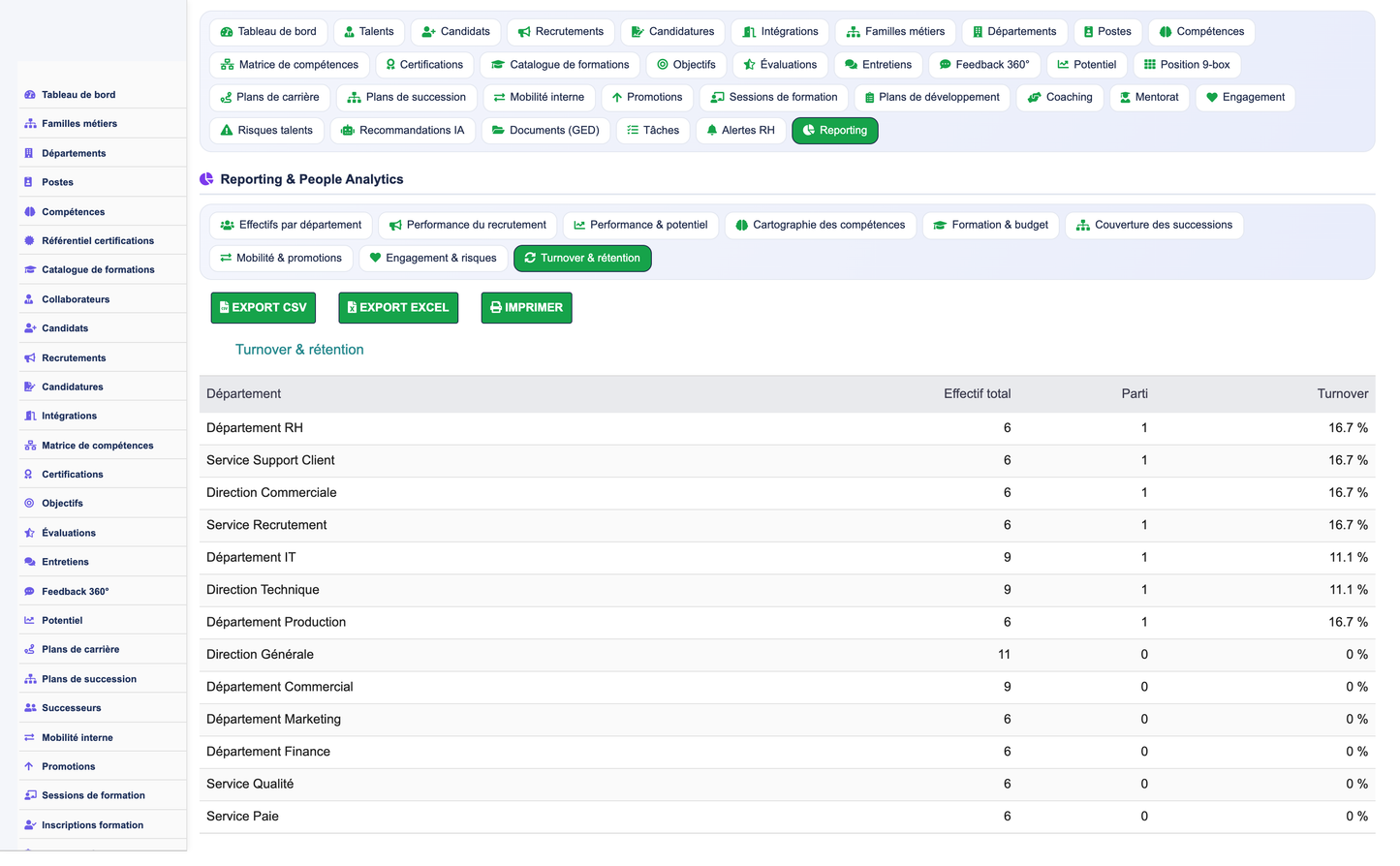
The reporting suite (reporting.php) delivers nine strategic HR reports, each exportable to CSV and Excel for offline analysis and board reporting.
|
Report |
Focus |
|
Headcount |
Workforce structure by department, job family and position. |
|
Recruitment |
Pipeline volume, stages and conversion from candidate to hire. |
|
Performance |
Evaluation scores and distribution across the organization. |
|
Skills |
Competency coverage, gaps and certification status. |
|
Training |
Sessions, registrations, attendance and completion. |
|
Succession |
Bench strength and readiness for key positions. |
|
Mobility |
Internal moves, promotions and transfers. |
|
Engagement |
Engagement scores and trends by population. |
|
Turnover |
Attrition and retention indicators. |
All exports pass through HTML-entity decoding so accented characters render correctly in the output files, and every report reflects the same underlying llx_gerh_* data as the dashboards.
The dashboard (dashboard.php), branded the "Performance & Growth Compass", is the executive cockpit of the module. It aggregates the entire HR data model into a single, real-time strategic view.
· Global HR evaluation index — one headline score summarizing organizational HR health.
· Eight axis indices — performance, engagement, potential, skills, training, leadership, mobility and succession.
· ~30 KPI cards — headcount, open positions, evaluation completion, average scores, engagement, attrition and more.
· 12-month trend charts — time series that reveal direction, not just a snapshot.
· Performance × Potential 9-Box matrix — interactive talent grid for calibration and review.
· Top performers — highest-rated employees surfaced for recognition and retention.
· Recommendations widget — AI-assisted next-best actions (gerhairecommendation).
· To-do / alert widgets — overdue evaluations, interviews and action items in one place.
The dashboard reads live KPIs through the same aggregation logic exposed by the API endpoint GET dashboard/kpis, ensuring the screen and integrations agree.
The module is a native Dolibarr add-on. It declares hard dependencies on two core modules and reuses Dolibarr's platform services rather than reinventing them.
|
Dolibarr module / service |
How it is used |
|
Société (Third parties) |
Required dependency; provides the organizational and company context. |
|
User |
Required dependency; Dolibarr users author, own and are linked to HR records. |
|
Rights & permissions |
The module registers 26 rights in Dolibarr's standard permission system. |
|
Menus |
Left-menu and top-menu entries integrated via the module descriptor. |
|
REST API framework |
Endpoints served through Dolibarr's /api/index.php with DOLAPIKEY auth. |
|
Translations |
Uses Dolibarr's langs mechanism, shipping five language files. |
|
Numbering & objects |
Objects extend Dolibarr's CommonObject with standard columns. |
Installed under htdocs/custom/, the module never modifies Dolibarr core files, so it remains upgrade-safe across Dolibarr 16 through 23.
Security is enforced at every layer using Dolibarr's native mechanisms plus module-specific guards.
· Granular permissions — 26 rights across nine functional groups gate every page and API call.
· Rights-guarded API — each endpoint checks the caller's rights via a guard() helper; unauthorized access is rejected.
· Authenticated API — requests require a valid DOLAPIKEY; a bogus key returns HTTP 401.
· Entity isolation — records carry an entity column, respecting Dolibarr multi-company boundaries.
· Audit columns — every table records date_creation, tms, fk_user_creat and fk_user_modif.
· Safe sorting — list queries validate sort fields against a whitelist to prevent injection.
· Non-invasive install — custom module only; no core files are touched.
The module ships a complete REST API under the base path /api/index.php/gestionevaluationsrh/. Endpoints are authenticated with DOLAPIKEY and guarded by the same rights as the UI; an invalid key returns 401 and insufficient rights are rejected.
|
Method & path |
Description |
|
GET evaluations |
List evaluations, filterable by type and status, paginated and sortable. |
|
GET evaluations/{id} |
Retrieve one evaluation together with its detail lines. |
|
GET objectives |
List objectives, filterable by employee and status. |
|
PUT objectives/{id} |
Update an objective, including its progress percentage. |
|
GET interviews |
List interviews, filterable by interview type. |
|
GET employees |
List employees in the HR data model. |
|
GET actionplans |
List action-plan items with due dates and status. |
|
GET notifications |
List HR notifications / alerts. |
|
GET dashboard/kpis |
Return the aggregated KPI set powering the dashboard. |
Requests pass the API key in the DOLAPIKEY header, for example:
GET /api/index.php/gestionevaluationsrh/evaluations?limit=50&status=validated
DOLAPIKEY: <your-api-key>
All list endpoints support sortfield, sortorder, limit and page parameters for stable, paginated integration.
The module includes an installable and safely purgeable demo dataset so that every dashboard, chart and report is fully populated out of the box for evaluation, training and demonstrations.
· Complete coverage — demo records span all 35 tables, so no screen appears empty.
· Tagged records — every demo row carries the import_key GERHDEMO for precise identification.
· Guarded purge — a guard constant protects the purge routine, and only GERHDEMO-tagged rows are removed.
· Idempotent — demo data can be installed and removed cleanly without affecting real records.
· Realistic — populations, scores and 12-month histories are seeded so trends and indices are meaningful.
The module follows standard Dolibarr add-on architecture. Each business object extends CommonObject, has a dedicated class in class/, a card and list page, an SQL definition in sql/, and is registered in the descriptor core/modules/modGestionEvaluationsRh.class.php.
|
Path |
Contents |
|
core/modules/modGestionEvaluationsRh.class.php |
Module descriptor: identity, rights, menus, dependencies, triggers. |
|
class/ |
35 business-object classes plus the API class. |
|
class/api_gestionevaluationsrh.class.php |
REST API controller with rights guards. |
|
sql/ |
llx_gerh_*.sql table definitions and .key.sql index/constraint files. |
|
langs/ |
Five language folders (fr_FR, en_US, es_ES, it_IT, de_DE). |
|
dashboard.php |
The Performance & Growth Compass cockpit. |
|
reporting.php |
Nine-report reporting suite with CSV/Excel export. |
|
*_card.php / *_list.php |
Detail and list UI pages for each object. |
|
css/ · js/ · img/ · lib/ |
Presentation assets and helper libraries. |
|
admin/ |
Module setup and configuration pages. |
Every one of the 35 tables carries the standard Dolibarr column set for consistency and auditability:
· rowid, entity, ref, status
· date_creation, tms (modification timestamp)
· fk_user_creat, fk_user_modif
· import_key (used by the demo-data mechanism), note
|
Table |
Object |
Table |
Object |
|
llx_gerh_jobfamily |
Job family referential |
llx_gerh_department |
Organizational department |
|
llx_gerh_position |
Job position / role |
llx_gerh_skill |
Skill referential |
|
llx_gerh_certificationref |
Certification reference |
llx_gerh_trainingcat |
Training catalog / category |
|
llx_gerh_employee |
Employee master record |
llx_gerh_candidate |
Recruitment candidate |
|
llx_gerh_recruitment |
Recruitment / requisition |
llx_gerh_application |
Job application |
|
llx_gerh_onboarding |
Onboarding process |
llx_gerh_employeeskill |
Employee skill profile |
|
llx_gerh_certification |
Awarded certification |
llx_gerh_objective |
SMART/OKR objective |
|
llx_gerh_evaluation |
Performance evaluation |
llx_gerh_evaluation_line |
Evaluation criterion line |
|
llx_gerh_interview |
HR interview |
llx_gerh_feedback |
360-degree feedback |
|
llx_gerh_potential |
Potential assessment |
llx_gerh_careerplan |
Career plan |
|
llx_gerh_succession |
Succession plan |
llx_gerh_successor |
Succession candidate |
|
llx_gerh_mobility |
Internal mobility move |
llx_gerh_promotion |
Promotion record |
|
llx_gerh_trainingsession |
Training session |
llx_gerh_training_reg |
Training registration |
|
llx_gerh_idp |
Individual development plan |
llx_gerh_coaching |
Coaching relationship |
|
llx_gerh_mentoring |
Mentoring relationship |
llx_gerh_engagement |
Engagement measurement |
|
llx_gerh_talentrisk |
Talent-risk record |
llx_gerh_airecommendation |
AI recommendation |
|
llx_gerh_document |
HR document |
llx_gerh_task |
Follow-up task |
|
llx_gerh_alert |
HR alert / notification |
|
|
The module registers 26 permissions in Dolibarr's standard six-column rights system, organized into nine functional groups. Read and write are granted by default for the operational groups; reporting is read-only.
|
Permission group |
Actions |
Purpose |
|
Referential |
read / write / delete |
Job families, departments, positions, skills, catalogs. |
|
Talent |
read / write / delete |
Employee master records and talent data. |
|
Recruitment |
read / write / delete |
Candidates, applications, recruitment, onboarding. |
|
Skills |
read / write / delete |
Competencies, employee skills, certifications. |
|
Performance |
read / write / delete |
Evaluations, evaluation lines, feedback, interviews. |
|
Career |
read / write / delete |
Career plans, succession, mobility, promotion. |
|
Development |
read / write / delete |
Training, IDP, coaching, mentoring. |
|
Analytics |
read / write / delete |
Engagement, talent risk, AI recommendations. |
|
Reporting |
read |
Access to the reporting suite and exports. |
|
Admin |
administer |
Module configuration and demo-data management. |
Each of the eight operational groups (referential, talent, recruitment, skills, performance, career, development, analytics) exposes read, write and delete rights — 24 rights — plus reporting (read) and admin, for 26 in total. Read and write are enabled by default on install so the module is immediately usable, while delete and reporting can be assigned per role.
The module installs like any Dolibarr custom module and requires no core modification.
· A working Dolibarr installation, version 16 to 23.
· PHP 7.1 to 8.x.
· The Société (Third parties) and User modules enabled.
1. Copy the gestionevaluationsrh folder into htdocs/custom/ (or deploy the module ZIP from Home ▸ Setup ▸ Modules ▸ Deploy).
2. Go to Home ▸ Setup ▸ Modules/Applications and locate "HR Performance Evaluation Management" under the Human Resources family.
3. Click the on/off toggle to activate the module; the 35 llx_gerh_* tables are created automatically.
4. Open the module setup page (admin/) to configure options and, optionally, install the demo data.
5. Assign the appropriate permissions to your HR users and managers under Users & Groups ▸ Permissions.
6. Optionally generate a DOLAPIKEY for any user that will consume the REST API.
To remove demo data later, use the guarded purge action; only rows tagged with import_key GERHDEMO are deleted, leaving real records intact.


