
Discover powerful Dolibarr extensions designed to automate your business processes
Industrial Sheet Metal Management turns Dolibarr into a complete ERP/MES for sheet metal shops, boilermakers and welded-assembly manufacturers. It covers the entire value...
Couldn't load pickup availability


Industrial Sheet Metal Management turns Dolibarr into a complete ERP/MES for sheet metal shops, boilermakers and welded-assembly manufacturers. It covers the entire value chain — from the customer enquiry through to the real cost price and margin of the finished job — so the company runs its whole operation inside Dolibarr, with no external MES, no spreadsheet costing tool and no separate production-planning software.
|
Item |
Value |
|
Publisher |
DoliResources — www.doliresources.com |
|
Version / module number |
1.0.0 / 531800 |
|
Licence |
GNU GPL v3 or later, © 2026 DoliResources |
|
Requirements |
Dolibarr 16.0 or higher, PHP 7.1 or higher |
|
Dependencies |
Native Third Parties (Societe) and Products modules |
|
Business objects |
22 |
|
Permissions |
26 granular rights across 8 functional groups |
|
Menu entries |
26 |
|
Interface languages |
French, English, Italian, German, Spanish |
|
Database tables |
22 tables, prefix llx_tli_ |
|
Reports |
10, each exportable to CSV, Excel, Word and PDF |
|
Demonstration data |
Loadable and clearable in one click from the setup page |
· Costing is typically done in spreadsheets that never feed back into the actual result, so nobody knows which jobs really made money.
· Material yield — the single most sensitive profitability driver in sheet metal — is invisible without nesting utilisation and scrap-rate tracking.
· Mill certificates (EN 10204 3.1), heat numbers and lot traceability are contractual obligations that are usually managed on paper.
· Shop-floor times, machine load and non-conformity costs are rarely captured, so quotations keep repeating the same estimating errors.
Enquiry → technical costing → quotation → sales order → manufacturing dossier → material procurement → nesting → work order → cutting → bending → welding → surface finishing → quality control → delivery → invoicing → real cost and margin.
The module is organised into eight functional areas, implemented by 22 business objects. Each object has its own list, card, search filters, column selector and permission set.
Parametric costing computes the selling price from the part's material, routing and machine times. The price is broken down into material, scrap, machine time, labour, surface finishing, subcontracting and set-up, then a margin rate is applied. Because set-up time is amortised over the batch, the quantity requested naturally produces a degressive unit price. Revision indices preserve the pricing history per customer, and an accepted costing becomes a native Dolibarr quotation.
Sheet metal parts carry their drawing index, material, flat and finished dimensions, unit weight, flat and painted surfaces, number of bends and holes, cut length, weld length, K-factor and bend radius. Multi-level bills of material cover fasteners, rivet nuts, seals and hardware. Routings chain the operations — cutting, deburring, bending, welding, grinding, inspection, packing — each with its work centre, set-up time, unit time, hourly rate and computed cost.
The material catalogue covers steel, stainless steel, aluminium, galvanised steel, copper and brass, with thicknesses, standard formats, density, price per kilogram and per square metre, and a reorder threshold. Physical sheets are tracked by lot number, heat number and mill certificate (EN 10204 3.1), with warehouse location and lifecycle status. Offcuts are measured and classified: reusable ones are stored at a dedicated location and can be reallocated to a work order, the rest are valued as scrap by grade.
Nesting plans group parts of the same grade and thickness onto a sheet and compute the material utilisation rate and the scrap rate, plus estimated cutting time, number of pierces and gas type. Work orders link the part, customer, routing and nesting plan, and track launched, good and scrapped quantities, the current shop-floor phase, priority, planned and actual dates, progress and cost. Shop-floor time logs record actual versus planned minutes, declared and rejected quantities, and stoppage reasons such as machine breakdown, missing material, waiting for a subcontractor or a tooling changeover.
The machine fleet covers fibre laser, plasma, waterjet, punching, shearing, press brakes, plate rollers, welding stations and deburring machines, each with maximum thickness and length, tonnage, hourly rate, weekly capacity, OEE and hour counter. Tooling manages punches, dies, welding jigs, fixtures and turrets with their dimensions, V opening, maximum tonnage, cabinet location, usage counter and life limit. Preventive, corrective and calibration maintenance is planned per machine, with downtime and cost.
Bending programs hold the bend sequence, punch and die references, V opening, angle, inner radius, K-factor, flat length, set-up time and first-part approval. Welding records the process (111 shielded metal arc, 135 MIG-MAG, 141 TIG, spot welding), position, bead length and throat, wire and gas consumption, the welder and their EN ISO 9606-1 qualification with its expiry date, and the visual inspection result.
Powder coating with RAL code and gloss level, hot dip galvanizing, electroplating, anodizing, shot blasting, passivation and electropolishing are handled internally or externally, costed per square metre of developed surface or per kilogram, with coating thickness and out/back dates. Subcontracting orders track quantities sent and returned, price, due date and lateness, and can generate a native supplier order.
Incoming, in-process and final inspections record the critical dimension, measured value and tolerance band, conformity rate, non-conformity cause, cost of poor quality and the decision — rework, scrap or accepted concession — with the corrective action. Full traceability runs from part to work order to nesting plan to sheet to heat number to mill certificate. Deliveries handle packaging, weight, carrier, tracking and certificates of conformity. Finally, cost price compares planned against actual material, machine and labour costs, adds finishing, subcontracting and the cost of poor quality, and reports margin in both value and percentage.
|
# |
Object |
Purpose |
|
1 |
Costing |
Parametric technical costing and selling price |
|
2 |
Sheet metal part |
Engineering reference: drawing, material, dimensions, weight |
|
3 |
Bill of material line |
Purchased components attached to a part |
|
4 |
Material |
Grade, thickness, format, density, price |
|
5 |
Sheet |
Physical sheet with lot, heat number and mill certificate |
|
6 |
Nesting plan |
Cutting layout, utilisation rate, scrap rate, cutting time |
|
7 |
Machine |
Work centre with capacity, hourly rate and OEE |
|
8 |
Routing |
Ordered sequence of manufacturing operations |
|
9 |
Operation |
Single phase with set-up time, unit time and cost |
|
10 |
Work order |
Production launch, quantities, phase and progress |
|
11 |
Time log |
Shop-floor declaration: actual time, quantity, stoppage |
|
12 |
Bending program |
Bend sequence, tooling, angle, flat length |
|
13 |
Welding |
Process, bead, consumables, welder qualification |
|
14 |
Surface finishing |
Treatment, RAL code, surface, cost, out/back dates |
|
15 |
Subcontracting |
External operation, quantities, price, due date |
|
16 |
Quality control |
Inspection, tolerances, non-conformity, decision |
|
17 |
Tooling |
Punches, dies, jigs, turrets, wear and life limit |
|
18 |
Offcut / scrap |
Reusable offcuts and scrap valuation |
|
19 |
Delivery |
Packaging, carrier, tracking, conformity certificate |
|
20 |
Maintenance |
Preventive, corrective and calibration interventions |
|
21 |
Cost price |
Planned versus actual cost, margin per job |
|
22 |
Operator |
Staff, skills, qualifications, productivity |
The dashboard is deliberately different from the standard Dolibarr layout. Its "Steel & Spark" identity uses deep steel blue #1E3A5F, brushed metal grey #5A6B7D, spark orange #FF6B1A and safety yellow #F2C200. A brushed-steel hero band with a laser-cutting spark halo carries four headline indicators; every KPI tile is clickable and opens the matching filtered list.
Only alerts that actually apply are displayed; when the shop is running normally, a single green chip is shown instead.
· Material below reorder threshold
· Work orders past their planned end date
· Sheets missing a mill certificate
· Machine maintenance due
· Tooling that has reached its life limit
· Open non-conformities
|
Zone |
Indicators |
|
Shop floor activity |
Open work orders · Late work orders · Machines in service · Parts shipped this month · Open subcontracting · Pending costings |
|
Material and yield |
Material usage rate (gauge) · Scrap rate · Steel tonnage this month · Material stock value · Reusable offcuts |
|
Quality and performance |
Conformity rate (gauge) · Non-conformities this month · Average machine OEE (gauge) |
|
Business economics |
Revenue this month · Average real margin |
An eleven-column kanban shows open work orders by shop-floor phase: cutting, punching, deburring, bending, rolling, welding, grinding, finishing, inspection, packing and shipping. Eight charts complete the picture:
· Load per work centre
· Material consumption by grade
· Scrap rate trend over twelve months
· Planned versus actual time by phase
· Pareto of non-conformity causes
· Revenue and margin per month
· Work orders by status
· Top customers by tonnage
A dedicated planning screen combines the phase kanban — each card linking to its work order — with an eight-week forward machine-load table that turns amber and then red when the declared weekly capacity is exceeded.
Ten reports answer the questions a sheet metal manager actually asks. Each one is filtered by period and can be exported to CSV, Excel, Word and PDF, or printed.
|
Report |
Question it answers |
|
Production |
What did we launch, produce and scrap, and at what yield? |
|
Material consumption |
Which grades and thicknesses do we consume, in tonnes and in value? |
|
Offcuts and recovery |
How much material is recovered rather than sold as scrap? |
|
Machine load and OEE |
Where are the bottlenecks in the machine fleet? |
|
Quality and non-conformities |
What causes our defects and what does poor quality cost? |
|
Cost price and margin |
Which jobs and which customers are actually profitable? |
|
Subcontracting and finishing |
What do we outsource, to whom, at what cost and delay? |
|
Material traceability |
Which heat number and certificate produced this part? |
|
Commercial |
What is our quotation win rate and revenue per customer? |
|
Operator productivity |
What are the productive hours and efficiency per operator? |
Eight functional groups each carry read, write and delete rights, plus a reporting read right and an administration right — 26 permissions in total. Read and write are granted by default on activation so the module is immediately usable; delete and administration are not.
|
Group |
Covers |
|
Commercial |
Costings and technical pricing |
|
Engineering |
Parts, bills of material, routings, operations, bending programs |
|
Material |
Materials, sheets, lots and offcuts |
|
Production |
Work orders, nesting, time logs, welding, operators |
|
Machine |
Machine fleet, tooling and maintenance |
|
Quality |
Inspections and non-conformities |
|
Logistics |
Deliveries, subcontracting and surface finishing |
|
Costing |
Real cost price and margin |
|
Reporting |
Read access to the ten reports |
|
Administration |
Module configuration and demonstration data |
The module is not a silo: it links to Quotations, Sales Orders, Supplier Orders, Invoices, Shipments, Products, Third Parties, Stock and Warehouses, Projects, the document management system and the Agenda. A costing becomes a quotation, a work order carries its sales order and project, a subcontracting order generates a supplier order, and a delivery links to a shipment and an invoice.
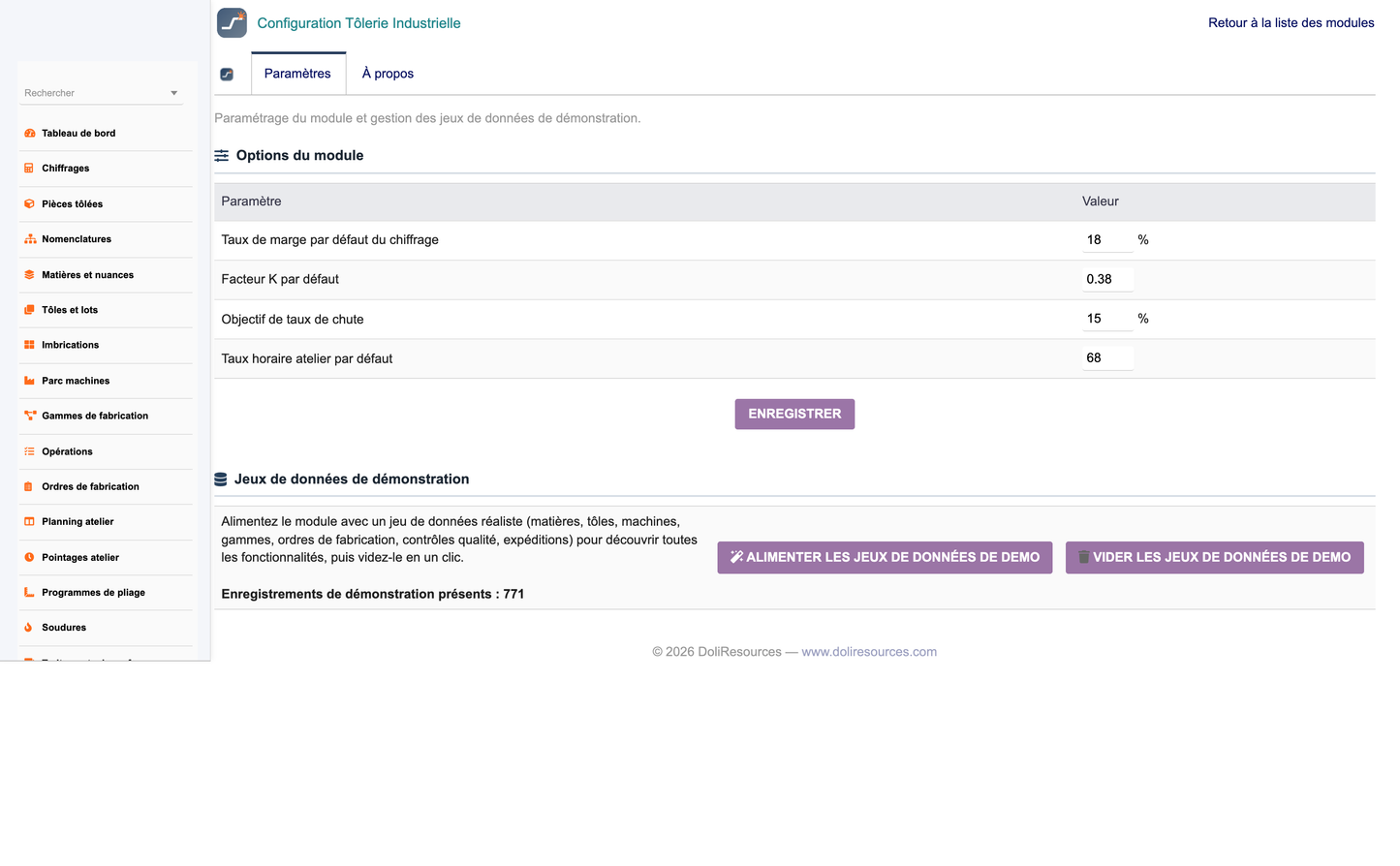
Four settings drive the default calculations: default costing margin rate, default K-factor, scrap rate target and default shop hourly rate.
The configuration page also provides the two demonstration controls requested for every DoliResources module:
· "Load demo dataset" installs a complete, realistic dataset — materials, sheets with certificates, machines, routings, work orders, time logs, quality controls, deliveries and cost prices — so every feature can be explored immediately.
· "Clear demo dataset" removes all of it, including the third parties created for the demonstration, and returns the module to a blank state.
· A counter permanently displays how many demonstration records are present.
· Copy the tolerieindustrielle folder into htdocs/custom.
· Go to Home → Setup → Modules and enable Industrial Sheet Metal Management.
· Open the module configuration and load the demonstration dataset.
DoliResources designs and publishes professional business modules for Dolibarr ERP/CRM. Industrial Sheet Metal Management is published under the GNU GPL v3 or later licence.
www.doliresources.com


