
Discover powerful Dolibarr extensions designed to automate your business processes
Gestion Ferronnerie turns Dolibarr into a complete, industry-specific ERP for ironwork companies: architectural metalwork, ornamental ironwork, structural steel fabrication and traditional blacksmithing. The...
Couldn't load pickup availability


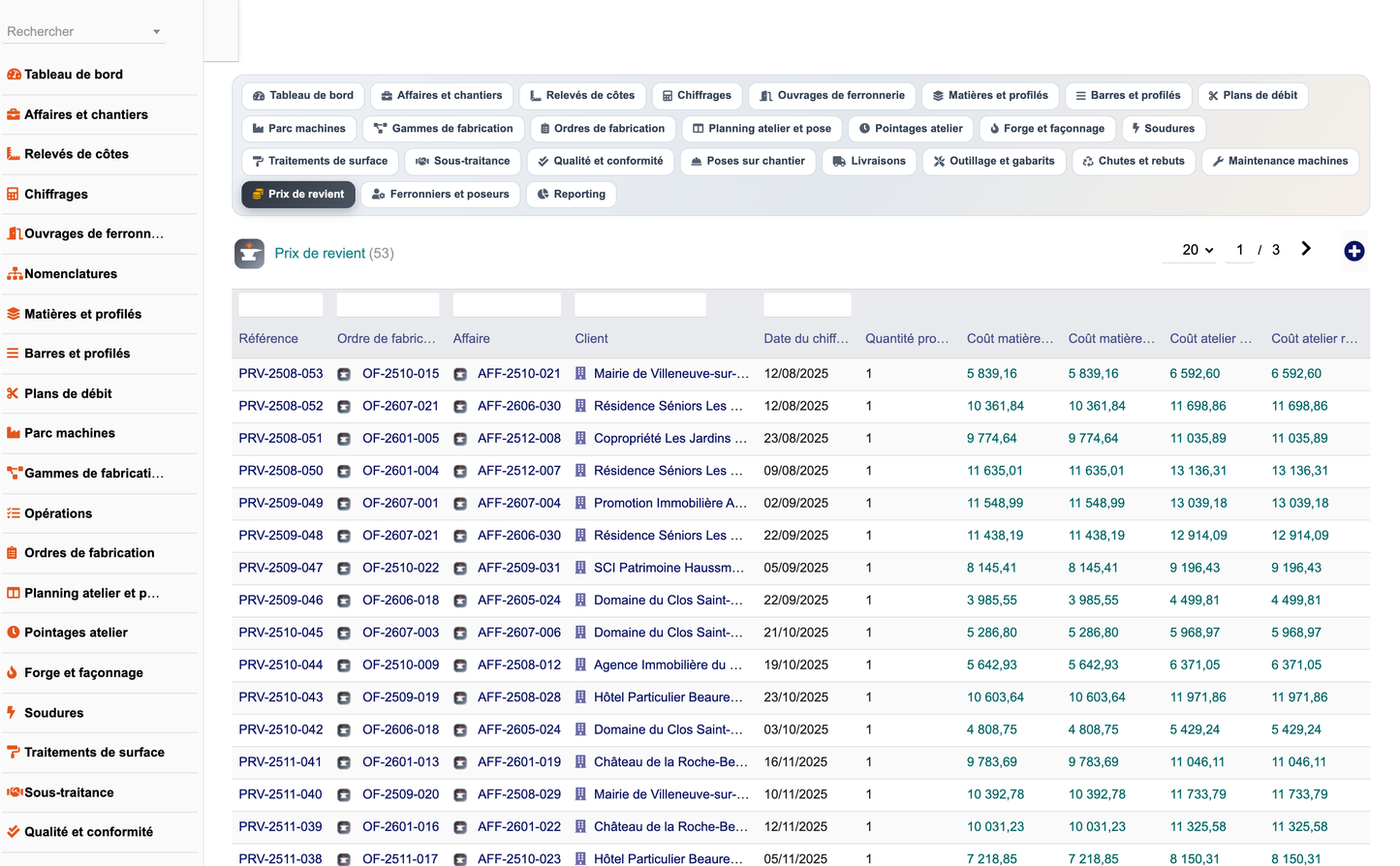
Gestion Ferronnerie turns Dolibarr into a complete, industry-specific ERP for ironwork companies: architectural metalwork, ornamental ironwork, structural steel fabrication and traditional blacksmithing. The goal is that a workshop can run 100 % of its business inside Dolibarr — no spreadsheet estimating, no separate production-planning software, no paper measurement books and no whiteboard installation planning.
The module covers the entire value chain of the trade:
· Enquiry and on-site survey of dimensions and constraints
· Design, drawings and forged-pattern references
· Parametric estimating of the item, converted to a native Dolibarr quotation
· Sales order, job file and material procurement
· Bar cutting optimisation, workshop routing and work orders
· Hot forging and shaping, bending, twisting, welding and assembly
· Surface finishing (powder coating, hot dip galvanizing, patina, varnish) and subcontracting
· Quality inspection and normative compliance verification
· Delivery, on-site installation and signed handover with snag tracking
· Invoicing, real cost price, actual margin and after-sales service
It addresses both building ironwork (guardrails, gates, fencing, security grilles, stair railings, steel staircases, canopies, glazed screens, pergolas, doors, shutters, structures) and artistic ironwork (forged pieces, scrolls, rosettes, metal furniture, signage, heritage restoration and bespoke commissions).
The module ships 25 business objects. Each one has a filterable list with a column selector, a detail card with a KPI header strip, full create/edit/delete handling and permission control.
|
# |
Object |
Purpose |
|
1 |
Job / site (affair) |
Central dossier: customer, site address, type of item, budget, key dates, phase and progress |
|
2 |
Site survey |
Digital measurement book: opening sizes, sections, support material, fixing type, level difference, access constraints, scaffolding or platform needs, photographs |
|
3 |
Costing |
Parametric estimate broken down into material, offcuts, forging, workshop, hardware, finishing, subcontracting, installation, travel, overheads and margin |
|
4 |
Ironwork item |
Catalogue entry: family, style, dimensions, weight, developed surface, baluster count and spacing, infill, handrail, colour, applicable standard and compliance flag |
|
5 |
Bill of material |
Component lines: profiles, hardware, fasteners and consumables with cut length, quantity, unit weight and unit cost |
|
6 |
Material / profile |
Catalogue of flat bar, solid square and round, square/rectangular/round tube, angle, U and IPE profiles, sheet, handrail, twisted baluster and ornaments |
|
7 |
Bar in stock |
Individual bar with lot number, heat number, 3.1 material certificate, remaining length and rack location |
|
8 |
Cutting plan |
Bar nesting: pieces, bars consumed, used length, material utilisation rate, scrap rate, number of cuts and cutting time |
|
9 |
Machine |
Workshop equipment from band saw to power hammer, with capacity, hourly rate, OEE and hour counter |
|
10 |
Routing |
Manufacturing route with total setup time, run time, cost and batch size |
|
11 |
Operation |
Routing step: rank, phase code, machine, setup time, unit run time, hourly rate and step cost |
|
12 |
Work order |
Shop floor order: quantities launched/good/scrapped, planned and actual dates, priority, current phase, progress, planned and actual cost |
|
13 |
Shop floor time log |
Production declaration: operator, machine, phase, planned versus actual time, quantities and stoppage reasons |
|
14 |
Forging operation |
Hot work: operation type, pattern reference, heat source, forging temperature, number of heats, forging time, scale loss and blacksmith |
|
15 |
Welding |
Process code, position, bead length and throat, filler wire, gas consumption, welder qualification and visual check |
|
16 |
Surface finishing |
Treatment type, RAL code, gloss, patina, coating thickness, treated surface, internal or subcontracted, cost and turnaround dates |
|
17 |
Subcontracting |
Outwork order: supplier, operation, quantities out and back, price, due date and status |
|
18 |
Quality control |
Inspection type, quantities checked/conforming/non-conforming, conformity rate, normative checks, critical dimension with tolerance band, defect cause, cost of non-quality, decision and corrective action |
|
19 |
Site installation |
Installation team, installer count, hours, fixing type, lifting equipment, vehicle, travel distance, handover acceptance and snag list |
|
20 |
Delivery |
Packaging, package count, total weight, carrier, tracking number, certificate of conformity |
|
21 |
Tooling and jigs |
Forging dies and swages, welding and bending jigs, marking table: location, uses, service life and last service |
|
22 |
Offcut / scrap |
Length, weight, reusability, rack location, recovery value and origin cutting plan |
|
23 |
Machine maintenance |
Preventive, corrective and calibration work with duration, downtime, cost and replaced parts |
|
24 |
Cost price |
Actual versus planned cost by category, revenue, margin amount and margin rate |
|
25 |
Blacksmith / installer |
Job title, workshop zone, skills, welding qualification and expiry, hourly cost, productive hours and efficiency |
· Job dossier linking customer, site contact, architect or project manager, site address and budget.
· Digital site survey replacing the paper measurement book, including support material, planned fixing method, level difference, floor level, access difficulty, scaffolding or access-platform requirement and existing item to remove.
· Parametric costing computed from material (grade, section, linear weight, price per kilo), fabrication times per phase, surface treatment per square metre or kilogram, installation hours and crew, travel, subcontracting, overheads and target margin.
· Fully transparent price breakdown that can be presented to the customer.
· Costing revisions with indices, preserving the price history per customer and per item type.
· One-click conversion into a native Dolibarr quotation (Propal) and then a sales order.
· Sixteen item families: guardrail, swing gate, sliding gate, pedestrian gate, security grille, stair railing, steel staircase, canopy, glazed screen, pergola, fencing, steel door, metal furniture, forged art piece, heritage restoration and steel structure.
· Five styles: contemporary, traditional, wrought iron, Art Deco and Provençal.
· Multi-component bills of material covering profiles, hardware (hinges, locks, base plates, gate rollers, motorisation), stainless fasteners and consumables.
· Built-in normative references: NF P01-012 and NF P01-013 for guardrails (minimum height and maximum baluster spacing), EN 1090 for CE-marked structures, EN 13241-1 for powered gates, DTU 32.1 for steel construction.
· Drawings in DXF, DWG or PDF and site photographs attached to the native Dolibarr document management system.
· Thirteen profile families and eight material families: carbon steel, pure wrought iron, stainless steel 304L and 316L, aluminium, galvanized steel, Corten, copper and brass.
· Each material carries its standard bar length, linear weight in kilograms per metre, density, price per kilo and per bar, supplier and suitability for forging.
· Individual bar tracking with lot number, heat number and 3.1 material certificate, required for CE-marked work under EN 1090.
· Bar cutting optimisation producing a material utilisation rate and a scrap rate.
· Valued offcut management: reusable offcuts are measured, returned to the rack and recovered at 60 % of the material price; non-reusable offcuts are valued as scrap.
· Reorder thresholds per material feed the dashboard alert bar and prepare native supplier orders.
· Fifteen equipment types: band saw, chop saw, pillar drill, punching machine, shear, press brake, roll bender, gas forge, coal forge, power hammer, MIG-MAG and TIG welders, plasma cutter, bench grinder and sand blasting cabinet.
· Routings across twelve workshop phases: cutting, drilling, forging, bending, twisting, welding, grinding, assembly, finishing, inspection, packing and installation.
· Work orders with launched, good and scrapped quantities, planned versus actual dates, priority, current phase and progress.
· Shop floor time logs capturing operator, machine, phase, planned versus actual time and stoppage reasons, producing the planned-versus-actual variance by phase.
· Forging operations documented individually: drawing down, upsetting, scroll, twisting, leaf work, spear point, rosette, splitting and stamping, with heat source, forging temperature, number of heats, die or swage used and scale loss percentage.
· Welding traceability by process (111, 135, 141, spot and forge welding), position, bead length and throat, filler wire, gas consumption, welder qualification under EN ISO 9606 and visual inspection.
· Tooling and jigs registry with location, number of uses, service life and last service date.
· Ten surface treatments: powder coating with RAL reference, hot dip galvanizing, electroplating, metal spraying, patina and wax, varnish, anti-rust primer, sand and shot blasting, brushing and polishing, anodizing.
· Subcontracting orders with quantities out and back, price, due date, automatic late flagging and generation of native supplier orders.
· Four inspection types: incoming material, in-process, final and normative compliance.
· The normative inspection specifically records the guardrail height and the baluster spacing against the configured thresholds, with two independent compliance flags.
· Non-conformities qualified by cause (material, drawing, survey, setup, welding, operator, finishing, installation), costed, and driven through to a corrective action and a decision of rework, scrap or concession.
· Installation records with team, installer count, hours, fixing method, lifting equipment, vehicle and travel distance.
· Signed handover with a counted and detailed snag list; open snags are raised on the dashboard until cleared.
· Actual cost price per job combining consumed material, logged workshop hours, forging, finishing, subcontracting, installation and the cost of non-quality.
· Comparison against the estimate, producing the variance and the actual margin by job, by item family and by customer.
· Order book and revenue tracking by item family, with a twelve-month revenue and margin chart.
The dashboard deliberately departs from the standard Dolibarr layout and adopts the visual identity of the trade: forge black, brushed patinated iron, ember orange and heated brass.
· A full-width hero banner in brushed-iron gradient with a radial ember halo, showing four macro indicators: open jobs, material tonnage for the month, revenue for the month and average actual margin.
· A conditional alert bar that only appears when action is required: material below threshold, late jobs, surveys to schedule, compliance checks to perform, missing material certificates, maintenance due, tooling to service, open non-conformities and uncleared site snags.
· Twenty-six clickable KPI tiles grouped into five business zones, each opening the matching filtered list.
· Progress gauges that turn green above target and red below: win rate, machine OEE, material utilisation, conformity rate and margin rate.
· A twelve-column job kanban from site survey through to invoicing, showing the committed amount per phase.
· Ten charts: workshop load per phase, material consumption by grade, revenue by item family, monthly scrap-rate trend, planned versus actual time per phase, Pareto of non-conformity causes, twelve-month revenue and margin, split of workshop hours, jobs by phase and top customers by revenue.
|
Colour |
Hex |
Use |
|
Forge black |
#1C1C20 |
Hero background, deepest gradient stop |
|
Patinated iron |
#2F3640 to #4A5361 |
Brushed metal gradient, tab bar active state |
|
Ember orange |
#E2571E |
Primary accent, values, active bars, menu icons |
|
Heated brass |
#F0A500 to #C9A227 |
Secondary accent, gauges, hero icon |
|
Cold steel |
#8D99AE |
Secondary text and neutral tiles |
A dedicated Reporting menu provides thirteen situation reports. Every report is filtered by period, presents its own KPI tiles and data table, can be printed, and exports to CSV, Excel, Word and PDF. All exported cells are decoded to plain UTF-8 so accented characters are never leaked as HTML entities.
|
# |
Report |
Content |
|
1 |
Activity and order book |
Jobs with customer, item type, site town, phase, budget, invoiced amount and progress |
|
2 |
Sales and costings |
Costings per customer with total value, average lead time and win rate computed on settled quotes only |
|
3 |
Production |
Monthly work orders, launched, good and scrapped quantities, yield |
|
4 |
Material consumption |
Consumption by family, profile type, grade and section with tonnage and purchase value |
|
5 |
Offcuts and recovery |
Offcuts by type and material with weight, recovery value and reusable count |
|
6 |
Workshop load and OEE |
Capacity, actual hours, OEE and load percentage per machine |
|
7 |
Forging and welding |
Forging operations by type and heat source with pieces, heats, time and scale loss; welding metres, wire consumed and visual checks |
|
8 |
Quality and compliance |
Pareto of non-conformity causes, conformity rate, cost of non-quality and normative compliance rate |
|
9 |
Finishing and subcontracting |
Treatments and outwork by supplier with surface, cost and late count |
|
10 |
Installation and sites |
Installations with team, fixing method, hours, distance, snags and handover rate |
|
11 |
Cost price and margin |
Planned versus actual cost, revenue, margin amount and margin rate per job |
|
12 |
Material traceability |
Bar, lot number, heat number, certificate, grade and related work orders |
|
13 |
Blacksmith productivity |
Job title, workshop zone, productive hours, logged hours and efficiency |
The module never duplicates a native Dolibarr object; it links to it. Foreign keys to native documents render as real clickable Dolibarr objects in every list and card.
|
Native object |
Use in the module |
|
Third parties |
Customers, material suppliers and subcontractors (galvanizing, powder coating) |
|
Contacts |
Site contact, architect, project manager |
|
Quotations (Propal) |
A costing converts into a native quotation in one click |
|
Sales orders |
A firm order drives the job and its work orders |
|
Supplier orders |
Material procurement and outwork orders |
|
Invoices |
Progress billing, deposits and final invoice |
|
Shipments |
Delivery of finished items to site |
|
Interventions |
On-site installation and after-sales visits |
|
Products and services |
Materials, hardware and catalogue items |
|
Stock and warehouses |
Material racks, hardware stock and offcuts |
|
Projects |
Each ironwork job can be backed by a native project |
|
Document management |
Drawings, survey photographs, certificates and signed handover reports |
|
Agenda |
Survey appointments, installation dates and deadlines |
|
Users and HR |
Operators, installers and qualifications |
The setup page exposes seven business parameters and the demonstration dataset controls.
|
Parameter |
Default |
Effect |
|
Default costing margin rate |
18 % |
Pre-fills the margin on a new costing |
|
Default workshop hourly rate |
68 |
Used when an operation has no machine rate |
|
Forging hourly rate |
82 |
Applied to hot forging time |
|
Installation hourly rate |
74 |
Applied to on-site installation hours |
|
Scrap rate target |
8 % |
Target line on the monthly scrap-rate chart |
|
Minimum guardrail height |
1000 mm |
Threshold for the normative compliance check |
|
Maximum baluster spacing |
110 mm |
Threshold for the normative compliance check |
· A "Load demo dataset" button installs a realistic, fully FK-coherent dataset covering all 25 objects: jobs and sites, surveys, costings, items and bills of material, materials and bars with certificates, cutting plans, machines, routings and operations, work orders, time logs, forging, welding, finishing, subcontracting, inspections, installations, deliveries, tooling, offcuts, maintenance, cost prices and staff, plus the native third parties they reference.
· The dataset is deliberately calibrated so that every dashboard figure is plausible: around 90 % material utilisation, an 8 to 9 % scrap rate, roughly 80 % machine OEE, a 98 % conformity rate, a 19 % actual margin and a win rate near 64 %. Twelve full months are populated so no monthly chart shows an empty bar, and the current month is pro-rated on elapsed days.
· A "Clear demo dataset" button removes every demonstration record, cascading to records created under a demonstration parent and deleting the native third parties the demonstration created.
· The dataset is versioned, so a module upgrade that improves the demonstration content re-seeds it automatically instead of leaving stale data behind.
Twenty-nine permissions are declared across nine functional groups. Read and write are granted by default so the module is usable immediately after activation; delete and administration are not granted by default.
|
Group |
Covers |
|
Commercial |
Jobs, site surveys and costings |
|
Engineering |
Ironwork items, bills of material and routings |
|
Material |
Materials, profiles, bars, cutting plans and offcuts |
|
Production |
Work orders, time logs, forging and welding |
|
Machine |
Machines, tooling and maintenance |
|
Quality |
Quality controls and standard compliance |
|
Logistics |
Surface finishing, subcontracting and deliveries |
|
Installation |
Site installations and handovers |
|
Costing |
Actual cost price and margin |
|
Reporting |
Read access to the reporting suite |
|
Administration |
Module configuration and demonstration data |
|
Item |
Value |
|
Technical name |
ferronneriemanagement |
|
Module number |
534700 |
|
Version |
1.0.0 |
|
Database tables |
25 tables prefixed llx_fer_ |
|
Business objects |
25 CommonObject classes |
|
Permissions |
29 |
|
Menu entries |
1 top menu and 29 left menu entries |
|
Languages |
French, English, Italian, German, Spanish (648 keys each) |
|
Dolibarr compatibility |
17.x to 23.x |
|
PHP requirement |
7.1 minimum, fully PHP 8 compatible |
|
Multi-entity |
Supported on every object |
|
Dependencies |
Third parties (modSociete) and Products (modProduct) |
|
Icons |
Font Awesome 5 Free only |
|
Licence |
GNU General Public License v3 |
|
Publisher |
DoliResources — www.doliresources.com |
Every language key is prefixed with "Fer" and the module re-asserts its own language file on each of its pages, so that on an installation running many modules the wording shown is always the module's own and never another module's value for a shared key.
· Extract module_ferronneriemanagement-1.0.zip into the htdocs/custom directory of the Dolibarr installation.
· Enable the module from Setup > Modules, in the Products family.
· Open the module configuration to set the hourly rates, the default margin and the normative thresholds.
· Optionally load the demonstration dataset to explore every feature, then clear it before going live.


