
Discover powerful Dolibarr extensions designed to automate your business processes
Language Center Management is an advanced, fully native Dolibarr ERP/CRM module that transforms a standard Dolibarr installation into a specialized management...
Couldn't load pickup availability


Language Center Management is an advanced, fully native Dolibarr ERP/CRM module that transforms a standard Dolibarr installation into a specialized management platform for language centers, linguistic institutes, international schools and language academies. It supports in-person, distance and blended (hybrid) learning models within a single, unified system.
The module brings together, in one coherent environment, every activity that a modern language center has to manage:
· Commercial — prospect capture, information requests, level-test scheduling, course proposals and enrollment conversion.
· Pedagogical — languages, CEFR levels, courses, teaching modules, groups, sessions, attendance, exams, grades and certifications.
· Administrative — student records, teacher and staff files, timetables, room allocation and document management.
· Financial — fees, discounts and scholarships, payments, outstanding balances and revenue reporting.
· Organizational — course planning, room-conflict detection, teacher workload and multi-channel communication campaigns.
Because it is built directly on the Dolibarr framework, the module inherits all native ERP capabilities — third parties, invoicing, banking, accounting, agenda and document management — while adding a rich, education-specific business layer on top.
The module follows Dolibarr’s standard architecture and is installed as a native custom module under htdocs/custom/languagecentermanagement. It is designed to be robust, maintainable and forward-compatible.
· Native module — installed under htdocs/custom/languagecentermanagement, activated from Home → Setup → Modules.
· ~30 business objects — each built on Dolibarr’s CommonObject class and served by a generic list/card engine for consistent behavior.
· Multi-entity aware — fully compatible with Dolibarr multi-company (multi-entity) environments.
· Self-healing schema — database tables and columns are created and repaired automatically on activation and upgrade.
· FontAwesome UI — a modern, icon-driven interface consistent with the Dolibarr look and feel.
· DolGraph charts — interactive dashboard charts rendered with Dolibarr’s native charting library.
· Module descriptor — a standard descriptor declaring permissions (rights), menus, triggers and hooks.
· Demo-data generator — a versioned demo dataset with one-click creation and a secure purge routine.
· 5 language packs — French, English, Italian, German and Spanish translations shipped with the module.
The module structures the complete student lifecycle as an end-to-end workflow, from first contact to renewal. Each stage is backed by a dedicated object and screen, so information flows naturally from one step to the next.
Prospect → Information request → Level test → Course proposal → Enrollment → Payment → Group assignment → Course scheduling → Pedagogical follow-up → Exams → Certification → Renewal
A prospect expresses interest and submits an information request. A level test is scheduled to position the learner on the CEFR scale, a tailored course proposal is issued, and enrollment is confirmed upon payment. The student is then assigned to a group, courses are scheduled, and pedagogical follow-up begins — attendance, exams and grades — culminating in certification and, ultimately, renewal for the next session.
The module is organized into roughly thirty interconnected functional areas. Each area below is served by a consistent list/card interface with search, filtering, inline editing and export.
A Kanban-style commercial funnel to capture and convert leads through clearly defined stages, with drag-and-drop movement between columns.
· Stages: New, Contacted, Test scheduled, Proposal, Enrolled, Lost.
· Full contact history, source tracking and follow-up scheduling.
Placement testing aligned with the CEFR scale to position each learner accurately.
· CEFR levels A1 to C2, written and oral formats.
· Comprehension and expression scores recorded for each candidate.
· Direct link from prospect to test to proposal.
Central student records with a unique matricule, contact details, enrollment history, group membership and full academic history.
Enrollment objects linking a student to a course, group and session, with fee, discount and payment status tracked end-to-end.
A configurable catalogue of the languages taught by the center, each with its own courses, levels and statistics.
Standardized level definitions (A1, A2, B1, B2, C1, C2) reused across tests, courses, groups and certifications.
Course catalogue supporting multiple delivery types to match every audience.
· Types: general, intensive, professional, exam-preparation, corporate, private and online.
· Configurable duration, level, language, price and pedagogical content.
Reusable teaching modules (units of content) that structure the syllabus of each course and can be shared across formations.
Class groups gather students by language, level and session, with capacity management, assigned teacher and linked schedule.
Detailed teacher files supporting resource planning and pedagogical assignment.
· Languages mastered, diplomas and qualifications.
· Availability and weekly hours load / workload tracking.
Administrative and support staff records (secretaries, accountants, directors) with roles and contact information.
Visual planning of courses and sessions with day and week views.
· Day and week calendar views.
· Automatic room-conflict and overlap detection.
Management of both physical and virtual (online) rooms, with capacity and availability used by the planning conflict-detection engine.
Concrete scheduled course sessions (a class at a given date, time, room and teacher) that anchor attendance and pedagogical follow-up.
Attendance registers captured per session with a clear status taxonomy.
· Statuses: present, justified absence, unjustified absence, late.
· Aggregated into per-student and per-group attendance rates.
Exam objects scheduling and recording assessments per course, group or certification, linked to grades.
Grade capture with automatic average computation and pass/fail validation against the configured passing average.
Consolidated academic transcripts summarizing a student’s grades, levels and results across sessions.
Issuance of certifications and diplomas with automatic PDF generation and sequential numbering for authenticity and traceability.
Configurable discounts and scholarships applied to enrollments and fees, with reason and eligibility tracking.
Full fee schedule and payment tracking, including partial payments, outstanding balances and unpaid follow-up, integrated with Dolibarr invoicing.
Multi-channel outreach to prospects, students and partners.
· Channels: email, SMS, notification and announcement.
· Targeted campaigns with history and status tracking.
Management of partner and client companies (corporate training clients, sponsors), linked to Dolibarr third parties.
A document management space attaching files to students, teachers, courses and certifications, built on Dolibarr’s native ECM/DMS.
The home dashboard provides a real-time, at-a-glance view of the center’s activity through KPI cards and interactive charts.
· Active students, new enrollments, prospects and level tests.
· Languages, open courses, active groups and scheduled classes.
· Average attendance, teacher load and success rate.
· Exams and certifications issued.
· Monthly and yearly revenue, payments received, outstanding and unpaid amounts.
· Students by language.
· Revenue by course.
· 12-month payments trend.
· Prospect funnel (conversion by stage).
The module adds a dedicated left-menu tree giving direct access to every functional area:
|
▸ Dashboard |
▸ Groups |
▸ Certifications |
|
▸ Prospects |
▸ Teachers |
▸ Diplomas |
|
▸ Prospect pipeline |
▸ Timetable |
▸ Discounts |
|
▸ Level tests |
▸ Course planning |
▸ Documents |
|
▸ Students |
▸ Rooms |
▸ Fees |
|
▸ Enrollments |
▸ Classes |
▸ Payments |
|
▸ Languages |
▸ Attendance |
▸ Communication |
|
▸ Levels |
▸ Exams |
▸ Companies |
|
▸ Courses |
▸ Grades |
▸ Reporting |
|
▸ Modules |
▸ Transcripts |
▸ Configuration |
A dedicated reporting center groups analytics into four families, each with filterable, exportable reports.
|
Report family |
Coverage |
|
Commercial |
Prospects, enrollments and conversion rates. |
|
Pedagogical |
Students, attendance and results. |
|
Financial |
Revenue, payments and unpaid balances. |
|
Resources |
Teachers, rooms and workload. |
Every report can be exported to CSV, Excel and PDF, or sent directly to the printer.
Access is governed by nine permission groups, each supporting read, write and delete rights. These map cleanly onto the typical roles found in a language center, so every user sees only what their function requires.
|
Role |
Typical access |
|
Administrator |
Full access to all objects, configuration and demo data. |
|
Center director |
Broad read/write across pedagogical, commercial and financial areas. |
|
Pedagogical manager |
Courses, groups, teachers, exams, grades and certifications. |
|
Teacher |
Own groups, attendance, exams and grades. |
|
Secretary |
Students, enrollments, planning and documents. |
|
Accountant |
Fees, payments, discounts and financial reporting. |
|
Sales |
Prospects, level tests, proposals and enrollments. |
|
Read-only |
Consultation access without modification rights. |
Because it is a native module, Language Center Management leverages the full Dolibarr ecosystem rather than duplicating it. It integrates seamlessly with:
· Third parties and Contacts (students, teachers, partner companies).
· Products / Services (courses and fees as sellable items).
· Quotes, Orders and Invoices (proposals and billing).
· Payments and Bank (cash-in, reconciliation).
· Accounting (revenue and financial postings).
· Agenda (sessions, exams and events).
· Projects (sessions and programs as projects).
· DMS / ECM (document management).
· Emailing (communication campaigns).
· Users (permission and role assignment).
· Unzip the module archive into htdocs/custom of your Dolibarr installation.
· Enable it via Home → Setup → Modules (search for “Language Center Management”).
· The schema is created automatically on first activation.
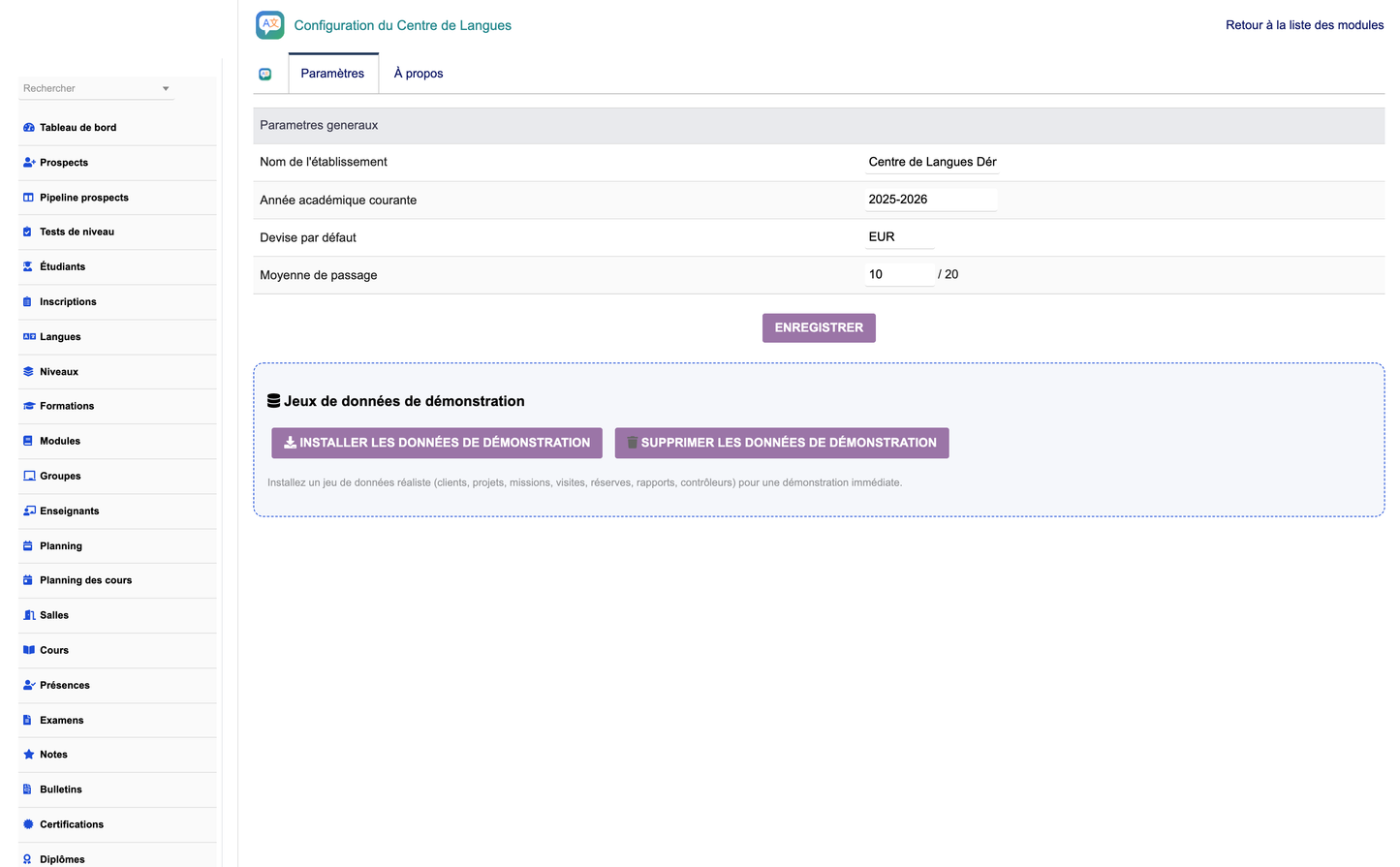
The dedicated setup page lets administrators define the operating parameters of the center:
· Center name.
· Current session.
· Currency.
· Passing average (grade threshold for validation).
A versioned demo dataset can be created or removed with one click using the Create DEMO and Remove DEMO buttons on the configuration page, allowing safe evaluation and training without affecting production data.
Assign the nine permission groups to users and groups via Dolibarr’s standard Users & Groups permission management.
The interface is shipped in five languages (French, English, Italian, German and Spanish) and follows the user’s Dolibarr language preference.
The module is engineered to Dolibarr’s development standards, ensuring reliability, security and long-term maintainability.
· Dolibarr standards — consistent use of CommonObject, DAO patterns and the framework’s coding conventions.
· Hooks — extensibility through Dolibarr’s hook system for clean third-party integration.
· Security — permission-gated pages, escaped SQL and HTML output to prevent injection and XSS.
· Responsive — interface adapts to desktop and mobile screens.
· Optimized SQL — efficient, indexed queries for fast list and dashboard rendering.
· Forward-compatible — designed to remain compatible with current and future Dolibarr releases (16+).
Language Center Management — © DoliResources — www.doliresources.com


