
Discover powerful Dolibarr extensions designed to automate your business processes
Metallurgy Management turns Dolibarr into a complete industry-specific ERP for foundries, steelworks and metal transformation workshops. The module covers the...
Couldn't load pickup availability


Metallurgy Management turns Dolibarr into a complete industry-specific ERP for foundries, steelworks and metal transformation workshops. The module covers the entire value chain, from raw-material sourcing to the dispatch of the finished part, without requiring any third-party software.
It does not replace the native Dolibarr modules — it plugs into them. Suppliers and customers are Dolibarr third parties, parts are Dolibarr products, and every sale can be linked to a native quote, order and invoice. The Stocks, Projects, Agenda and DMS modules remain fully usable.
|
Technical name |
metallurgiemanagement |
|
Module number |
532400 |
|
Version |
1.0.0 |
|
Publisher |
DoliResources — www.doliresources.com |
|
Licence |
GNU GPL v3 |
|
Compatibility |
Dolibarr 16.0 and above — PHP 7.1 minimum |
|
Dependencies |
Third parties (modSociete), Products (modProduct) |
|
Business objects |
27 |
|
Database tables |
27 (prefix llx_mtl_) |
|
Permission groups |
9 (26 individual permissions) |
|
Menu entries |
30 |
|
Reporting axes |
9, exportable to CSV, Excel, Word and print |
|
Languages |
French, English, Spanish, Italian, German |
· Materials & sourcing — grades and alloys, materials and semi-products, steelworks and suppliers, purchasing and receipts, EN 10204 material certificates.
· Foundry & melting — furnaces and equipment, heats and charges, metallurgical yield, heat and surface treatments.
· Technical catalogue — parts and drawings, bills of materials, manufacturing routings.
· Production — production orders, shop-floor operations, workshops and lines, machines and tooling, maintenance.
· Quality & safety — standardised controls and tests, non-conformities and corrective actions, HSE events.
· Stock & logistics — finished-goods stock, scrap and recycling, shipments.
· Commerce — sales and customer orders, sale lines, cost estimating and technical quotes.
· Resources — workforce and qualifications, energy consumption and CO2 emissions.
The cockpit is the module home page. Its visual charter — anthracite steel structure with molten-metal orange accents and copper highlights — is deliberately different from the standard flat-blue Dolibarr dashboards, so the module is recognisable at a glance.
|
Foundry & Melting |
Heats today, tonnes melted this month, average metallurgical yield, furnaces running, energy per tonne (kWh/t), spectrometry conformity. |
|
Production & Shop floor |
Orders in progress, late orders, tonnage produced this month, pieces produced, production cost, machine availability. |
|
Sales & Customers |
Total revenue, revenue this month, commercial margin, average order value, number of sales, open estimates. |
|
Materials, Stock & Energy |
Material stock value, finished-goods stock value, stock alerts, monthly scrap value, monthly energy cost, monthly CO2 emissions. |
A kanban-style band shows one column per stage of the metallurgical process — Planned, Melting, Casting/Forming, Machining, Treatment, Inspection, Completed, Cancelled — each with the number of orders, the quantity and the tonnage engaged. Statuses are stored language-independently, so the flow never depends on the display language.
Four gauges display conformity rate, metallurgical yield, machine availability and certificate conformity, colour-coded against industry thresholds. Five clickable alert tiles surface open non-conformities, HSE events for the month, maintenance due, stock alerts and the scrap rate; each links straight to the corresponding filtered list.
· Produced tonnage evolution over twelve rolling months.
· Melting yield evolution over twelve rolling months.
· Material stock distribution by grade family.
· Quality defect Pareto.
· Best-selling parts.
· Sales by market segment.
· Load by workshop.
· Energy consumption evolution.
The module ships 27 business objects. Each one comes with a searchable and sortable list (column show/hide selector, per-column filters, pagination) and a detail card. Hub objects additionally display a KPI cockpit and their related records, editable inline.
Table: mtl_alloy
Reference library of metallurgical grades: carbon steels, alloy steels, stainless steels, cast irons, aluminium alloys, copper alloys, tool steels and titanium. Holds the standardised designation (EN, AISI/UNS), the chemical composition (C, Cr, Ni, Mn, Si), physical properties (density, melting point), mechanical properties (tensile strength, yield strength, elongation, Brinell hardness) and service criteria (weldability, machinability, corrosion resistance, typical applications).
Table: mtl_material
Raw material inventory: plates, round and flat bars, tubes, sections, billets, ingots and wire rod, each linked to a grade and a supplier. Dimensions are captured per shape, and valuation is per kilogram (price/kg, stock in kg, alert threshold in kg). The heat number provides upstream traceability to the supplier's material certificate. Each material can be linked to a native Dolibarr product.
Table: mtl_supplier
Directory of steelworks, rolling mills, stockholders, foundries, scrap merchants and treatment subcontractors. Each supplier is linked to a native Dolibarr third party, so supplier quotes, orders and invoices remain in the standard modules. Certifications, lead time, minimum order quantity, rating and country support sourcing decisions.
Table: mtl_purchase
Material purchasing from request to receipt, with ordered and received quantities in kilograms, price per kilogram and total amount. The status moves through Request, Ordered, Partially received and Received. The heat number and the 'certificate received' flag enforce documentary compliance at goods-in.
Table: mtl_cert
Archive of EN 10204 certificates (types 2.2, 3.1 and 3.2) issued by suppliers. Each certificate records the chemical analysis, the mechanical properties and the conformity verdict. The heat number / material / grade chain makes it possible to reconstruct full traceability in the event of a customer claim.
Table: mtl_furnace
Melting equipment fleet: medium-frequency induction furnaces, electric arc furnaces, cupolas, crucible furnaces, continuous and chamber treatment furnaces. Capacity, maximum temperature, power and specific consumption (kWh/t) characterise each unit. Refractory lining tracking (type, number of campaigns, last relining date) anticipates relining shutdowns.
Table: mtl_heat
Every melting charge is recorded with its heat number, furnace, target grade and status. The metallurgical yield is derived from the charged weight and the liquid metal obtained, and is only computed over heats that were actually tapped. Scrap input, tapping temperature, duration and energy consumed drive melting cost optimisation. The end-of-melt spectral analysis and its verdict gate the release of the heat.
Table: mtl_treatment
Quenching, tempering, annealing, case hardening, nitriding, hot-dip galvanising and electroplating. Cycle parameters are traced (temperature, duration, quenching medium, furnace atmosphere, coating thickness). Hardness before and after quantifies the effectiveness of the cycle. Subcontracted treatments are linked to the subcontractor third party and costed.
Table: mtl_part
Technical catalogue of manufactured parts: flanges, valve bodies, shafts, gears, frames, cylinder liners, housings, wheels, turbine blades and more. Each part carries its drawing reference and index, its grade, net and gross weights, tolerance class, surface treatment and manufacturing process. Material cost, labour cost, cost price and sale price feed the margin analysis. Each part is linked to a native Dolibarr product.
Table: mtl_bom
Material breakdown of each part into primary and secondary components, with quantities in kilograms. A forecast scrap allowance percentage is included in the line cost calculation.
Table: mtl_route
Sequence of production phases: cutting, melting, moulding, forging, turning, milling, drilling, welding, heat treatment, grinding, finishing and final inspection. Each phase carries its workshop, machine, setup time, cycle time, hourly rate and tooling. A 'control required' flag triggers a quality hold point.
Table: mtl_order
The shop-floor pivot: part, planned quantity, workshop, priority, customer and dates. The status follows the metallurgical flow (Planned, Melting, Casting/Forming, Machining, Treatment, Inspection, Completed). Produced and scrapped quantities plus planned and produced tonnages feed the cockpit KPIs. Cost is split into material, labour and energy. An order can be linked to a heat for traceability and to a sale.
Table: mtl_orderop
Every operation of an order is tracked individually: workshop, machine, operator, planned time and actual time, conforming and non-conforming quantities, status and date. The planned-versus-actual gap feeds productivity analysis.
Table: mtl_workshop
Plant organisation into workshops: foundry, moulding, forming, machining, welding, heat treatment, finishing and dispatch. Capacity in hours per week and tonnes per month, headcount, shift pattern and hourly rate. Workshop load is charted on the cockpit.
Table: mtl_machine
Machine fleet: presses, rolling mills, CNC lathes and machining centres, grinders, laser and plasma cutting, press brakes, welding stations, robots, shot-blasting machines and overhead cranes. Brand, model, serial number, year, power and maximum capacity are recorded. Availability rate and running hours drive industrial performance; the next maintenance date raises the cockpit alert.
Table: mtl_maintenance
Preventive, corrective, predictive and regulatory interventions on machines and furnaces. Machine downtime and costs (parts and labour) are capitalised for total-cost-of-ownership analysis. Open interventions surface in the cockpit's 'maintenance due' tile.
Table: mtl_quality
Dimensional inspection, hardness and tensile testing, dye penetrant, magnetic particle, ultrasonic and radiographic examination, and spectral analysis. The test method references the applicable standard (ISO 6892-1, ISO 6506-1, EN ISO 3452-1, EN ISO 17640 and others). Measured value, target value and min/max tolerances allow an objective verdict. Conformity rate and decision (accepted, rework, rejected) feed the quality gauge.
Table: mtl_nc
Each non-conformity is qualified by type and severity (minor, major, critical). Root cause analysis and corrective action are documented, with an owner and detection and closure dates. Affected quantity and financial impact support prioritisation. Open non-conformities appear in the cockpit alerts.
Table: mtl_hse
Reporting of near misses, accidents with or without lost time, dangerous situations, environmental incidents and PPE checks. Each event is linked to a workshop and, where relevant, to an employee. Lost days and the actions taken are recorded for the safety review.
Table: mtl_stock
Multi-site stock of finished parts (store, dispatch bay, customer hub) with available and reserved quantities, alert threshold, location, heat number and valuation. Total finished-goods stock value is reported on the cockpit.
Table: mtl_scrap
Valuation of cutting offcuts, machining swarf, risers, runners and rejected parts. Each lot is linked to its grade and originating workshop, a prerequisite for correct recycling. The destination distinguishes internal remelting from sale to a scrap merchant. Monthly scrap value is a cockpit indicator.
Table: mtl_delivery
Preparation, shipment and delivery of customer orders, with carrier, tracking number, number of packages, total weight and shipping cost. The 'certificate enclosed' flag guarantees that material documentation travels with the goods.
Table: mtl_sale
Customer orders with market segment, incoterm, total weight, net and gross amounts and margin. The status follows the Quote, Confirmed, In production, Ready to ship, Delivered, Invoiced cycle. Each sale can be linked to a native Dolibarr quote, order and invoice.
Table: mtl_saleline
Order lines with part, grade, quantity, weight, unit price, discount and line total.
Table: mtl_quote
Full cost build-up of a part: material cost, labour cost, energy cost and treatment cost, then an overhead percentage and a margin percentage to derive the unit price and total. A quote can be linked to a native Dolibarr proposal for commercial conversion.
Table: mtl_employee
Production headcount: founders, moulders, operators, welders, inspectors, technicians, forklift and crane drivers. Qualifications and certifications are tracked with their expiry date (EN ISO 9606 welding, COFREND, CACES, electrical authorisations). Job title, workshop, shift and hourly rate complete the record.
Table: mtl_energy
Monthly readings per energy type (electricity, natural gas, coke). Consumption, unit cost and total cost are matched against tonnage produced. The kWh-per-tonne ratio and CO2 emissions constitute the environmental performance indicators.
The Reporting menu offers nine situation reports. Each report can be exported to CSV, Excel or Word, or printed directly. Exported cells are decoded to plain UTF-8 text, so accented characters never leak as HTML entities into the file.
|
Report |
Content |
|
Production |
Twelve rolling months: number of orders, pieces produced, tonnage, scrap and production cost. |
|
Melting & Heats |
Monthly melting activity: number of heats, charged weight, tonnes melted, metallurgical yield, energy and kWh per tonne — yield and ratio computed on the same tapped-heat scope for consistency. |
|
Parts & Margins |
Sold parts ranked by revenue, with grade, quantity, cost price and margin. A part with no cost price shows a dash rather than a 100 % margin: a missing cost is an unknown, not a zero. |
|
Quality & Non-conformities |
Summary per control type and test method, plus non-conformities aggregated by type with their financial impact. |
|
Stock & Materials |
Material stock valuation by type and grade family with the count of references below the alert threshold, and finished-goods stock by site. |
|
Sales & Customers |
Twelve rolling months: number of sales, revenue, tonnage sold, average order value and commercial margin. |
|
Purchasing & Suppliers |
Per supplier: number of orders, ordered and received quantities, total amount and material-certificate return rate. |
|
Energy & Environment |
Consumption and cost per period and energy type against tonnage produced, with kWh per tonne and CO2 emissions. |
|
Maintenance & Machines |
Per machine type: fleet size, average availability, running hours, downtime hours and maintenance cost. |
Access is governed by nine permission groups. Each group except Reporting carries read, write and delete permissions; read and write are granted by default on activation so the module is usable immediately, while delete and administration are not.
|
Permission group |
Covers |
|
Materials |
Grades, materials, suppliers, purchasing, certificates |
|
Foundry |
Furnaces, heats, heat and surface treatments |
|
Technical catalogue |
Parts, bills of materials, routings |
|
Production |
Production orders, operations, workshops, machines, maintenance |
|
Quality |
Quality controls, non-conformities, HSE events |
|
Stock |
Finished-goods stock, scrap, shipments |
|
Sales |
Sales, sale lines, technical quotes |
|
Resources |
Workforce, energy |
|
Reporting |
Read access to the nine decisional reports |
|
Third parties |
Customers and suppliers are native third parties; the module stores the link, never a duplicate. |
|
Products |
Each part and each material can be linked to a native product, making it available in the standard catalogue. |
|
Proposals (quotes) |
A sale and a technical quote can each reference a native proposal. |
|
Orders |
A sale can reference a native customer order. |
|
Invoices |
An invoiced sale references the native invoice; invoicing stays in the standard module. |
|
Stocks |
Finished-goods stock complements native warehouse management with heat-number traceability. |
|
Projects / Agenda / DMS |
Remain fully available on every module object. |
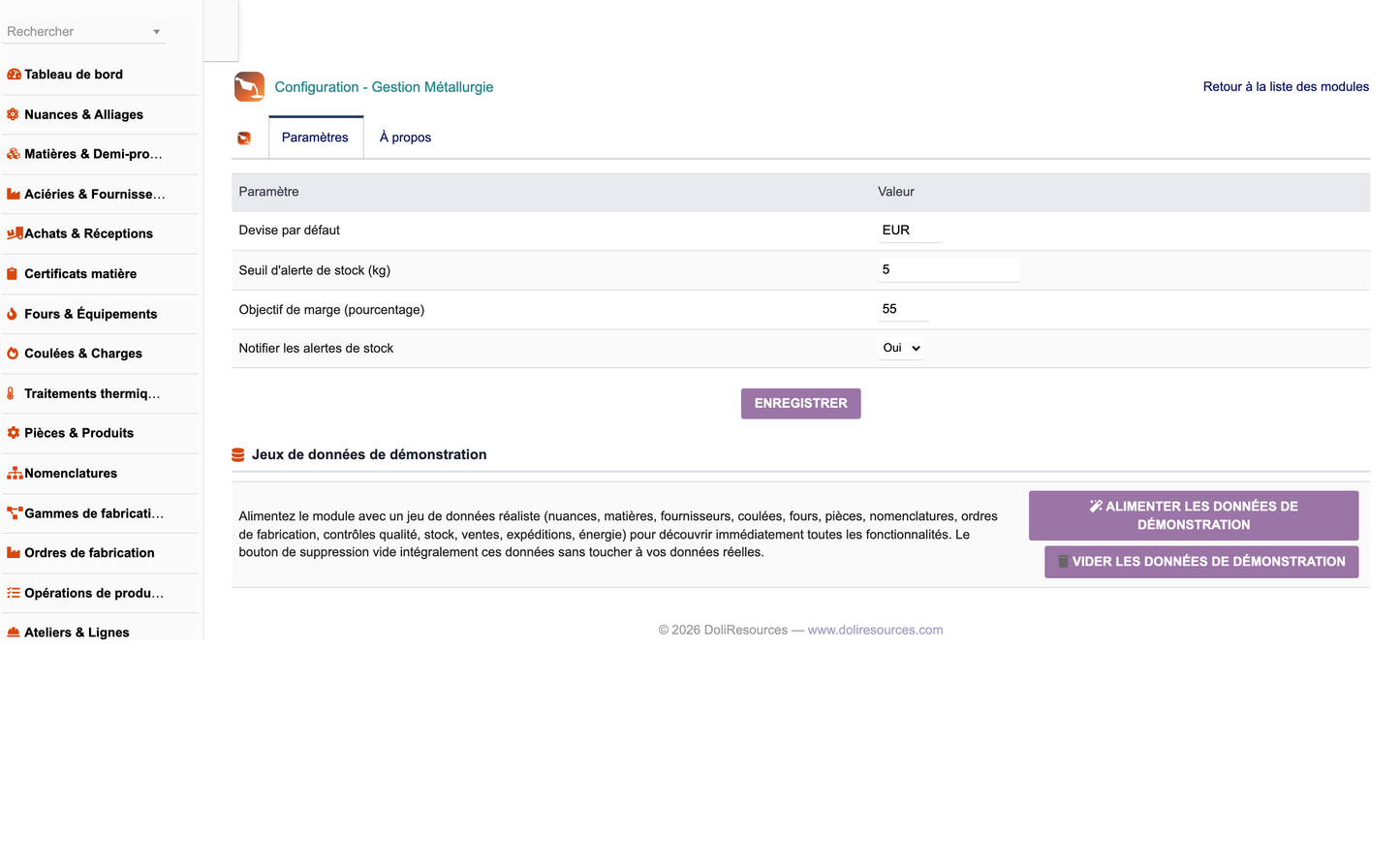
The module configuration page provides two buttons. Install demo data populates all 27 tables with a realistic, FK-coherent dataset — 16 grades, 38 materials, 8 suppliers, 7 furnaces, 60 heats, 26 parts, 58 production orders with their operations, quality controls and treatments, 46 sales, 24 months of energy readings, and the associated native third parties and products.
The dataset is engineered so that every headline KPI is plausible rather than merely present: metallurgical yield around 92 %, conformity above 95 %, roughly 540 kWh per tonne, and about 15 % of live orders genuinely late. A share of records is forced into the current month so monthly indicators are never zero.
Remove demo data clears the dataset in full — including records the user created underneath a demonstration parent, which would otherwise be left orphaned on a dead foreign key — and never touches real data. Both operations are reversible and can be repeated at will.
· Every language key is module-prefixed, so no label can be overridden by another active module's language file (Dolibarr merges them all into a single table).
· All icons are FontAwesome 5 Free names, matching the version bundled with Dolibarr 16 to 23.
· A schema self-heal runs on activation and adds any missing column, since Dolibarr only ever creates tables and never alters them on upgrade.
· Left-menu positions use a module-unique high base so they cannot collide with another module's entries on a densely populated instance.
· Multi-entity aware: every object filters on the active entity.
· The module registers a dashboard widget (box) with the key indicators for the Dolibarr home page.


