
Discover powerful Dolibarr extensions designed to automate your business processes
Gestion Cabinet Neurologue turns Dolibarr into a complete practice-management solution for neurology. It is designed for the independent neurologist, the group practice, the...
Couldn't load pickup availability


Gestion Cabinet Neurologue turns Dolibarr into a complete practice-management solution for neurology. It is designed for the independent neurologist, the group practice, the neurology centre and the clinical neurophysiology unit. The module covers the full care pathway — from the first appointment request through admission, consultation, structured neurological examination, neurophysiological testing, diagnosis, treatment, signed medical reporting and long-term pathology follow-up — and connects that clinical activity directly to the administrative and financial side of the organisation: insurance cover, billing and collection, consumable stock, biomedical equipment, maintenance, and quality management.
Rather than sitting alongside the ERP as a separate silo, the module builds on Dolibarr's native foundations. Patients and insurers can be linked to Third Parties, consultations to Invoices, practitioners to Users, and documents to the DMS. The result is a single system in which clinical activity and business management share the same data, the same permissions and the same reporting.
The module is organised around 32 business objects, each with its own list view, record card, search and filter tools, and permission group. They are grouped into eight functional zones, which are also the sections of the left-hand menu and of the dashboard.
|
Functional zone |
What it manages |
Business objects |
|
Patients |
Patient identity, administrative and social data, consent, and the structured neurological record |
Patients, Neurological records |
|
Schedule |
Appointments, arrival and queue management, remote consultations |
Appointments, Admissions, Teleconsultations |
|
Clinical |
Consultations, reported symptoms, structured examination, configurable clinical scales |
Consultations, Symptoms, Examinations, Scales, Scale items |
|
Neurophysiology |
EEG and video-EEG, EMG and nerve conduction, evoked potentials, cognitive assessment |
EEG, EEG events, EMG, EMG measures, Evoked potentials, Cognitive assessments |
|
Care pathways |
Long-term follow-up of chronic neurological conditions, imaging and laboratory workup |
Follow-ups, Event logs, Imaging requests, Laboratory tests |
|
Therapeutics |
Treatment plans, prescriptions, and signed medical reports |
Treatments, Prescriptions, Reports |
|
Back office |
Billing, insurance cover, referring physicians, staff, consumables, equipment |
Billing, Insurances, Referrers, Practitioners, Stock, Equipment, Maintenance |
|
Quality |
Adverse events and continuous quality improvement |
Incidents, Quality reviews |
The patient file holds identity, contact and address details, social security identifier, emergency contact, trusted person and main caregiver, referring GP, insurance and membership number, profession and preferred language. Fields specific to neurological care are integrated directly: autonomy level, mobility, minor status and legal guardian, plus separate consent flags for care and for data processing.
Attached to each patient, the neurological record captures the clinical history as dated, typed and rated entries — antecedents, diagnoses, risk factors, allergies and intolerances — each with its severity, its active/resolved status, its source and a free description, so the practitioner sees a consolidated history rather than scattered notes.
Appointments are scheduled by practitioner, date and duration, type and reason, room, site and, where relevant, the required equipment — so an EEG slot reserves both the neurophysiologist and the machine. Confirmation, reminder tracking, cancellation with a documented reason, waiting-list flagging and a teleconsultation flag are all managed on the record.
On the day itself, admission records the arrival and call times and derives the waiting time, assigns a priority, and runs the front-desk checklist: identity verified, insurance verified, consent collected, supporting documents complete. A configurable waiting-time threshold turns this into an operational alert rather than a passive log.
The consultation record covers reason for visit, history summary, current treatments, clinical findings, diagnosis in both free text and coded form, care plan, advice given and the planned next appointment. It carries its own amount and can be linked to the Dolibarr invoice it generated, so clinical and financial records stay tied together.
Symptoms are recorded as their own child entries, allowing a consultation to be described symptom by symptom. The structured neurological examination provides the systematic assessment, and configurable clinical scales — defined once as a scale with its items, then scored per patient — let the practice use recognised instruments without hard-coding them into the software.
Neurophysiology is the technical heart of the module, and each modality has a dedicated object with a parent record for the examination and child records for its detailed measurements:
· EEG and video-EEG — standard, sleep, prolonged, ambulatory and video-EEG recordings, with the individual events identified during the trace recorded as child entries and timestamped against it.
· EMG / NCS — electromyography and nerve conduction studies, where each nerve or muscle measurement is stored as its own detailed child record under the parent study.
· Evoked potentials — visual, auditory and somatosensory evoked potentials, recorded with their latencies and results.
· Cognitive assessments — neuropsychological and cognitive testing, with scores, interpretation and validation.
All three technical modalities share a two-stage workflow: the examination is first performed and recorded, then interpreted and signed by an authorised practitioner. Interpretation is a separate permission, so acquisition by a technician and interpretation by a physician are properly distinguished. Examinations awaiting interpretation are surfaced as dashboard indicators.
Follow-up records organise long-term management of chronic neurological conditions — epilepsy, stroke, Parkinson's disease, multiple sclerosis, migraine and neuropathies among them. Each follow-up carries the pathology code and clinical form, the diagnosis date, the responsible practitioner, severity, the date and frequency of the last event and the number of events per year, the current protocol and rehabilitation programme, an autonomy score, therapeutic objectives, an evolution assessment and the next review date.
A dated event log complements this longitudinal view, while imaging requests and laboratory tests track the complementary workup — request, scheduling, result and conclusion — for each patient.
Treatments record the therapeutic plan; prescriptions are issued against it and pass through a validation step reserved to authorised prescribers. Medical reports — consultation letters, examination reports, referral replies — are drafted, then signed under a dedicated signature permission and produced as PDF through a configurable document template. A target signature delay is a module setting, and unsigned reports past that delay are raised as an alert.
Teleconsultations are managed as first-class records rather than a variant of a standard visit, with their own scheduling, conduct and reporting. Referring physicians are held in their own directory with speciality, organisation, professional identifier and referral volume, and can be granted portal access — making referral flows measurable and giving the correspondent a channel back into the practice.
Insurance and mutual cover is configured per organisation: cover type, coverage percentage, reimbursement ceiling, direct-billing arrangement, convention reference, validity dates and the supporting documents required. Billing records then split each act between the covered amount and the patient's share, track amounts excluding and including tax, and record payment — giving a clear view of outstanding balances alongside billed revenue.
Consumable stock is managed with quantities, minimum thresholds and expiry dates, with a configurable expiry alert window. Biomedical equipment — EEG and EMG systems, evoked potential units and their accessories — is inventoried with its type, status, availability and downtime, and can be reserved by an appointment. Maintenance operations, both preventive and corrective, are planned and recorded against each device, with maintenance falling due raised as an alert.
Incidents are declared, typed and followed through to resolution, while quality records support non-conformity tracking and continuous improvement reviews. Both feed the dashboard and the reporting module, so quality is measured rather than merely documented.
The dashboard is the module's home page and presents the practice at a glance through key performance indicators grouped by zone, together with charts of monthly activity, monthly revenue, consultations by type and caseload by pathology.
|
Indicator family |
Examples of indicators provided |
|
Daily activity |
Appointments today, consultations today, patients present, patients waiting, average waiting time |
|
Patient base |
New patients, chronic patients under follow-up, teleconsultations, satisfaction |
|
Neurophysiology |
EEG scheduled, EEG awaiting interpretation, EMG scheduled, EMG awaiting interpretation, evoked potentials and cognitive assessments this month |
|
Clinical throughput |
Average consultation duration, cancellation rate, no-show rate, prescriptions issued, reports awaiting signature |
|
Financial |
Revenue today, revenue this month, average act value, outstanding unpaid amounts |
|
Resources and quality |
Equipment available, maintenance due, critical stock, items expiring soon, open incidents |
A dedicated reporting page extends this with analytical views — activity and revenue by month, examination volumes, caseload by pathology, workload by practitioner, equipment utilisation and downtime, billing by insurer, referral volumes by correspondent, stock and expiry status, and incident and non-conformity counts — each exportable to CSV and printable.
A scheduled daily job automates surveillance: appointment reminders, examinations awaiting interpretation, reports awaiting signature, approaching expiry dates and maintenance falling due are all checked without user intervention.
Access is governed by 24 functional permission groups, each with read, create/modify and delete rights, so a receptionist, a technician, a neurologist and an administrator can be given exactly the access their role requires. On top of these, sensitive clinical actions carry their own separate permissions:
· validation of consultations, cognitive assessments and prescriptions;
· interpretation of EEG, EMG and evoked potential examinations;
· signature of medical reports.
The module applies least privilege by default: read and write are granted on activation so it is usable immediately, while deletion, the clinical validation, interpretation and signature rights, and the administrative rights all remain switched off until deliberately granted. Additional cross-cutting rights govern access to reporting, to cost and profitability data, to data export and to module administration. Every sensitive medical function remains under the control of a qualified, authorised healthcare professional; the software supports the clinical decision but never substitutes for it.
|
Area |
Detail |
|
Native module integration |
Third Parties, Products, Stock, Quotations, Orders, Invoices, Payments, Projects, Agenda and DMS |
|
REST API |
16 resource families exposed (patients, practitioners, referrers, appointments, consultations, EEG, EMG, evoked potentials, cognitive assessments, follow-ups, prescriptions, reports, billing, stock, equipment, incidents), each with full list, read, create, update and delete operations under the same permission model as the interface |
|
Configuration |
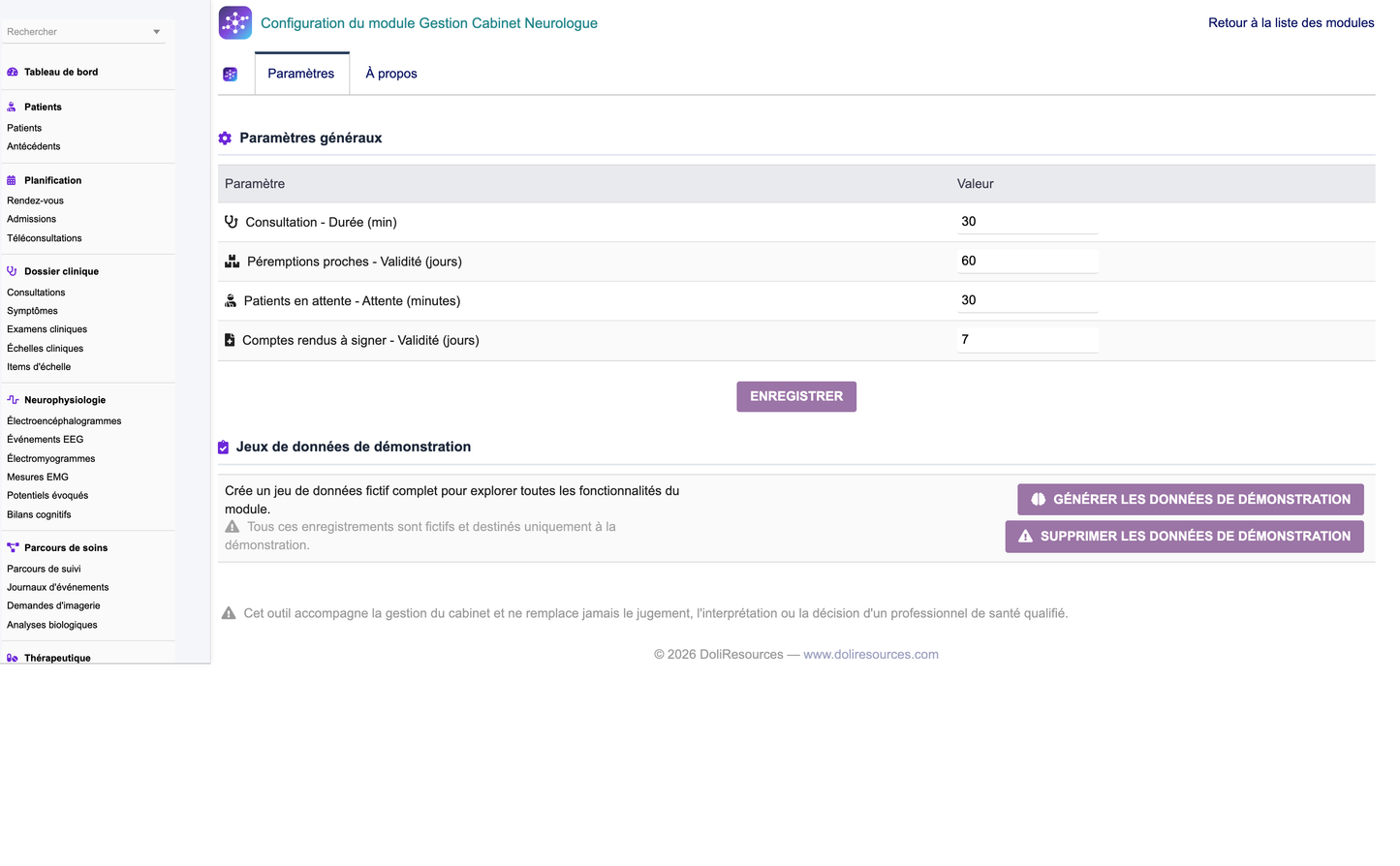
Default consultation duration, stock expiry alert window, patient waiting-time alert threshold, target report signature delay, and default report PDF template |
|
Extensibility |
Custom fields on every object, document templates, triggers, numbering models and a dashboard widget |
|
Demo dataset |
A realistic sample dataset can be generated on first activation and purged afterwards, so the module can be evaluated fully populated |
|
Requirements |
Dolibarr 16.0 or later, PHP 7.1 or later; depends on the Third Parties and Products modules |
· One consolidated record — a single patient file shared by clinical, administrative and financial staff, replacing parallel spreadsheets and disconnected tools;
· Genuine neurophysiology support — EEG, EMG, evoked potentials and cognitive testing modelled properly, with acquisition and interpretation kept as distinct, separately authorised steps;
· Structured long-term follow-up — chronic neurological conditions followed over years, with events, protocols, autonomy and review dates tracked rather than remembered;
· Clinical activity tied to billing — consultations, insurance cover and patient share connected to invoices and payments, so activity converts into measured revenue;
· Operations under control — waiting times, examinations awaiting interpretation, unsigned reports, expiring stock and maintenance due are surfaced automatically;
· Confidentiality by design — granular permissions, a least-privilege default and explicit validation, interpretation and signature rights protect medical confidentiality.
Publisher: DoliResources — www.doliresources.com · Gestion Cabinet Neurologue version 1.0.0 · All sensitive medical functions remain under the responsibility of an authorised healthcare professional.


