
Discover powerful Dolibarr extensions designed to automate your business processes
Organic Store Management is a complete, ready-to-use management solution for organic and natural food retailers, built natively on the Dolibarr ERP/CRM platform. It brings...
Couldn't load pickup availability


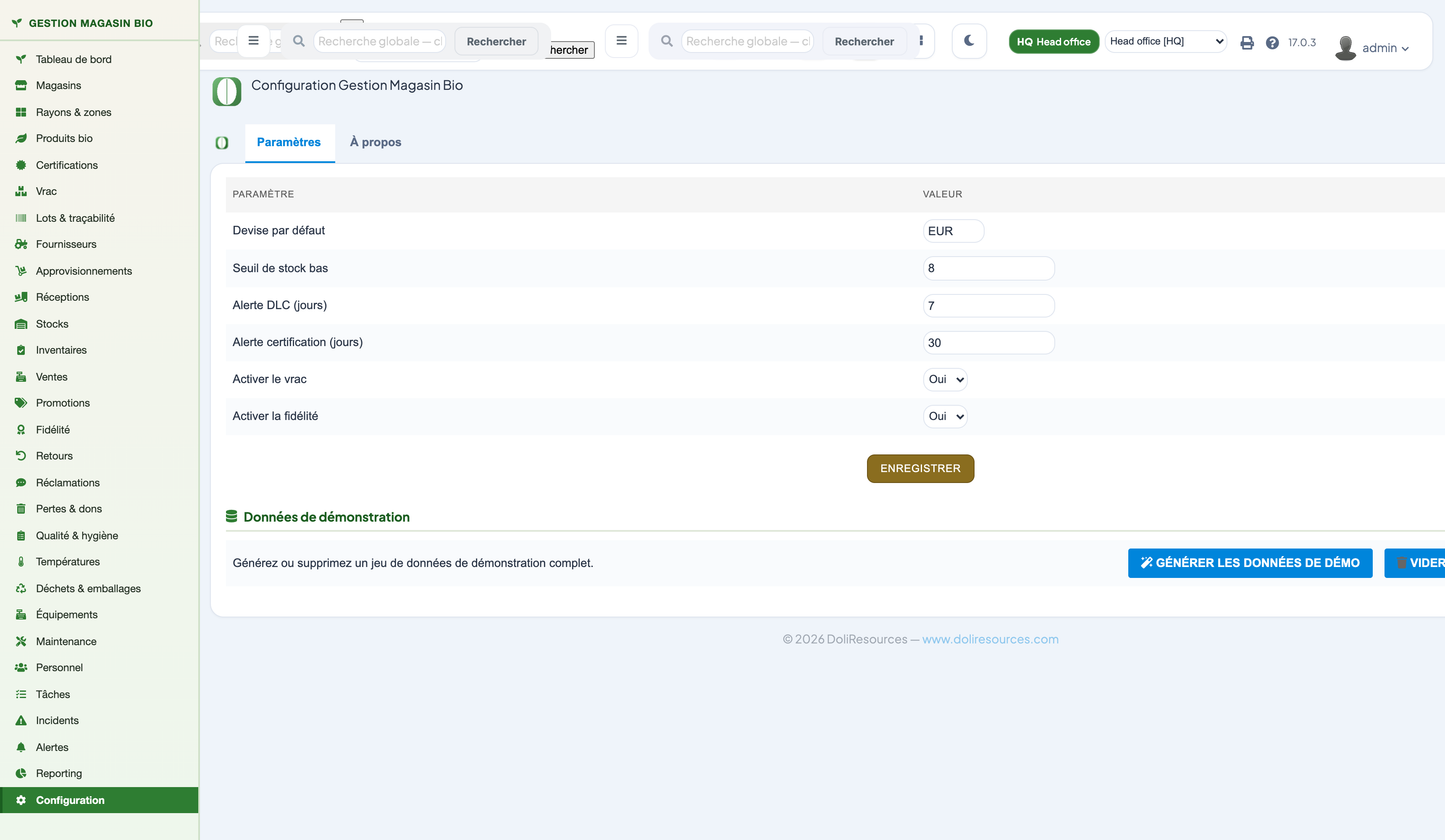
Organic Store Management is a complete, ready-to-use management solution for organic and natural food retailers, built natively on the Dolibarr ERP/CRM platform. It brings together every operational area of an organic store — from certified product catalog and local sourcing to bulk sales, lot traceability, HACCP hygiene, checkout tickets and environmental reporting — inside a single, coherent, multilingual module. Published by DoliResources, the module is designed to help independent stores, cooperatives and small retail chains run a compliant, transparent and sustainability-driven business without leaving their existing Dolibarr environment.
This document provides a structured overview of the module's functional scope, its business objects and permission model, its native integrations with Dolibarr, and its technical requirements. It is intended for store managers, buyers, quality officers and IT decision makers evaluating the solution.
1. Product overview
2. Target users
3. Business challenges
4. Key benefits
5. Organic store & aisle management
6. Product certifications & labels
7. Organic product catalog
8. Bulk product management
9. Weighing & tare management
10. Allergen management
11. Nutritional information
12. Local producer management
13. Procurement (supply proposals & orders)
14. Supplier management & scoring
15. Receiving & quality checks at reception
16. Stock management
17. Lot traceability (upstream/downstream)
18. Expiration management (use-by / best-before)
19. Inventories
20. Sales (checkout tickets)
21. Promotions (incl. anti-waste)
22. Loyalty program (Seed/Sprout/Leaf/Tree tiers)
23. Returns & refunds
24. Complaints & satisfaction
25. Quality control & HACCP hygiene
26. Temperature logs & cold chain
27. Losses, breakage & donations
28. Waste & packaging management
29. Equipment & maintenance
30. Staff & operational tasks
31. Incidents
32. Alert center
33. Bio Retail Ecosystem dashboard
34. Decision reporting & analytics
35. Native Dolibarr integrations
36. Security
37. Multilingual support
38. Demonstration data
39. Technical requirements
40. About DoliResources
Gestion Magasin Bio is an all-in-one Dolibarr module that digitizes the daily operations of an organic retail store, structured around 30 dedicated business objects and 8 permission groups. It covers the full retail cycle — sourcing, receiving, stock, sales, quality and reporting — while putting organic-specific requirements such as certification tracking, allergens, traceability and cold chain at the heart of the workflow.
The module is built for independent organic grocers, natural-food cooperatives, farm shops and small specialist retail chains that want professional-grade management without heavy custom development. It serves store managers, buyers, cashiers, quality and hygiene officers, and back-office staff, each guided by role-based permissions that expose only what they need.
Organic retailers must reconcile strict regulatory demands — certification validity, allergen labelling, batch traceability and HACCP hygiene — with thin margins and highly perishable stock. They also face pressure to source locally, reduce waste and prove their environmental commitment, all while running fast checkout operations. Gestion Magasin Bio addresses these challenges in a single integrated tool instead of scattered spreadsheets and disconnected apps.
By unifying catalog, sourcing, stock, sales and quality data, the module reduces manual re-keying, cuts compliance risk and accelerates day-to-day decisions. Built-in anti-waste promotions, donation tracking and environmental KPIs turn sustainability into measurable performance, while native Dolibarr integration protects existing accounting and CRM investments.
Define one or several stores and organise them into aisles and shelf zones (fresh produce, bulk, grocery, cosmetics, refrigerated, frozen) that mirror the physical layout of the shop. This structure drives merchandising, stock localisation and reporting by department.
Record and monitor organic certifications and quality labels (EU Organic, AB, Demeter, Nature & Progrès, fair-trade and more) together with their certifying body and validity dates. Expiring or missing certificates are surfaced proactively so non-compliant products never reach the shelf.
Manage a rich, organic-oriented product catalog that extends native Dolibarr products with fields for certification, origin, producer, packaging and environmental attributes. Products are classified by aisle and category for fast search, pricing and reporting.
Handle bulk (vrac) products sold by weight or volume from dispensers and gravity bins, including container identification and refill tracking. Bulk sales are fully integrated with weighing, stock and traceability so loose products are managed as rigorously as pre-packed items.
Capture net weight at the point of sale with automatic tare deduction for customer containers and reusable jars. Accurate tare handling ensures fair pricing, correct stock decrement and compliance with weights-and-measures rules.
Attach standardized allergen information to each product and make it visible across catalog, labels and checkout to protect sensitive customers. Allergen data supports both regulatory labelling and in-store customer advice.
Store nutritional values (energy, fats, sugars, proteins, salt, Nutri-Score and more) for packaged and prepared products. This information feeds shelf labels and gives staff instant answers to customer questions.
Maintain a directory of local producers and farms with location, distance, product ranges and partnership terms. Local sourcing is measured and highlighted, reinforcing the short-supply-chain positioning of the store.
Generate supplier supply proposals and purchase orders directly from stock needs and sales trends. The procurement flow connects to Dolibarr's native supplier orders, keeping purchasing and accounting aligned.
Manage suppliers with a scoring model based on quality, reliability, lead time, local sourcing and pricing. Objective supplier scores guide buying decisions and continuous improvement of the supply base.
Record goods receptions with quantity, lot and expiration capture, and perform quality and conformity checks before products enter stock. Non-conforming deliveries are logged and can trigger complaints or returns to the supplier.
Track real-time stock levels per store and warehouse with reorder thresholds, movements and valuation, built on Dolibarr's native stock engine. Perishable and bulk specifics are handled alongside standard stock rules.
Follow each lot from supplier reception through storage to final sale, enabling complete upstream and downstream traceability. In case of a recall, affected lots and their customers or destinations can be identified quickly.
Manage use-by (DLC) and best-before (DDM/DLUO) dates at lot level, with proactive alerts as products approach expiry. This drives rotation, anti-waste promotions and safe removal of out-of-date goods.
Plan and execute full or partial inventories with count sheets, discrepancy analysis and stock adjustments. Regular inventories keep stock accurate for both operations and accounting.
Issue checkout tickets that combine standard, weighed and bulk items, apply promotions and record payment. Sales feed stock, traceability and reporting in real time.
Create promotions including targeted anti-waste discounts on products nearing their expiry date. Anti-waste pricing reduces losses while offering customers value and reinforcing the store's sustainability commitment.
Reward customers through a four-tier loyalty program — Seed, Sprout, Leaf and Tree — with points and benefits that grow with engagement. The nature-inspired tiers strengthen customer retention and community around the store.
Process product returns and issue refunds with reason tracking, linked back to the original ticket and stock. Clear return handling protects both customer satisfaction and stock accuracy.
Log customer complaints and satisfaction feedback, categorise them and follow through to resolution. Aggregated feedback highlights recurring issues and supports service quality improvement.
Run HACCP-based hygiene and quality controls with checklists, control points and corrective actions. Documented controls demonstrate compliance during audits and inspections.
Record temperature readings for refrigerated and frozen equipment to guarantee cold-chain integrity. Out-of-range readings raise alerts so corrective action is taken before product safety is compromised.
Track stock losses, breakage and shrinkage, and register donations of edible surplus to associations. This turns unavoidable losses into measured, partly valorised outcomes rather than hidden costs.
Monitor waste streams and packaging, including reusable and deposit containers, to reduce environmental footprint. Packaging data supports both cost control and sustainability reporting.
Register store equipment (refrigeration units, scales, dispensers) and plan preventive and corrective maintenance. Well-maintained equipment protects the cold chain, weighing accuracy and continuity of operations.
Assign and follow operational tasks to staff members, from shelf replenishment to cleaning and controls. Task tracking keeps daily store operations organised and accountable.
Report and manage in-store incidents — safety, equipment, hygiene or customer-related — through to closure. Structured incident handling reduces risk and builds an auditable history.
Centralise operational alerts — expiring certifications and lots, cold-chain breaches, low stock and overdue tasks — in one place. The alert center ensures critical issues are seen and acted on promptly.
The Bio Retail Ecosystem dashboard is the module's control tower, presenting commercial, stock/quality and environmental KPIs through clear charts and indicators. It gives managers an at-a-glance view of performance across sales, sourcing, quality and sustainability.
Beyond the dashboard, detailed reports analyse sales, margins, supplier scores, losses and environmental indicators such as local-product share, bulk share, local-supplier share, average supply distance, waste valorization rate and donations. These analytics turn day-to-day data into concrete decisions and sustainability proof points.
Gestion Magasin Bio integrates natively with core Dolibarr modules — Third parties, Products, Stock, Warehouses and Users — reusing existing records instead of duplicating them. This ensures a single source of truth and full continuity with accounting, CRM and purchasing.
The module enforces granular, role-based permissions across its 8 groups plus an administration right, and applies CSRF protection and server-side input validation on its forms. It is multi-entity aware, so groups managing several shops can isolate data per entity.
The interface and data labels are fully translated into French, English, Spanish, Italian and German. Stores operating in multilingual regions or cross-border contexts can work in their preferred language out of the box.
A complete set of realistic demonstration data can be loaded to explore every feature — products, producers, suppliers, sales, lots, controls and KPIs — immediately after installation. This lets evaluators and new users learn the module on meaningful, pre-populated examples.
The module ships with 8 functional permission groups plus a dedicated administration right, allowing precise control over what each role can see and do.
|
Permission group |
Scope covered |
|
Stores & aisles |
Manage stores, aisles, shelf zones and store organisation. |
|
Bio catalog |
Manage organic products, certifications, labels, allergens and nutrition. |
|
Purchasing & receptions |
Handle producers, suppliers, supply proposals, orders and goods receptions. |
|
Stock & inventories |
Manage stock levels, lot traceability, expirations and inventories. |
|
Sales & customers |
Operate checkout tickets, promotions, loyalty, returns and complaints. |
|
Quality & losses |
Run HACCP controls, temperature logs, losses, donations and waste. |
|
Equipment & staff |
Manage equipment, maintenance, operational tasks and incidents. |
|
Reporting |
Access the Bio Retail Ecosystem dashboard and decision analytics. |
An additional administration permission governs module configuration and setup.
The module is structured around 30 business objects. The table below lists representative objects and their purpose.
|
Business object |
Purpose |
|
Store |
A physical organic retail outlet. |
|
Aisle |
A department or shelf zone within a store. |
|
Certification |
An organic or quality label with validity and body. |
|
BioProduct |
An organic catalog product with origin and attributes. |
|
BulkProduct |
A loose product sold by weight or volume. |
|
Allergen |
A standardized allergen linked to products. |
|
NutritionInfo |
Nutritional values for a product. |
|
Producer |
A local producer or farm supplying the store. |
|
Supplier |
A supplier with a performance score. |
|
SupplyProposal |
A proposed supply/purchase suggestion. |
|
PurchaseOrder |
A confirmed order to a supplier. |
|
Reception |
A goods reception with lot and quality checks. |
|
StockMovement |
A stock entry, exit or adjustment. |
|
Lot |
A traceable batch with expiry dates. |
|
Inventory |
A stock count and reconciliation session. |
|
SalesTicket |
A checkout ticket for a customer sale. |
|
Promotion |
A discount, including anti-waste offers. |
|
LoyaltyCard |
A customer loyalty account with tier and points. |
|
Return |
A product return and refund record. |
|
Complaint |
A customer complaint or feedback item. |
|
QualityControl |
An HACCP hygiene or quality inspection. |
|
TemperatureLog |
A cold-chain temperature reading. |
|
Loss |
A loss, breakage or shrinkage record. |
|
Donation |
A donation of surplus edible goods. |
|
Packaging |
A packaging or reusable container record. |
|
Equipment |
A piece of store equipment. |
|
MaintenanceTask |
A preventive or corrective maintenance action. |
|
StaffTask |
An operational task assigned to staff. |
|
Incident |
An in-store incident record. |
|
Alert |
A centralized operational alert. |
|
Item |
Requirement |
|
Dolibarr version |
16.0 or higher |
|
PHP version |
7.1 or higher |
|
Database |
MySQL 5.5+ / MariaDB 10+ |
|
Module technical name |
gestionmagasinbio (installs under htdocs/custom/gestionmagasinbio) |
|
Languages |
French, English, Spanish, Italian, German |
|
License |
GNU GPL v3 or later |
|
Editor |
DoliResources — www.doliresources.com |
Gestion Magasin Bio runs on Dolibarr 16 or higher with PHP 7.1 or higher and a MySQL or MariaDB database. It installs as a standard custom module under htdocs/custom/gestionmagasinbio and requires no external services, making deployment straightforward on any compliant Dolibarr instance.
DoliResources is a specialist publisher of professional Dolibarr modules, focused on ready-to-use business solutions for specific industries and trades. Committed to open standards and the GNU GPL, DoliResources helps organisations extend Dolibarr with robust, multilingual and well-documented modules. Learn more at www.doliresources.com.
Gestion Magasin Bio · Version 1.0.0 · © 2026 DoliResources · GNU GPL v3+ · www.doliresources.com


