
Discover powerful Dolibarr extensions designed to automate your business processes
Packaging Factory Management transforms Dolibarr into a complete, specialized ERP for packaging plants. It covers the entire value chain of a company...
Couldn't load pickup availability


Packaging Factory Management transforms Dolibarr into a complete, specialized ERP for packaging plants. It covers the entire value chain of a company that designs, prints, cuts, folds, glues, assembles, stores and ships packaging, so the business can be driven end-to-end without a separate industry system.
The module ships 39 fully-integrated business objects, a new-generation industrial dashboard, an advanced technical-quote engine, multi-level bills of materials and routings, full production management (manufacturing orders, declarations, printing, cutting, gluing), one-click lot traceability, a complete quality system (control plans, SPC, non-conformities, CAPA, audits, claims), an integrated GMAO maintenance module, purchasing, logistics, cost-of-goods and margin analysis, a decision-support reporting suite, Business Intelligence, an optional AI assistant and a secured REST API — all in five languages and integrated with Dolibarr's native modules.
· Give packaging manufacturers a single system covering engineering, quoting, production, quality, maintenance, inventory, purchasing, logistics and costing.
· Guarantee continuity from prospect to after-sales: prospect, quote, technical validation, mock-up, print proof, order, planning, manufacturing order, procurement, production, quality control, storage, shipment, invoicing, payment, after-sales.
· Improve overall equipment effectiveness (OEE/TRS), reduce scrap and changeovers, and control real vs. planned cost.
· Ensure regulatory traceability (food, pharmaceutical, cosmetic packaging) with upstream/downstream lot tracing and quality release.
· Fit both a small workshop and a multi-site industrial plant organised in sites, workshops, lines, machines, teams and warehouses.
The module manages, from within Dolibarr, the full set of packaging-plant entities and processes:
· Master data: sites, workshops, production lines, machines, teams, operators, materials, reels, inks, toolings and packaging products.
· Engineering & design, print proofs (BAT), technical quotes, bills of materials, routings.
· Planning, manufacturing orders, production declarations, printing / cutting / gluing detail sheets, stoppages, waste & scrap.
· Inventory & traceability: lots, pallets (SSCC), stock movements, FIFO/FEFO logic, valuation.
· Quality, maintenance (GMAO), purchasing & approved suppliers, logistics & shipments.
· Costing & margins, reporting, Business Intelligence, optional AI, REST API, demo data.
A standard Dolibarr external module under htdocs/custom/packagingfactory, using only official mechanisms and never modifying the core. 39 business objects extend CommonObject and are described in a central registry; generic list and card engines render any object, avoiding per-object duplication.
· SQL: 39 llx_pkf_* tables with indexes, multi-entity aware, a runtime schema self-heal for upgrades.
· Descriptor: 42 granular permissions, a 13-section menu tree, cron job, boxes, module constants.
· Presentation: industrial CSS charter, FontAwesome 5 icons, responsive layout for desktop, tablet, touch panels and supervision screens.
· Five languages: French, English, Spanish, Italian, German. Every visible key is module-prefixed to prevent cross-module collisions.
Granular rights map to real plant roles. Read and write are granted by default so the module is usable immediately after activation; sensitive actions (validate quote, validate proof, launch/close production, inventory, release/block lot, access costs, reporting, export, demo data, API) are off by default.
Typical profiles: administrator, management, plant manager, production manager, planner, workshop/shift leader, operator, quality manager, quality controller, maintenance manager and technician, storekeeper, logistics and purchasing managers, sales, accountant, and read-only viewer.
A new-generation cockpit, deliberately different from Dolibarr's classic dashboards. It opens with a supervision bandeau (active site, shift, running/stopped lines, connected user, critical alerts) and a 'Digital Packaging Factory' view where every line is an interactive card colour-coded by state (running, preparing, slowdown, changeover, down, idle, cleaning, maintenance) showing the current order, product, customer, target vs. produced quantity, progress and rate.
A KPI grid presents production of the day/week/month, completion rate, OEE/TRS, availability, performance, quality, scrap rate, conformity rate, material and energy consumption, waste, production cost, orders to ship, critical stocks, breakdowns, maintenance due and pending controls. Interactive charts and a smart-alert panel complete the view.
The engineering office manages technical studies with full versioning: customer request, product to pack, constraints (dimensions, weight, fragility, transport/storage/print/food/environmental), estimated quantity, budget, deadline, responsible technician, files and status. Previous versions are never overwritten. Statuses run from request received through study, prototype, internal validation, sent to customer, modification requested, validated, abandoned or converted to a quote.
Each proof records customer, product, version, PDF/image files, dimensions, colours, texts, barcodes, regulatory mentions, send and return dates, customer comments, internal and customer validation and the proof of validation. Statuses: draft, internal control, sent, modification requested, validated, refused, expired. A print order should not be launched without a validated proof, except with a special right and justification.
An advanced costing engine computes required material, used surface, waste rate, number of ups, sheets, reel length, ink, glue, varnish, film, setup/machine/operator/changeover time, tooling, plate, cutting die, energy, quality, secondary packaging, transport, storage, subcontracting, overheads, margin and final price. It supports multi-quantity simulation, price breaks, economic quantity, scenario comparison, cost variants, margin in value and percentage, floor price and breakeven. A technical quote converts into a native Dolibarr commercial proposal.
Multi-level BOMs manage version, application date, quantity, unit, loss rate, substitute material, preferred supplier, cost, status and validation. Example: a printed box breaks down into cardboard, CMYK inks, varnish, glue, film, label and grouping carton.
Manufacturing routings model the operations of a packaging line: preparation, printing, drying, lamination, varnishing, cutting, creasing, embossing, hot foil, folding, gluing, assembly, control, packing and palletisation. Each operation specifies the workstation, machine, setup time, cadence, unit time, number of operators, required skills, controls, documents, consumption and hourly cost.
Manufacturing orders carry the full context and a rich status lifecycle: draft, planned, validated, materials reserved, in preparation, ready, launched, running, suspended, in control, done, closed, cancelled. Production declarations capture per-operation machine, operator, team, times, produced/good/scrap quantities, material, ink, glue and energy consumption, stoppages, incidents and yield.
Print orders cover offset, flexography, gravure, screen, digital, inkjet and thermal processes with number and sequence of colours, ink references, plates, cylinders, viscosity, temperature, speed, registration, density, ink quantity, losses and cleaning time.
Cut orders record the cutting die and tooling reference, number of ups, pressure, speed, creasing, perforation, cutting, embossing, hot foil and windowing, plus sheets in, good sheets, rejected sheets and waste.
Glue orders manage glue type, dosage, temperature, drying time, number of glue points, speed and closure system, and record folding/gluing defects, missing pieces and the final control result.
Detailed waste management by category (cardboard, paper, plastic, films, inks, glues, solvents, chemicals, defective packaging, broken pallets, metals, hazardous and recyclable waste) with origin, cause, quantity, weight, valorisation, provider, cost and recycling revenue. The module computes scrap rate, material loss rate, waste cost, recovered value, recycling rate and estimated environmental impact.
Integrated with native Dolibarr stock. Manages raw materials, reels, sheets, inks, glues, varnishes, films, consumables, toolings, semi-finished and finished products, waste and spare parts, with lots, serial numbers, locations, warehouses, reservations, transfers, inventories, min/max levels, alerts, FIFO/FEFO, valuation and one-click upstream/downstream lot traceability. Finished lots roll up to pallets identified by SSCC.
A complete quality system: control plans (stage, type, frequency, sampling, target and tolerances, method), reception/production/finished controls with measured values and conformity, non-conformities with root cause, decision and cost impact, CAPA corrective/preventive actions, audits (internal, certification, supplier), certificates, lot release/block and customer claims.
An integrated GMAO manages the machine park, equipment records, counters, preventive/corrective/conditional maintenance, breakdowns, interventions, technicians, providers, spare parts, contracts, costs and history. It computes MTBF, MTTR, availability, maintenance cost, downtime, production loss and the realised-preventive rate.
Links to native suppliers, price requests, purchase orders, receptions, supplier invoices and payments, with approved suppliers, supplied materials, lead time, price, quality, certifications, conformity and on-time rates, rating and audits. Purchase needs are created from customer orders, manufacturing orders, minimum stock, maintenance and forecasts.
Integrated with prospects, customers, contacts, opportunities, quotes, orders, contracts, shipments, invoices, payments, tickets and agenda. From a customer order the user can trigger the study, technical quote, print proof, manufacturing orders, material reservation, planning, follow-up, shipment and invoicing.
Manages preparations, picking, parcels, cartons, pallets, labels, SSCC, loading, shipments, carriers, delivery tracking, proof of delivery and returns. Before shipment it checks conformity, quantity, lot, pallet, documents, order, weight, volume, customer and destination.
Automatic cost of goods: material, ink, glue, film, tooling, machine, operator, energy, maintenance, quality, subcontracting, logistics, waste and secondary packaging, giving total and unit cost and margin. Planned, standard, real and invoiced costs are compared, with planned vs. real margin and variance.
A developed reporting menu produces daily, weekly, monthly, quarterly, annual and custom reports across production, yield, quality, maintenance, stock, purchasing, sales, margins, waste, energy and traceability. Every report exports to CSV, Excel, Word and PDF, and can be printed or emailed. Non-HTML exports decode entities and preserve accents.
A decision centre with multi-criteria filters and drill-down across sites, workshops, lines, machines, customers, products, teams and materials, with saved filters, interactive charts and computed indicators.
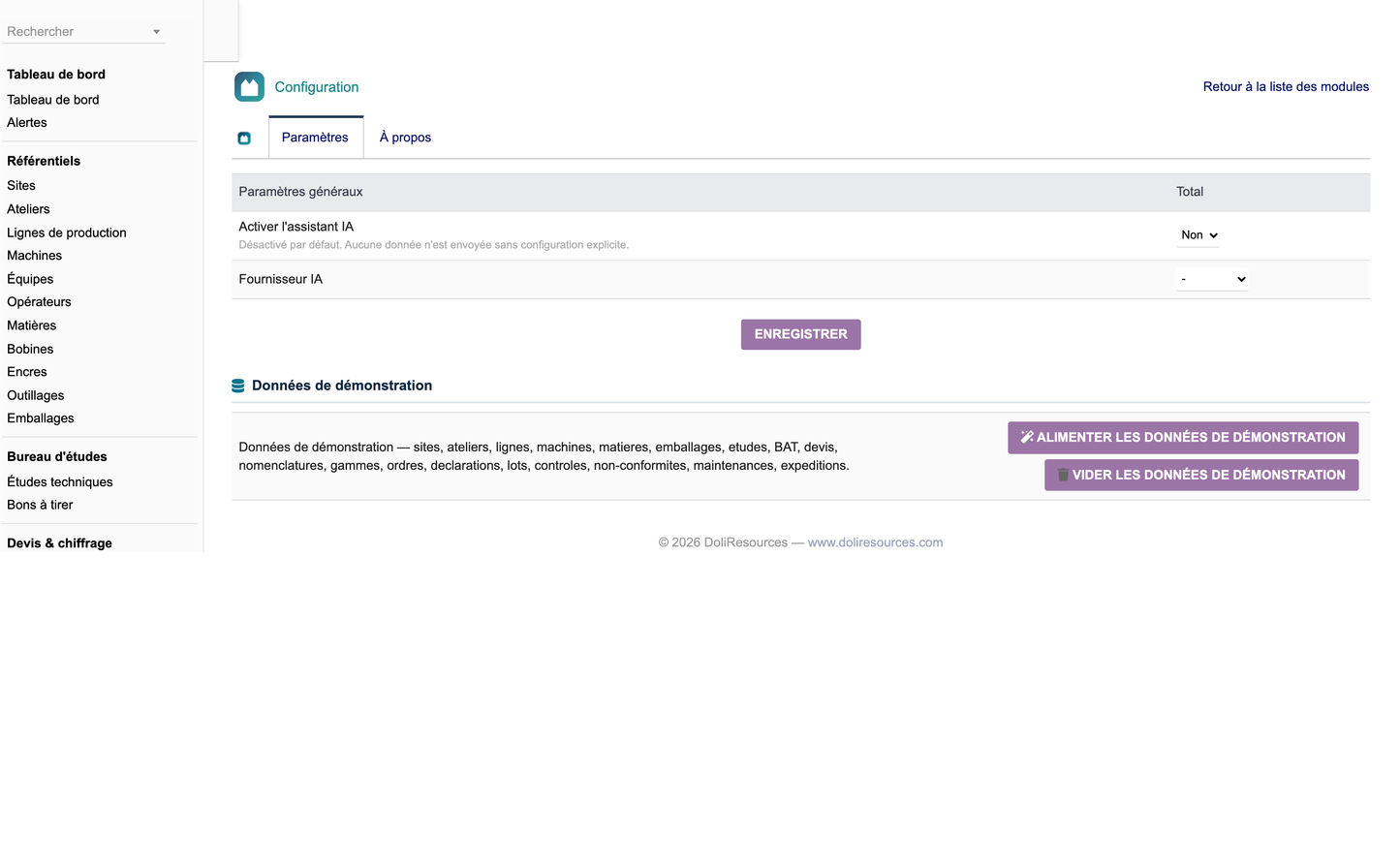
An optional AI architecture can connect OpenAI, Anthropic, Mistral, Google Gemini or Ollama for demand and material forecasting, delay and breakdown prediction, cost estimation, price recommendation, anomaly detection, planning optimisation, scrap and non-conformity analysis, corrective-action suggestion and report summarisation. The AI is disabled by default; no data is sent to any external service without explicit consent and configuration. An explainable offline heuristic mode is always available.
A secured REST API exposes manufacturing orders, packagings, materials, controls, lots, maintenances and shipments with authentication by API key, permission checks, pagination, filters, sort-field whitelisting and JSON error handling. The URL base is /api/index.php/packagingfactory/. A bogus key returns 401.
CSRF and XSS protection, prepared statements, input validation, per-page permission checks, secured uploads with MIME control, logging without sensitive data, API protection and error handling. Critical operations are historised.
The setup page offers one-click 'Load demo data' and 'Clear demo data'. The generator creates a realistic, FK-coherent dataset so dashboards and reports are immediately meaningful (production today, ~98% conformity, ~92% availability, ~4% scrap). Every demo row is tagged with the marker PKFDEMO and removed on purge, which cascades to user-created children and never touches real data. A strong confirmation is shown before deletion.
Installation: copy the packagingfactory folder into htdocs/custom, enable the module in Home > Setup > Modules, and open the dashboard from the top menu. Compatible with Dolibarr 18 to 23, PHP 8.0+, MariaDB/MySQL, mono- and multi-entity.
Deliverables: the installable module ZIP (module_packagingfactory-1.0.zip), high-resolution screenshots, this English features document, a French user training manual (PDF) and the English technical documentation.
Copyright © 2026 DoliResources — www.doliresources.com


