
Discover powerful Dolibarr extensions designed to automate your business processes
The Packaging Unit Management module turns Dolibarr into a dedicated ERP for the complete control of an industrial packaging unit. It...
Couldn't load pickup availability


The Packaging Unit Management module turns Dolibarr into a dedicated ERP for the complete control of an industrial packaging unit. It covers 100% of the business needs of a packaging company, regardless of its industry.
· Food processing; fresh, frozen and dry food products
· Cosmetics, pharmaceuticals, chemicals, cleaning products
· Agricultural products; contract packaging and repackaging; industrial packaging
· Liquid, powder, granulated, pasty and solid products
Without leaving Dolibarr, the solution manages: raw materials and packaging, lines and machines, packaging orders, finished goods, lots (use-by/best-before dates), pallets, cartons and parcels, operators and teams, maintenance, quality and controls, non-conformities, statistics and costs, sales, purchasing, shipments, stock, dashboards and reporting.
Key figures: 36 business objects · 10 functional domains · 34 granular permissions · 50 menu entries on 2 levels · 5 languages (FR, EN, ES, IT, DE) · 569 translation keys · full REST API.
The module strictly follows Dolibarr development standards and never alters any core file. It integrates exclusively through the module descriptor, business classes, menus, permissions, hooks and the native API.
|
Characteristic |
Value |
|
Technical name / folder |
conditionnement |
|
Module number |
527600 (dedicated range, collision-free) |
|
Table prefix |
llx_cnd_* (36 tables) |
|
Languages & technologies |
PHP 8+, MariaDB / PostgreSQL, jQuery, Ajax, Bootstrap, HTML5, modern responsive CSS |
|
Structure |
class/, core/modules/, core/boxes/, css/, js/, sql/, img/, lib/, langs/, admin/ |
|
Dolibarr compatibility |
V18, V19, V20, V21, V22, V23 and later |
|
Schema self-healing |
Automatic ALTER TABLE of missing columns on upgrade |
|
Multi-company |
Every record carries the entity field (multi-company) |
|
Technical traceability |
Creation date, author, modification date, status and import key on every record |
· Protection against SQL injection (all queries escaped)
· XSS protection (all HTML output escaped)
· CSRF protection (Dolibarr security tokens on forms and actions)
· Form validation and permission checks on every sensitive action
· No hard-coded strings: 569 translation keys across 5 languages
· Responsive interface: PC, tablet, mobile, large and industrial touch screens
A redesigned interface evoking a modern production floor. Industrial palette: industrial blue, production green, performance orange, aluminium grey and white. The display relies on dynamic cards with icon, value, sub-text and colour coding, together with charts.
· Actual production and target achieved (%)
· Number of lots produced, pallets and cartons
· Scrap rate
· Number of packaging orders of the day
· Overall OEE
· Availability
· Performance
· Quality
· Production over 7 days
· Scrap by cause
· Orders by state
· Downtime by type
Each line is shown as a colour-coded card according to its state: green (running), orange (maintenance/cleaning), red (stopped/breakdown), blue (setup). The card shows the OEE, actual rate, yield and current product.
· Lots expiring soon
· Open non-conformities
· Open maintenance work orders
· Measuring instruments out of validity
· Non-conform controls
Multi-site, multi-workshop and multi-line management. Eleven objects structure the industrial setup. The main fields are detailed below.
|
Field |
Description |
|
Code / Name |
Site identifier and label |
|
Address, town, country, zip |
Location |
|
Manager |
Dolibarr user in charge |
|
Latitude / Longitude |
GPS coordinates |
|
Timezone, opening hours |
Production calendar |
|
Maximum capacity |
Production volume |
|
Nb lines / machines / operators |
Computed automatically |
|
Certifications |
ISO 9001, ISO 22000, HACCP, BRC, IFS |
Types: preparation, packaging, wrapping, palletising, storage, quality control. Fields: site, manager, area, min/max temperatures, utilisation rate.
|
Field |
Description |
|
Line type |
Liquid, powder, solid, granulated, pasty |
|
State (real time) |
Running, setup, cleaning, maintenance, stopped, paused, breakdown, end of run |
|
Nominal / actual rate |
Theoretical and observed throughput |
|
Maximum speed |
Line capacity |
|
Yield, Availability, Performance, Quality |
OEE components |
|
OEE |
Overall equipment effectiveness |
|
Current product / lot |
Activity tracking |
Equipment that can make up a line: filler, scale, conveyor, bagger, heat sealer, welder, labeller, inkjet printer, robot, vision camera, metal detector, checkweigher, palletiser, wrapper, pick & place robot.
|
Field |
Description |
|
Reference, brand, model, serial no. |
Manufacturer identification |
|
Purchase / commissioning / warranty dates |
Life cycle |
|
Criticality |
Low, medium, high, critical |
|
Machine state |
Running, stopped, maintenance, setup |
|
Power, capacity |
Technical characteristics |
|
Hour / cycle counters |
Cumulative use |
|
Nb failures, MTBF, MTTR |
Reliability |
|
Availability, OEE |
Performance |
|
Elec / air / water consumption |
Energy monitoring |
Logistics hierarchy: reception, storage, quarantine, quality control, shipping, preparation, picking, palletising zones, cold rooms. Fields: site, parent warehouse, type, capacity, capacity unit, maximum weight and volume, min/max temperatures, humidity, occupancy rate, barcode/QR code.
Types: bag, sachet, box, bottle, jar, canister, carton, pallet, drum, big bag, glass bottle, tray, film, tube, capsule, blister. Fields: dimensions, weight, volume, capacity, unit, contact standards.
Levels: primary, secondary, tertiary, films, labels, adhesives, dunnage, dividers, pallets. Fields: family, supplier, unit cost, stock and minimum stock, weight, dimensions, barcode, recyclability.
Types: inks, ribbons, films, glues, labels, gases, lubricants, cleaning and disinfection products. Fields: supplier, cost, unit, stock/min stock, lot number, expiry date, safety data sheet.
Versioned industrial recipes linked to a product. Fields: version, state (draft, validated, approved, obsolete), format, target weight, tolerance, allergens, shelf life (days), approval date, approver, components.
A route describes the full sequence of packaging steps. Example: reception → control → preparation → weighing → dosing → filling → closing → sealing → labelling → marking → control → cartoning → palletising → storage → shipping. Each step is configurable: rank, type, machine, duration, number of operators, control step, instructions.
The core of production management. Fields: customer, sales order, product, recipe, route, line, team, manager, planned/produced/good/scrap quantities, unit, priority, dates (planned, start, end), duration, yield, OEE, total cost, subcontracting.
Order life cycle:
|
State |
Meaning |
|
Planned |
Order created, not yet scheduled |
|
Scheduled |
Positioned in the planning |
|
In preparation |
Materials and packaging being prepared |
|
In production |
Packaging in progress |
|
Suspended |
Temporarily interrupted |
|
Done |
Production completed and closed |
|
Cancelled |
Order cancelled |
Detailed entry per operator and per order: good production, scrap, rework, time spent, actual rate, comments.
Types: planned, unplanned, micro-stop, maintenance, cleaning, breakdown, waiting for material, waiting for operator, waiting for quality, setup, format changeover. Feeds the automatic calculation of MTBF, MTTR and availability. Fields: line, machine, order, dates, duration, lost quantity.
Categories: machine error, operator error, wrong packaging, quality defect, raw material, humidity, breakage, print error, label, tear, weight, leak, deformation. Fields: order, line, operator, quantity, cost, cause, corrective action.
Complete, instant traceability from raw material to the end customer: upstream, internal and downstream.
|
Field |
Description |
|
Lot no., product, order |
Identification and linking |
|
Parent lot, supplier lot |
Upstream genealogy |
|
Origin, country of origin, supplier |
Provenance |
|
Manufacturing / packaging dates |
Time markers |
|
Use-by / best-before dates |
Shelf-life limits |
|
Initial / available / reserved / blocked / consumed quantities |
Quantity tracking |
|
Quality status |
Pending, quarantine, conform, released, blocked, non-conform, expired |
|
Location, block reason |
Location and justification |
Fields: reference, SSCC, lot, order, location, customer, type, number of cartons and layers, total quantity, net/gross weight, height, state (building, complete, stored, shipped), consignment.
Logistics hierarchy unit → carton → pallet. Fields: parent pallet, lot, format, barcode, number of units, net/gross weight, state.
A lot record shows its quality cockpit (status, available quantity, use-by date, blocked quantity) and all linked records (controls, pallets, claims, stock movements): the full genealogy is available in one click.
A quality management system adaptable to the ISO 9001, ISO 22000, HACCP, BRCGS and IFS standards, good manufacturing practices and customer specifications.
Defined by product, line and step. Fields: control point, method, instrument, frequency, sample size, target value, lower and upper limits, unit, mandatory flag, action on deviation, version.
Stages covered: reception control, start-up / first article, in-process (weight, volume, dosing, temperature, closure, sealing, tightness, labelling, barcode, metal detector, foreign bodies, organoleptic, microbiological) and finished product. Fields: plan, order, lot, instrument, controller, measured value, conformity, deviation, status.
Full register. Origins: reception, storage, production, packaging, quality, maintenance, transport, customer, supplier, audit, hygiene, safety, documentary.
Possible decisions:
|
Decision |
Decision |
|
Accept |
Accept under waiver |
|
Sort |
Rework / reprocess |
|
Repackage |
Downgrade |
|
Return to supplier |
Replace |
|
Destroy |
Block |
Root-cause analysis methods: 5 whys, Ishikawa diagram, 5W2H, Pareto, 8D analysis, FMEA, cause tree.
Types: immediate action, correction, corrective action, preventive action. Fields: source non-conformity or audit, owner, due date, cost, state, effectiveness verification, verification date, action plan. Automatic alerts when overdue.
Types: internal, supplier, customer, regulatory, hygiene, quality, traceability, 5S. Fields: standard, site, audited party, auditor, dates, number of major/minor findings, score, state, conclusion.
Calibration register: scales, thermometers, probes, pressure gauges, detectors, laboratory devices, calipers. Fields: measuring range, accuracy, calibration and next-calibration dates, body, state. Automatic alert when an instrument is out of validity.
Cleaning and disinfection plans by line and machine. Fields: type, frequency, product used, concentration, duration, operator, planned/actual dates, allergen change, control result, state. No production starts without validation of the mandatory cleaning.
Types: preventive, corrective, condition-based, improvement. Fields: machine, line, priority, technician, provider, dates (planned, start, end), duration, production stop, symptom, diagnosis, parts and labour costs, report.
Life cycle: reported → to qualify → planned → assigned → in progress → waiting for part → done → checked → closed (or cancelled).
Fields: compatible machine, supplier, location, unit cost, stock and minimum stock, lead time, criticality, quantity consumed. A purchase requirement can be triggered when the stock reaches the defined threshold.
· Number of failures, total downtime
· MTBF (mean time between failures), MTTR (mean time to repair)
· Availability rate
· Costs per machine and per line
· Most critical equipment and failure recurrence
Reception wizard: order, supplier, product, lot, vehicle/seal/temperature/certificate checks, expected/received/refused quantities, quarantine or release, allocation to a location, state.
Fields: customer, carrier, dock, driver and phone, tractor/trailer plates, seal, departure temperature, number of pallets and cartons, gross weight, volume, incoterm, state. Pre-shipment checks: quality conformity, lot release, sufficient use-by/best-before date, availability, mandatory documents.
Types managed and logged: supplier reception, production consumption, finished-goods production, transfer between warehouses/locations/sites, reservation, quality block/release, quarantine, downgrade, repackaging, customer/supplier return, destruction, inventory, shipment. Fields: product, lot, quantity, source and destination locations, reason, source document.
Types: annual, cycle, permanent, surprise, post-incident. Fields: site, location, scope, freeze, number of gaps, gap value, state. Workflow: creation → scope → freeze → counting → validation → gaps → correction movements → closing → report.
Fields: supplied families, certifications, lead time, minimum quantity, conformity/service/late rates, number of claims and non-conformities, global score, approval status (prospect, evaluating, approved, conditional, suspended, banned), last audit date.
Full workflow: reception → identification of customer/product/lot/delivery → description → severity → lot block if needed → analysis → decision → control → reprocessing/replacement/credit/destruction → customer reply → closing. Linked to third parties, orders, shipments, products, lots.
· Operators: employee ID, role, skills, certifications, authorised machines, hire date, productivity, quality rate, number of errors
· Teams: morning, afternoon, night, weekend — team leader, hours, headcount, performance
· Timesheets: operator, team, order, worked hours, breaks, overtime, absences
Twelve automatically generated reports, each exportable to CSV, Excel, Word and PDF:
|
Report |
Content |
|
Daily production |
Produced/good/scrap quantities, scrap rate per day |
|
Yield / OEE |
OEE, availability, performance and quality per line |
|
Downtime |
Downtime by type, count and duration |
|
Scrap |
Scrap by cause, quantity and cost |
|
Quality |
Controls by stage and conformity rate |
|
Non-conformities |
NC by source, count and estimated cost |
|
Traceability |
Lots with quality status, manufacturing and use-by dates |
|
Maintenance |
Work orders by type, duration and cost |
|
Stock |
Lots by quality status, available/blocked quantities |
|
Shipments |
Shipments by state, pallets and weight |
|
Suppliers |
Conformity, service, score and approval |
|
Cost |
Production cost per line |
Exports respect UTF-8 encoding: correct accents in CSV and PDF, safe character escaping in Excel and Word, with no HTML entity leakage.
34 granular permissions. Each functional group holds read, create/modify and delete rights; reporting read access and module administration are added.
|
Right group |
Scope covered |
|
Master data |
Sites, workshops, lines, machines, locations, formats, packaging, consumables, recipes, routes |
|
Production |
Orders, declarations, downtime, scrap |
|
Traceability |
Lots, pallets, cartons |
|
Quality |
Control plans, controls, non-conformities, CAPA, audits, instruments, cleaning |
|
Maintenance |
Work orders, spare parts |
|
Logistics |
Receptions, shipments |
|
Stock |
Movements, inventories |
|
Purchasing |
Approved suppliers |
|
Sales |
Customer claims |
|
Human resources |
Operators, teams, timesheets |
|
Reporting |
Access to the decision centre (read) |
|
Administration |
Module configuration |
The module primarily leverages native objects, without duplicates, and enriches them: Third parties, Contacts and addresses, Prospects and customers, Suppliers, Products and services, Variants, Lots and serial numbers, Stock and warehouses, Stock movements, Supplier price requests and orders, Receptions, Supplier invoices, Commercial proposals, Sales orders, Shipments, Invoices, Payments, Contracts, Projects, Tasks, Agenda, Resources, Users and groups, DMS, E-mails, PDF templates, Barcodes, REST API, Accounting, Banks, Multi-company.
Examples of relationships visible from the records: from a sales order, the associated packaging orders; from an order, the sales order, customer, lots, controls and shipments; from a lot, its full genealogy; from a machine, its work orders and costs.
A secure API exposed at /api/index.php/conditionnement/{object}/{id}. Operations: single read, paginated and sorted list, create and delete over all business objects. Authentication via Dolibarr API key; permission checks per functional group (invalid key → HTTP 401; missing right → HTTP 403).
The module provides configurable workflows and alerts, notably:
· Automatic creation of packaging orders from customer orders
· Reservation of raw materials and packaging; stock decrement at launch
· Generation of finished goods, lots, pallets and parcels; real-time indicator updates
· Notification of managers on incidents; creation of maintenance tasks based on thresholds
· Alerts: stock below minimum, shortage risk, lot near expiry or expired, late reception, non-conform control, blocked lot, overdue corrective action, upcoming audit, instrument to calibrate, maintenance due, low rate, low OEE, excessive scrap
· Channels: Dolibarr notification, e-mail, agenda event, task, webhook, SMS (if configured), dashboard alert
The system warns about or prevents, in particular, the following situations (configurable mode: strict block, warning with confirmation, or plain information):
· Consumption of an expired, blocked or unreleased lot
· Use of an incompatible packaging or a product not approved for a customer
· Issue greater than available stock; shipment of an unreleased lot; insufficient remaining shelf life at delivery
· Use of a non-calibrated instrument; start of a non-cleaned line or a machine under maintenance
· Validation of a reception without mandatory information; exceeding a location's capacity
· Closing a non-conformity without action or justification; closing a work order without a report
Controlled import from Excel/CSV (products, packaging, materials, initial stock, lots, locations, suppliers, prices, control plans, equipment, spare parts, maintenance plans, customers) with template file, preview, error checking and report. Excel, CSV and PDF export of lists and reports.
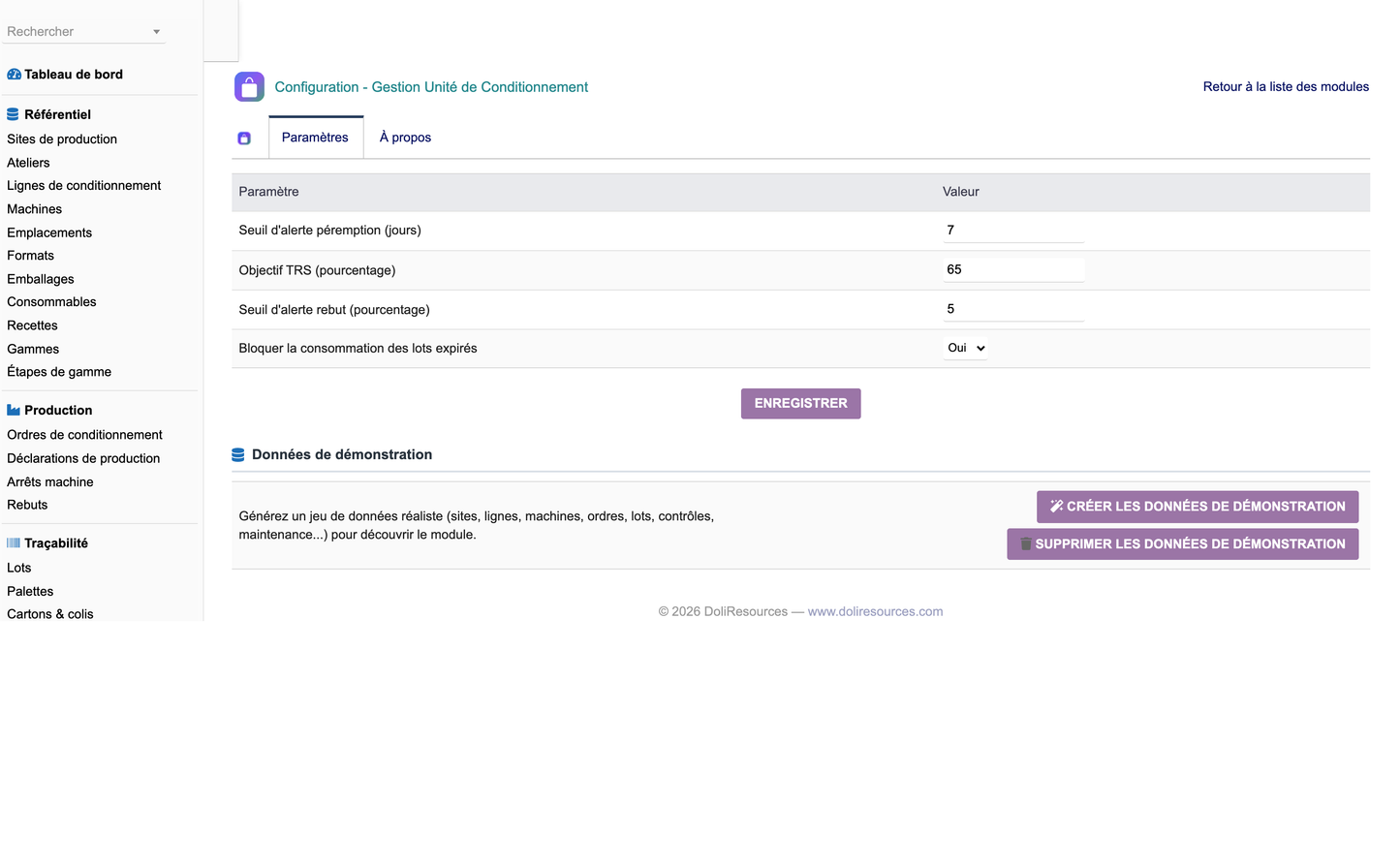
A realistic and consistent demonstration dataset is installed on first activation and remains reinstallable/removable from the configuration. Removal only deletes records tagged by the generator, without touching real Dolibarr data.
© 2026 DoliResources — www.doliresources.com · Packaging Unit Management v1.0.0 · Detailed Functional Specification


