
Discover powerful Dolibarr extensions designed to automate your business processes
Paint Factory Management turns Dolibarr into a genuine ERP and MES platform dedicated to the...
Couldn't load pickup availability


Paint Factory Management turns Dolibarr into a genuine ERP and MES platform dedicated to the manufacturing of paints, varnishes, lacquers, wood stains and industrial coatings. It covers the entire industrial value chain of a coating plant, from raw material procurement and laboratory formulation through to production batches, colour matching, quality release, packaging, warehousing, customer shipment, regulatory safety documentation, waste treatment and full cost accounting.
The objective is explicit: a company operating a paint factory should be able to run its whole business inside Dolibarr, without any additional software. Every function that a paint manufacturer would otherwise buy as a separate formulation package, laboratory information system, production scheduler or quality module is provided natively here, and is fully connected to the standard Dolibarr modules the company already uses.
· Formulation-first design: recipes are versioned, weight-based, costed to the litre, and drive production directly.
· True colour management: a shade catalogue (RAL, NCS, Pantone), CIELab L*a*b* measurement, Delta E tolerance and right-first-time tinting statistics.
· A manufacturing flow that mirrors reality: weighing, dispersion, grinding, let-down, tinting, quality control, filling.
· Regulatory readiness built in: CAS numbers, REACH registration numbers, hazard classes, CLP pictograms, H and P statements, safety data sheets, ADR transport classes and hazardous waste tracking forms.
· A cockpit dashboard designed specifically for a paint plant, including a live paint-chip palette of the shades actually produced during the month.
· Full cost transparency: material, packaging, labour, energy and overhead costs consolidated per batch, per product and per period.
The module ships 22 interconnected business objects. Each one has a searchable and filterable list with a column selector, a full record card with creation, modification, validation, closing, cancellation and deletion, and automatic cross-references to every related record.
|
# |
Object |
Purpose |
|
1 |
Raw materials |
Resins, pigments, solvents, additives, mineral fillers, colorants, hardeners and demineralised water, with CAS number, REACH registration, density, solids content, VOC content, unit cost, stock level, reorder point, shelf life, storage class and hazard class. |
|
2 |
Suppliers |
Raw material and packaging vendors, linked to the native Dolibarr third party, with speciality, lead time, quality rating, on-time delivery rate and ISO certification flag. |
|
3 |
Purchases and receipts |
Purchase orders and goods receipts per material, with ordered and received quantities, supplier batch number, certificate of analysis flag and receipt status. |
|
4 |
Colour chart |
The shade catalogue: code, name, reference standard (RAL, NCS, Pantone), hexadecimal rendering, colour family, gloss level and maximum acceptable Delta E. |
|
5 |
Formulas |
Versioned manufacturing recipes: paint type, binder family, application, target shade, standard batch size, target viscosity, density and gloss, solids content, VOC per litre, cost per litre, formulator and validation status. |
|
6 |
Formula lines |
The weight-based bill of materials: material, manufacturing phase, quantity in kilograms, weight percentage, addition order, line cost and operator instruction. |
|
7 |
Finished paints |
The commercial catalogue: SKU, formula, shade, paint type, product range, packaging size, volume, gloss level, coverage, drying time, sale price, cost price, stock and barcode. |
|
8 |
Production batches |
Manufacturing orders and traced lots: formula, product, lot number, manufacturing status, planned, produced and scrapped quantities, material yield, start and end times, equipment, operator, and material, labour, energy and total costs. |
|
9 |
Production steps |
The operations inside a batch: label, step type, sequence, duration, temperature, agitation speed, equipment, completion date and completion flag. |
|
10 |
Tinting and colorimetry |
Shade adjustment records: target shade, tinting base, colorant recipe, number of corrections, measured Delta E, L*, a* and b* values and acceptance decision. |
|
11 |
Quality tests |
Laboratory control: test type, applicable standard, measured value, unit, lower and upper specification limits, conformity verdict, date and operator. |
|
12 |
Non-conformities |
Deviations and customer complaints: type, severity, description, root cause, corrective action, financial impact, opening and closing dates and status. |
|
13 |
Equipment |
The plant asset register: dispersers, bead mills, mixers, filling lines, tinting machines, reactors and storage tanks, with capacity, power, workshop, commissioning year, running hours, availability rate, next maintenance date and status. |
|
14 |
Maintenance |
Preventive, corrective and regulatory interventions with planned and actual dates, duration, production downtime, cost, technician and status. |
|
15 |
Packaging |
Cans, pails, drums, IBC containers and CLP labels, with material, volume, unit cost, stock, reorder point, supplier and recyclability. |
|
16 |
Stock and warehouses |
Multi-zone inventory for raw materials, finished goods and packaging, with zone code, stock type, available and reserved quantities, reorder point, unit, lot number, expiry date, temperature class, stock value and last movement. |
|
17 |
Customer orders |
Sales orders with customer, product, dates, quantity, unit price, net and gross totals, margin, market segment, status and links to the native Dolibarr quotation, order and invoice. |
|
18 |
Deliveries |
Shipments with carrier, ADR transport class, number of packages, weight, freight cost, shipping and delivery dates, status and tracking number. |
|
19 |
Safety and SDS |
The HSE register: safety data sheets, incidents, audits, training sessions and regulatory inspections, with SDS reference and version date, CLP pictograms, H and P statements and required personal protective equipment. |
|
20 |
Waste and effluents |
Hazardous and non-hazardous waste: type, European waste code, quantity, treatment route, approved collector, cost, collection date, tracking form number and recovery flag. |
|
21 |
Production staff |
Operators and technicians with job role, workshop, shift, qualification, qualification expiry, hourly cost and monthly hours. |
|
22 |
Cost prices |
Full costing per product and per period: material, packaging, labour, energy and overhead costs, total cost, cost per litre, sale price and margin rate. |
The dashboard deliberately departs from the classic Dolibarr layout. It is organised as an industrial cockpit built around the identity of a paint plant: a pigment gradient banner, a ten-band colour ribbon, a horizontal manufacturing flow rail instead of a generic kanban, and a live paint-chip palette that renders the actual shades produced during the current month as real colour swatches.
· Volume produced this month, today and this year, in litres.
· Number of batches currently in progress.
· Average material yield, colour-coded against the plant target.
· Scrap rate.
· Average cost price per litre across validated formulas.
· Average VOC content of the formula portfolio, in grams per litre.
Ten columns, one per manufacturing stage (planned, weighing, dispersion, grinding, let-down, tinting, quality control, filling, completed, blocked). Each column carries its own colour, the number of batches at that stage and the corresponding volume in litres, so a supervisor sees instantly where the plant is congested.
A grid of paint chips rendered in the true hexadecimal colour of each shade actually manufactured during the month, ranked by volume, each showing the shade code, its commercial name and the litres produced. This is the signature visual element of the module and has no equivalent in a standard Dolibarr dashboard.
· Twelve-month production volume (bar chart).
· Volume breakdown by paint type (pie chart).
· Cost price structure: material versus labour versus energy (pie chart).
· Most produced paints (bar chart).
· Quality: conformity rate with a graphical gauge, right-first-time tinting rate, average Delta E and open non-conformities.
· Supply: stock value, materials below reorder point, late receipts, equipment availability, maintenance due and waste treated this month.
· Commercial: revenue for the month, average margin rate and orders awaiting shipment.
A dedicated Reporting menu provides nine cross-functional situation reports. Every report can be exported to CSV, Excel and Word, or sent directly to the printer, and every export is encoding-safe so accented characters are never corrupted.
|
Report |
Content |
|
Production |
Twelve-month history: number of batches, volume produced, scrap, average yield and total cost per month. |
|
Quality |
Per test type: number of tests, conform results, conformity rate and average measured value. |
|
Formulation |
Per formula: paint type, number of components, solids content, VOC per litre, cost per litre and validation status. |
|
Stock |
Per storage zone and stock type: number of lines, available quantity, stock value and number of lines below reorder point. |
|
Purchasing |
Per supplier: country, number of orders, purchased amount, lead time and on-time delivery rate. |
|
Sales |
Per market segment: number of orders, volume, net revenue, margin and margin rate. |
|
Cost prices |
Per finished product: material, packaging, labour and overhead costs, cost per litre, sale price and margin rate. |
|
Maintenance |
Per equipment: type, running hours, availability, number of interventions, production downtime and maintenance cost. |
|
Environment |
Per waste type and treatment route: number of collections, tonnage, treatment cost and number of recovered streams. |
Access is governed by nine functional permission groups. Read and write permissions are granted by default on activation so that the module is immediately usable, while deletion and administration permissions remain closed until explicitly granted.
|
Permission group |
Scope |
|
Formulation |
Colour chart, formulas, formula lines and finished paints. |
|
Production |
Production batches, manufacturing steps, tinting and production staff. |
|
Quality |
Quality tests and non-conformities. |
|
Stock |
Warehouses, stock locations and packaging. |
|
Purchasing |
Raw materials, suppliers, purchases and receipts. |
|
Sales |
Customer orders and deliveries. |
|
Maintenance |
Equipment and maintenance interventions. |
|
Safety and environment |
Safety data sheets, HSE records, waste and effluents. |
|
Reporting |
Decisional reports and cost price records. |
A tenth permission grants administration of the module itself, including the configuration page and the demonstration dataset controls.
The module is not an isolated silo. Every record that carries a business partner or a product exposes a native integration bar giving one-click access to the corresponding standard Dolibarr features.
|
Native module |
Integration |
|
Third parties |
Suppliers, customer orders, deliveries and non-conformities all reference a native third party record, which can be opened directly from the module card. |
|
Quotations |
A quotation can be created directly from a customer order or any partner-bearing record, pre-filled with the correct third party. |
|
Customer orders |
A native sales order can be raised in one click from the module record. |
|
Invoices |
A customer invoice can be raised in one click; the module record stores the link to the resulting invoice. |
|
Products and services |
Raw materials and finished paints can be bound to a native Dolibarr product, so purchasing, stock and pricing stay consistent. |
|
Stock |
The module warehouse objects complement the native stock module with paint-specific attributes such as lot number, expiry date and temperature class. |
|
Document management |
The attached documents area is reachable from every card, so technical data sheets, safety data sheets and certificates of analysis stay with the record. |
|
Users |
Formulators, operators and equipment managers reference native Dolibarr users. |
|
Widgets |
A dashboard widget publishes the plant key indicators on the Dolibarr home page. |
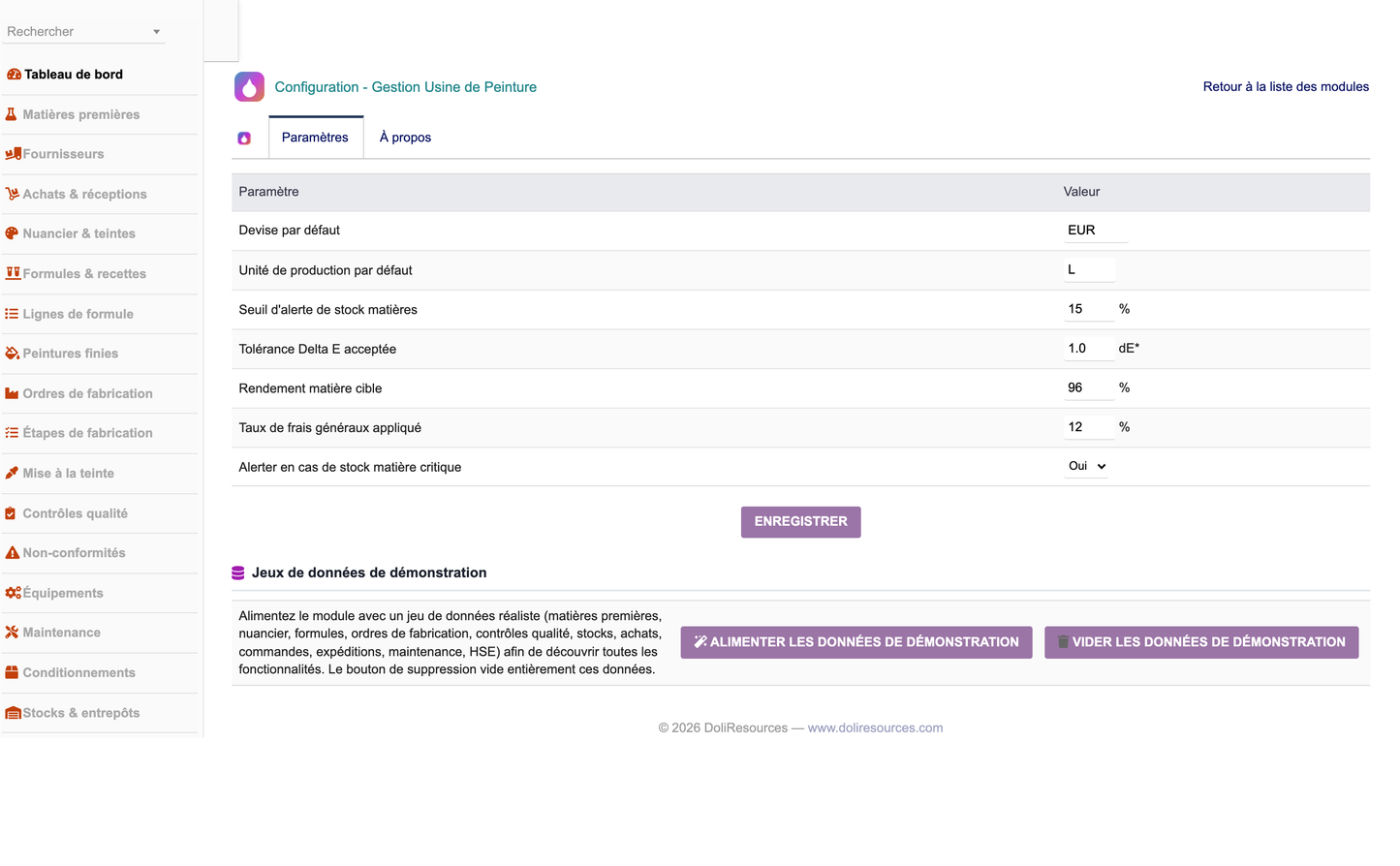
The configuration page exposes the plant-level parameters and, importantly, the demonstration dataset controls requested for evaluation and training purposes.
|
Parameter |
Description |
|
Default currency |
Currency used for costs, prices and stock valuation. |
|
Default production unit |
Unit used for batch quantities, typically litres. |
|
Raw material stock alert threshold |
Percentage of nominal stock triggering the low stock indicator. |
|
Accepted Delta E tolerance |
Maximum colour deviation accepted before a tinting operation is rejected. |
|
Target material yield |
Plant yield objective used to colour-code the yield indicator. |
|
Applied overhead rate |
Overhead percentage applied when consolidating cost prices. |
|
Low stock notification |
Enables or disables the critical raw material stock alert. |
Two buttons are provided on the configuration page:
· Install demo data - populates the module with a complete, coherent and realistic paint plant: suppliers and customers as native third parties, raw materials with genuine CAS numbers, a RAL, NCS and Pantone shade catalogue, versioned formulas with weight-based bills of materials, finished products in several packaging sizes, production batches spread over twelve months with manufacturing steps, tinting records, laboratory tests, non-conformities, equipment and maintenance, packaging, multi-zone stock, purchases, customer orders, deliveries, safety data sheets, waste collections, production staff and cost records.
· Remove demo data - completely clears the demonstration dataset, including the native third parties it created and any records a user has attached to a demonstration parent, leaving the module empty and ready for production use.
The dataset is deliberately built so that every headline indicator is meaningful from the first screen: production is forced into the current day and current month, measured quality values are drawn inside their own tolerance bands with a realistic small rejection rate, and cost prices are derived from the actual bill of materials rather than being random.
The complete user interface, including every field label, menu entry, status, report header and help text, is delivered in five languages: French, English, Italian, German and Spanish. Each language file contains the full terminology set, and the module protects its own wording against interference from other installed modules so that labels always display the intended paint industry vocabulary.
· 22 dedicated database tables with multi-entity support and indexed foreign keys.
· Automatic schema self-healing on upgrade: missing columns are added without manual intervention.
· Demonstration dataset versioning so improved demo content is refreshed on module upgrade.
· Column selector, per-column search and pagination on every list.
· Consistent visual charter: pigment palette, gradient KPI cards, in-page tab bar, responsive grids.
· Font Awesome 5 compatible iconography throughout.
· Encoding-safe exports in CSV, Excel, Word and print for all reports.
(C) 2026 DoliResources - https://www.doliresources.com - All rights reserved.


