
Discover powerful Dolibarr extensions designed to automate your business processes
Pet Store Management turns Dolibarr into a specialised ERP for the day-to-day, commercial, logistical, administrative, sanitary and financial management...
Couldn't load pickup availability


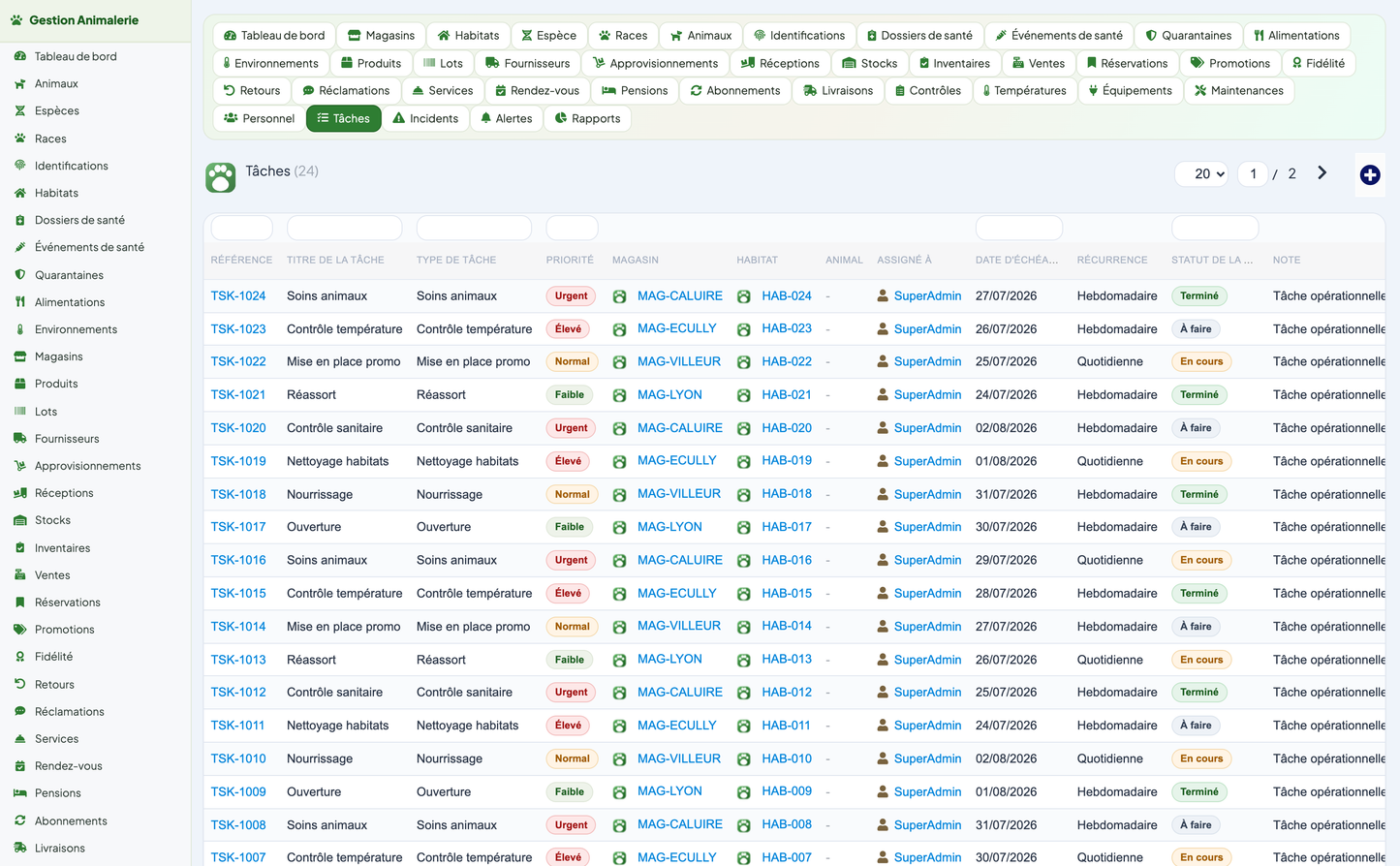
Pet Store Management turns Dolibarr into a specialised ERP for the day-to-day, commercial, logistical, administrative, sanitary and financial management of a pet store. It covers the full lifecycle of live animals alongside the retail operation of pet products and services, so the whole business can be run inside Dolibarr without a separate vertical application. The module ships with 41 business objects, a purpose-built “Animal Retail Ecosystem” dashboard, decision reporting, a REST API and a full demonstration dataset.
Give pet-store operators a single, coherent system to trace every animal from arrival to sale, keep sanitary and regulatory records, manage habitats and their environmental conditions, run purchasing, stock and point-of-sale, deliver value-added services (grooming, boarding, subscriptions, delivery), and steer the business with real-time KPIs and analytics.
Independent pet stores and chains, garden centres with a pet department, animal-feed shops, commercial breeders, wholesalers and distributors of pet supplies, aquatics / birds / reptiles / rodents / cats & dogs specialists, grooming salons, boarding facilities, pet-product delivery businesses and online pet shops.
Each animal has an individual record: reference, name, species, breed, sex, birth date and computed age, colour, size, weight, behaviour and sociability, current habitat and store, and a configurable lifecycle status (arrived, in control, quarantine, available, reserved, sold, ceded, in care, monitoring, unavailable, deceased). Origin and cost of ownership are tracked (supplier, country, arrival date, purchase price, transport and veterinary costs, full cost price and sale price), together with identification (microchip, ring, tattoo, passport).
Configurable referentials for species (with scientific name, family, category, diet, feeding frequency, recommended habitat type, temperature and humidity ranges, difficulty level, quarantine duration, CITES regulation flag and required documents) and breeds (origin, size class, average weight and lifespan, temperament).
Every animal carries a health record (veterinarian, status, weights, last and next check, restrictions) and a timeline of health events (visits, vaccinations, treatments, deworming, check-ups, surgery, observations) with medication, next-due dates and cost. A care planning surfaces upcoming and overdue interventions on the dashboard.
Dedicated quarantine records with cause, quarantine zone, start date, expected and real end, required controls, observations and status (ongoing, extended, lifted, non-conform). Quarantine durations default from the species referential.
Habitats (cages, aquariums, terrariums, aviaries, ponds, boxes, pens, quarantine and care zones) hold dimensions, volume, capacity and occupancy, compatible species, target temperature/humidity, water quality and lighting, cleaning schedule, status and maintenance cost. Occupancy rate is a headline KPI.
Environment readings per habitat record temperature, humidity, pH, nitrites, nitrates and light level, with a conformity flag against species thresholds. Cold-chain temperature logs cover refrigerated and frozen zones for food.
Multi-store stock with physical, available, reserved and alert quantities, locations and last movement; physical, rolling and by-zone inventories with theoretical vs counted quantities and gaps; lot and batch traceability with use-by (DLC) and best-before (DDM) dates, recall flag and remaining quantity.
Suppliers and breeders with agreement number, supplied species, service, conformity and mortality rates and a supplier score; procurement orders with lines; goods receptions with sanitary control, document control, temperature control and anomaly count.
Checkout tickets record store, customer, optional animal, sale type (animal, product, service, pack, subscription), payment method, channel, items, totals and margin, with detailed sale lines. Sales of live animals are traced back to the individual animal record.
Customers can reserve animals, products or services with a deposit, expiry date and status (reserved, confirmed, converted, expired, cancelled).
The module structures the data required for cession certificates, care sheets and identification documents; records carry references, identification codes and regulatory information ready for document generation.
Loyalty cards extend the native third-party with level, points, total spent, visits, last visit and the species owned, supporting a “pet household” view of each customer.
Configurable loyalty tiers (bronze, silver, gold, platinum) with points accrual and spending history.
A service catalogue (grooming, boarding, pet-sitting, delivery, aquarium installation and maintenance, training, advice) drives grooming appointments with groomer, duration, price and status.
Boarding stays record check-in/out dates, number of days, diet, authorised treatments, emergency contact, daily and total price and status (booked, checked-in, checked-out, cancelled), with box occupancy.
Recurring subscriptions for food, litter, grooming, boarding, delivery, care and monthly boxes, with frequency, next date, amount and status (active, paused, cancelled, expired).
Delivery orders with type, planned date, driver, vehicle, tour, cost and status (preparing, planned, in transit, delivered, failed, returned).
A decision-reporting suite covers sales (monthly revenue, tickets, margin), animals (by species, availability, average cost and price), stock value, health events, supplier performance and services, each exportable to CSV.
The “Animal Retail Ecosystem” dashboard consolidates commercial, animal, health/service and alert KPIs with interactive DolGraph charts: sales evolution, animals by status and species, sales by product family, health events by type and habitat occupancy.
A secured REST API exposes animals, species, habitats, health events, quarantines, reservations, sales, products and dashboard KPIs, with pagination, sort-field whitelisting and per-route permission checks.
Input validation, output escaping, CSRF protection through Dolibarr, prepared/escaped SQL, fine-grained permissions (including protected sanitary data), API authentication via DolibarrApiAccess and audit-friendly logging.
Ten right groups — Stores & habitats, Animals, Health & quarantine, Catalog, Purchasing, Stock, Sales, Services, Quality and Reporting — each with read/write/delete, plus a module administration right.
One click generates a realistic, FK-coherent dataset (stores, habitats, species, breeds, animals, health records, products, suppliers, 13 months of sales, services, subscriptions, deliveries and more) tagged with import_key ANIMDEMO; a second click safely removes only the demonstration data.
MVC-style: CommonObject business classes, a generic list/card engine driven by an object registry, a shared helper library (permissions, vocabulary, KPI rendering, schema self-heal), module-local menus and a bespoke dashboard and reporting layer. No core Dolibarr file is modified.
41 tables prefixed llx_anim_ with entity (multi-company), status, creation/modification metadata and import_key, plus indexes on entity and every foreign key. A schema self-heal adds any missing column on upgrade.
Deploy the ZIP from the Dolibarr module manager or copy the folder to htdocs/custom, then activate the module (Products family). Tables, menus, permissions and demo data are created automatically.
A settings page manages default currency, low-stock threshold, use-by alert days, default quarantine duration and the services/loyalty switches, plus the demo-data generation and removal buttons.
The delivery package includes around sixty professional screenshots covering activation, configuration, the dashboard, every list and card, reporting and the demo-data tools.
Published and maintained by DoliResources. Compatible with Dolibarr 16 to 23+ and PHP 8.1+.
© 2026 DoliResources. All rights reserved. Website: https://www.doliresources.com. All files, classes, SQL scripts, language files and documents are produced under the DoliResources copyright.


