
Discover powerful Dolibarr extensions designed to automate your business processes
Plastic Injection Management transforms Dolibarr into a specialized industrial ERP for plastic injection molding. From a single, integrated environment, an injection company...
Couldn't load pickup availability


Plastic Injection Management transforms Dolibarr into a specialized industrial ERP for plastic injection molding. From a single, integrated environment, an injection company manages its commercial, technical, industrial, logistics, financial and quality activities without resorting to a separate specialized software.
The module covers the complete value chain: raw materials and formulations, injected products, molds and individual cavities, injection presses and peripherals, bills of materials and routings, versioned setting sheets, planning, manufacturing orders, mold mounting, first-article approval, real-time production, scrap and recycling, quality (control plans, non-conformities, corrective actions, claims), maintenance (CMMS), stock with full lot traceability, procurement, costing and decision reporting — fully connected to native Dolibarr objects.
It is designed to serve a small injection unit, a multi-workshop plant, an automotive sub-contractor, and manufacturers of technical parts, plastic packaging, and medical, electrical or electronic components.
· Pilot the shop floor in real time through an Injection Control Center that shows every press, its state and its current order.
· Guarantee product quality through a first-article gate, control plans, non-conformities and corrective actions.
· Maximize asset availability with an integrated CMMS for presses, molds and peripherals.
· Ensure end-to-end lot traceability from supplier material to the customer shipment.
· Master cost of goods and margins per product and per manufacturing order.
· Reduce material cost by tracking regrinding, recycling and re-integration rates.
· Operate in five languages across a single multi-company Dolibarr instance.
The module ships 39 interconnected business objects organized in six functional sections, each with dedicated list, detail (card) and create/edit pages, plus a modern dashboard and a reporting page.
|
Section |
Objects |
|
Referentials |
Sites, Workshops & lines, Teams, Materials, Formulations (+ components), Injected products, Molds, Cavities, Presses, Peripherals, Supplier evaluation |
|
Engineering |
Technical studies, Bills of materials (+ lines), Routings (+ operations), Setting sheets (+ parameters) |
|
Production |
Manufacturing orders, Mold mountings, First-article approvals, Production declarations, Downtime, Scrap, Grinding & recycling |
|
Quality |
Control plans (+ characteristics), Quality controls, Non-conformities, Corrective actions (CAPA), Customer claims |
|
Maintenance |
Maintenance plans, Work orders, Spare parts |
|
Stock & Costing |
Lots, Pallets, Stock movements, Costings |
Access is governed by 13 granular permission groups, each with read/write and, where relevant, delete rights. Read and write are granted by default on activation so the module is immediately usable; delete and administration are not.
|
Permission group |
Scope |
|
Read |
Consult the Plastic Injection module |
|
Referential |
Manage materials, molds, presses, sites, teams… |
|
Engineering |
Manage studies, BOMs, routings, setting sheets |
|
Production |
Manage MOs, declarations, downtime, scrap |
|
First article |
Approve the first article (narrow grant) |
|
Quality |
Manage controls, non-conformities, CAPA, claims |
|
Lot release |
Block / release a lot |
|
Maintenance |
Manage the CMMS |
|
Stock |
Manage stock, lots and traceability |
|
Cost |
View costs and margins |
|
Reporting |
Access reporting and export |
|
Demo |
Load / purge demonstration data |
|
Admin |
Administer the module and API |
These groups map naturally to typical shop-floor roles: management, plant/production manager, planner, shift leader, setter, mold fitter, operator, quality manager and inspector, maintenance manager and technician, storekeeper, buyer, salesperson, accountant and read-only viewer.
The landing page is a modern, industrial-styled control center (petrol/cyan/teal charter) that differs deliberately from classic Dolibarr screens.
Ten live indicators: production today and this month, orders in progress and late, presses running versus total, scrap rate, quality rate, average cycle time, molds available and pending controls.
Each press is shown as an interactive card whose colour reflects its runtime state, following the specified colour code:
· Green — normal production
· Blue — preparation
· Teal — setup
· Violet — mold change
· Orange — slowdown
· Red — breakdown
· Yellow — maintenance
· Grey — idle machine
A card displays the press reference and status, the current product, mold, manufacturing order and team, a production progress bar (produced vs planned) and the cycle time. A production-by-press chart completes the view. When no data exists, the dashboard shows a clear empty state instead of failing.
A complete record per plastic material, covering the common families (PP, PEHD, PEBD, PVC, PET, PS, ABS, PA, PC, POM, PMMA, TPU, TPE, PBT, SAN, PEEK), biodegradable, biobased, recycled and custom blends.
· Reference, label, family, polymer, form (granule/resin/powder/masterbatch/regrind)
· Supplier, manufacturer, brand, grade, colour
· Density, melt flow index, transformation temperature range
· Drying temperature and time, maximum humidity, allowed recycled percentage
· Shrinkage, mechanical / thermal properties, chemical resistance, certifications
· Price per kg, stock in kg, location, quality status
· Optional link to a native Dolibarr product
Formulations define a compound as a base material plus recycled material, masterbatch, colorant and additives, each with a percentage, tolerance and mixing order.
· Base material, version, target colour, recycled percentage
· Mixing time, temperature and equipment; application date and validator
· Component lines: material, role (base/recycled/masterbatch/colorant/additive/stabilizer/plasticizer/filler/fiber/flame-retardant/release-agent), percentage, tolerance, order
· Cost per kg
Injected products link the plastics part to a native Dolibarr product and carry the full technical definition.
· Reference, label, customer, family, sector, material, formulation, colour
· Theoretical and real weight, runner weight, dimensions, tolerances, volume, thickness
· Associated mold and number of cavities, theoretical cycle time
· Plan reference, version
A very complete mold record with a twelve-state lifecycle (available, reserved, assigned, preparing, mounted, producing, trial, maintenance, blocked, out of service, stored, returned to customer).
· Code, label, owner, customer/supplier, manufacturer, serial number, type
· Number of cavities and active cavities, mold material, weight, dimensions
· Required clamping force, shot volume, cooling / ejection / runner / heating systems
· Manufacture and service dates, cost, cycle counters, theoretical life, maintenance threshold
· Storage location and current press
Each mold cavity is managed individually so capacity, cadence and cost can be recomputed when a cavity is deactivated.
· Number, position, associated product, part weight
· Cycle count, scrap count and rate, active flag, last maintenance date
A full press record with runtime state used by the dashboard colour code.
· Code, label, manufacturer, model, serial number, build year
· Clamping force, shot volume, screw diameter, maximum pressure, power, energy per hour
· Site, workshop, location, service date, hourly cost
· Operating hours, cycles and breakdown counters
Robots, dosers, dryers, dehumidifiers, thermoregulators, chillers, conveyors, grinders, mixers, feeders, compressors, vision systems, detectors, scales and control equipment, each linked to presses and workshops.
· Reference, label, type, manufacturer, model, serial number
· Associated press and workshop, power, capacity, service date, hourly cost
Multi-component BOMs listing virgin and recycled material, colorant, masterbatch, additive, insert, component, packaging, label and consumable.
· Reference, product, version, base quantity, application date, total cost
· Lines: type, material or child product, quantity, unit, loss percentage, unit and line cost
Production routings covering the full sequence from material preparation and drying through injection, holding, cooling, demolding, robotized extraction, deburring, assembly, decoration, marking, control, packaging and palletizing.
· Reference, product, version, total time and cost
· Operations: rank, code, press, mold, peripheral, setup and cycle time, cadence, operators, required skill, hourly cost, required control
Versioned setting sheets store the machine parameters for a product/mold/press, with a current-version flag.
· Reference, product, mold, press, material, version, current flag
· Cycle / cooling / holding times, clamping force, validation date, author and validator
· Parameter lines grouped by family (temperatures, pressures, speeds, dosing, cooling, robot, drying) with target, tolerance and real value
The manufacturing order is the heart of the shop floor, with a sixteen-state workflow: draft, planned, validated, material reserved, preparing, mold mounting, setup, first article to approve, ready, launched, running, suspended, under control, finished, closed, cancelled.
· Reference, sales order, customer, product, version, planned/produced/good/scrap quantities
· Material, formulation, mold and cavities used, press, peripheral, routing, BOM, setting sheet, team
· Planned and real start/end, priority, theoretical and real cycle time, cycles, material and energy consumption
· First-article flag, planned and real cost, instructions
A dedicated mold-mounting record tracks the twelve-step changeover workflow with checkboxes for each step.
· Order, mold, press, mount type, fitter, start/end, duration
· Steps: mold checked, press checked, transfer, mounted, hydraulic, electric, cooling, peripheral, safety, validated
· Tools used, incidents
No series production should start without first-article approval. The control record captures the full acceptance checklist and dual sign-off.
· Order, product, mold, press, cavity, control date
· Measured vs target weight; aspect, colour, dimensions, flash, sink marks, burn, short shot, warpage, weld lines, inclusions, inserts, marking and plan conformity checks
· Measurements, quality and production sign-off
· Status: to control, conform, conform with reservation, non-conform, setup to redo, validated
Production declarations record the live output of a press for an order.
· Order, press, mold, team, operator, material lot
· Start/end, duration, cycles, produced / good / scrap quantities
· Real cycle time, material and energy consumption
Scrap is recorded against a rich defect vocabulary (short shot, flash, sink mark, burn, weld line, warpage, breakage, wrong colour, contamination, bubbles, inclusion, dimensional defect, bad demolding, stuck part, bad ejection, missing insert, scratch, ejector mark, orange peel, mold/machine/setting problems, wet or degraded material).
· Order, production, product, press, mold, cavity, material, operator, team
· Defect code and family, quantity, weight, date, cost, destination, action taken
Grinding and recycling operations track the conversion of scrap into regrind and its re-integration.
· Source and output material, type, grinder
· Input / output / waste quantities, yield, output lot, provider, valorization certificate, cost and saving
The quality module provides control plans and their execution.
· Control plans per stage (material reception, formulation, drying, first article, in-process, final, lot, pallet, shipment) with characteristics (target, tolerance, method, criticality)
· Quality controls with sample size, conform / non-conform counts and results
· Non-conformities with source, type, severity, root cause, immediate action and decision
· Corrective actions (CAPA) with owner, due date and efficiency check
· Customer claims linked to products, lots and non-conformities
An integrated CMMS covers presses, molds and peripherals.
· Maintenance plans (preventive / corrective / conditional / predictive) triggered by calendar, hours or cycles
· Work orders with priority, failure code, technician/provider, downtime, labour and part cost, report
· Spare parts with stock, minimum, unit cost, location and lead time
Stock is managed as lots, pallets and movements, integrated with native Dolibarr warehouses.
· Lots (material / regrind / semi-finished / finished / waste) with supplier lot, quantities, production/reception/expiry dates, certificate and a six-state lifecycle (quarantine, released, blocked, consumed, shipped, scrapped)
· Pallets grouping lots for a shipment; stock movements with valuation
· Full traceability chain: supplier -> material lot -> formulation -> MO -> press -> mold -> cavity -> setter -> operator -> finished lot -> pallet -> shipment -> customer
Supplier evaluation records approval status, certificates, lead time, conformity and on-time rates, claims and a score, feeding purchasing decisions alongside native Dolibarr purchase objects.
The module reuses native Dolibarr third parties, proposals, sales orders, shipments and invoices. Manufacturing orders and studies link back to the originating customer and proposal, so the flow from prospect to invoice stays connected.
Finished lots are packed into pallets and linked to native Dolibarr shipments, preserving lot and pallet traceability through delivery.
A costing record breaks the cost of goods into material, recycled material, masterbatch, additives, inserts, press, mold, mounting, setup, labour, energy, maintenance, quality, packaging, logistics, scrap, recycling and overhead, then computes total cost, unit cost, sale price, margin and margin percentage.
The reporting page provides production analysis (production and scrap by product, month to date) and is the anchor for the decision-report suite. Dashboard KPIs and charts cover production, presses, scrap rate and quality in real time.
The module integrates with Dolibarr's native REST API for the linked native objects (third parties, products, stock, orders, shipments). A dedicated module REST surface is on the roadmap and, when delivered, will follow Dolibarr's authenticated-access conventions.
· Permission gate enforced on every page before rendering.
· List and card SQL built from a trusted registry (column-safe), values escaped or cast.
· Foreign keys cast to integers; text search via Dolibarr natural_search().
· CSRF tokens on state-changing actions.
· Multi-company entity isolation on every query.
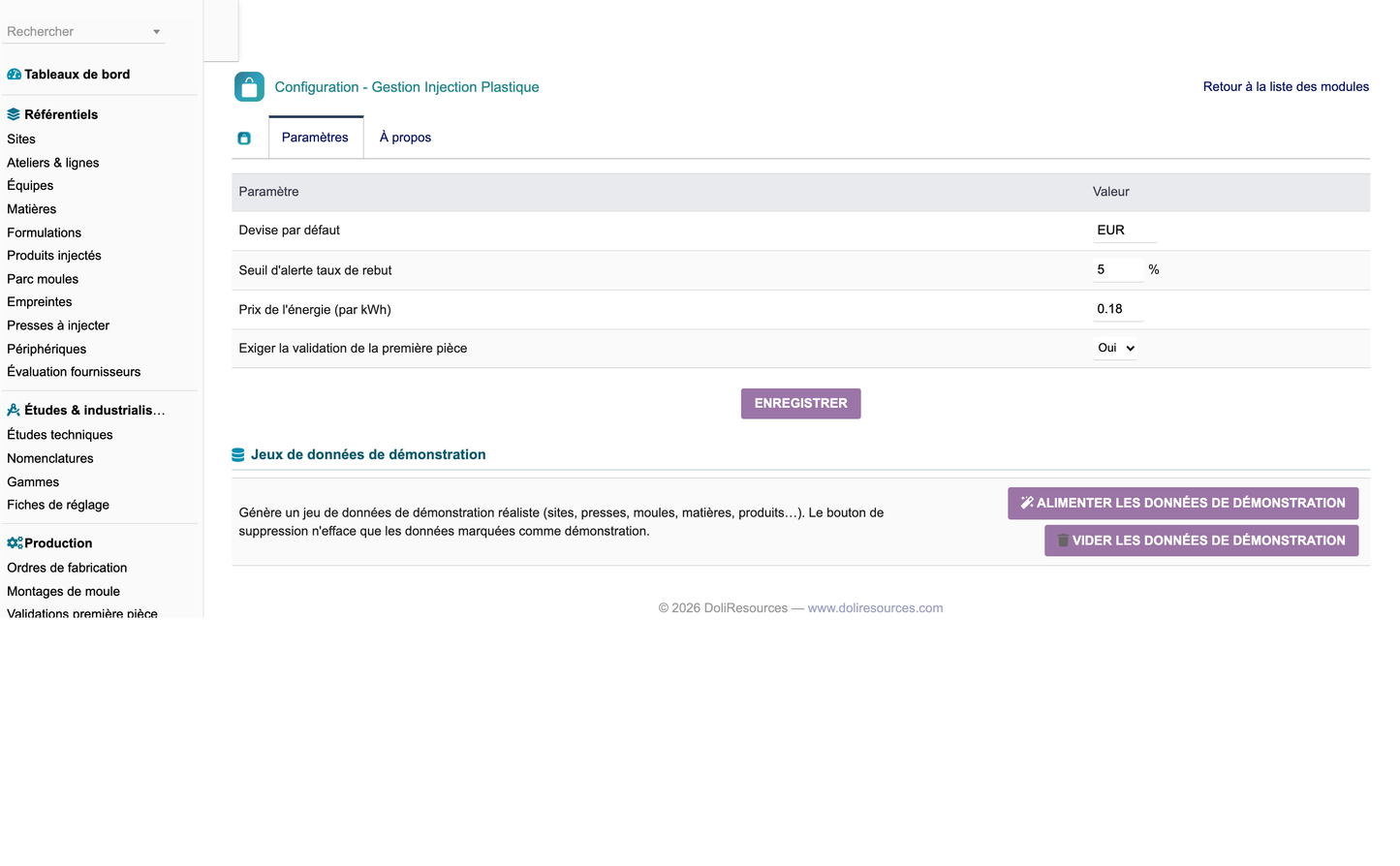
From the module Setup page, a single click loads a coherent demonstration dataset (sites, workshops, teams, materials, formulations, products, molds and cavities, presses, peripherals and supplier evaluations) with realistic plastic-injection values. Every generated row carries a technical marker (import_key = PINJDEMO). The purge deletes only marked rows across every module table, so real data is never affected; it is idempotent, so re-seeding never duplicates rows.
· Copy the plasticinjection folder into htdocs/custom (or deploy the ZIP from Setup -> Modules).
· Enable Plastic Injection Management in Home -> Setup -> Modules.
· Grant permissions to the relevant user groups.
· Optionally load demonstration data from the module Setup page.
Requirements: Dolibarr 16.0+ (tested on 17.x, targets 18-23), PHP 7.4+/8.x, MySQL/MariaDB, and the native Societe and Product modules.
· module_plasticinjection-1.0.zip — installable module archive (extracts to plasticinjection/).
· screenshots/ — captured screens of the dashboard, referentials, cards, quality, maintenance, stock, reporting and setup.
· Plastic_Injection_Management_User_Training_Manual_FR.pdf — French training manual.
· Plastic_Injection_Management_Complete_Features_EN.docx — this functional description.
· Plastic_Injection_Management_Technical_Documentation_EN.md — technical documentation.
© 2026 DoliResources — www.doliresources.com


