
Discover powerful Dolibarr extensions designed to automate your business processes
1. Module overview
Silo Management turns Dolibarr into a complete business solution for...
Couldn't load pickup availability


1. Module overview
Silo Management turns Dolibarr into a complete business solution for a grain company, an agricultural cooperative, a storage operator, a flour mill, a food processing plant, a grain trader, a port company or a collection centre. It covers the whole life of the grain, from the lorry arriving at the gate to the customer invoice, without any external software. The module ships 60 business objects, 60 database tables, 114 permissions, 80 menu entries, 18 reports, a REST API with 308 routes, two scheduled jobs and five languages.
· 60 business objects and 60 dedicated tables, all multi-entity aware
· 114 granular permissions, read and write granted by default, every decision right off
· A control tower, a 2D cell synoptic, a weighing station and a thermometry board
· A complete twelve-month demonstration dataset, removable without touching real records
2. Business objectives
The module answers the questions a storage operator asks every morning: how much grain is on site, in which cell, in what condition, what is arriving today, what must ship, what is drifting out of specification and what it all costs.
· Centralise every site, silo, cell and industrial asset in one place
· Know the exact stock and its quality at cell level, at any time
· Trace every tonne from the grower to the customer invoice, in both directions
· Detect a conservation risk before it becomes a loss
· Measure the real cost of storing, drying, ventilating and treating a tonne of grain
3. Target users
The module is designed for the whole site team, with permissions matching the role.
· Site director, silo manager, operations manager
· Reception and shipment supervisors, weighbridge operators, storekeepers, silo operators
· Quality manager and laboratory technicians
· Maintenance manager and technicians, health and safety manager
· Sales manager, purchasing manager and management controller
· Dolibarr administrator and read-only users
4. Storage site management
Every site carries its identity, its location with GPS coordinates, its manager, its capacities, its equipment counts, its certifications and its regulatory authorisation. Capacities are recomputed from the cells that actually exist, so a declared figure can never drift away from the physical installation.
· Reference, type, address, region, province, GPS position, manager
· Total and available capacity, recomputed nightly from the cells
· Counts of silos, cells, flat stores, weighbridges, docks and reception pits
· Laboratory, workshop and dryer flags, certifications, authorisation reference
· Seven operating states, from under construction to archived
5. Silo management
A silo groups its cells and carries its own construction and equipment data. Its capacity and volume are the sum of its cells.
· Ten silo types: metal, concrete, tower, horizontal, flat store, hopper, buffer, port, farm
· Builder, build year, commissioning date, material, height, diameter
· Ventilation, thermometry, filling and emptying systems
· Allowed product family, maximum temperature and moisture
6. Cell management
The cell is the heart of the model. It carries its capacity, its current load, its product, its lot, its temperature, its moisture and its operating state, and it refuses a product that is incompatible with the family it is dedicated to unless a cleaning has been validated.
· Thirteen operating states, from empty to out of service
· Fill percentage, free capacity, average density, average and maximum temperature
· Last and next cleaning dates, risk level
· 2D synoptic: one gauge per cell, grouped by silo, with a colour legend
7. Product management
Bulk products carry the technological characteristics a storage operator actually uses to decide what to do with a delivery.
· Twenty-one product families, from soft wheat to fertilizer and food powders
· Variety, origin, harvest year, bulk density, reference and maximum moisture
· Maximum impurities, target protein, minimum falling number, germination rate
· Maximum storage time, ventilation and drying rules, blending permission
· Quality class, standard reference, purchase and sale price per tonne
8. Supplier management
Growers, cooperatives, collectors and traders are linked to the native Dolibarr third party and enriched with the data a collection business needs.
· Seven supplier types, grower code, farm name, region, farmed area, main crops
· Certifications, annual tonnage, quality score, rejection rate, financial balance
· The tonnage and rejection rate are recomputed from the deliveries themselves
9. Reception management
A reception follows the real workflow of the gate and keeps a genuine backlog of vehicles in progress rather than a list of closed records.
· Twelve states: announced, arrived, waiting, weighing, sampling, control, accepted, unloading, done
· Vehicle, driver, product, variety, harvest year, origin, parcel reference
· Announced quantity, gross weight, tare, net weight, moisture, impurities, specific weight
· Quality decision with price reduction, premium or penalty, and the resulting value
· Automatic lot creation, cell assignment and stock movement on acceptance
10. Weighbridge management
The weighing station is a simplified operator screen: it records the first weighing, lists the vehicles still on site and closes the ticket with the second weighing, computing the net weight whichever way round the vehicle was weighed.
· Weighbridge register with range, division, platform length and verification dates
· Seven weighing types, five capture modes including reading from the indicator
· First and second weighing with their own timestamps, gross, tare and net weight
· Correction with a reason, ticket printing, full journal
· The module records weighings; it never replaces the legal verification of the instrument
11. Sampling
Sampling is recorded as its own operation, with the witness sample kept for the retention period configured in the module.
· Six sampling methods, number of increments, sampled quantity, sampling points
· Witness sample, storage place, retention date
· Samples carry a barcode and QR code data for label printing
12. Quality control
Quality templates are configurable per product, supplier, customer, contract or campaign. Each criterion carries its unit, target, limits, tolerance, price reduction rule and whether it is blocking.
· Twenty-four criteria, from moisture and specific weight to mycotoxins and falling number
· Measured values compared to the limits, with the deviation and the result state
· Eleven decisions: accepted, accepted with reduction, to dry, to clean, to treat, blocked, refused
· Conformity is computed over the criteria actually measured on that control
13. Laboratory management
Analysis requests are routed to an internal, external, accredited, customer or official laboratory, and their results are compared to the specification.
· Eight analysis scopes, eighteen analysis codes, method and equipment used
· Result, unit, specification range, measurement uncertainty, validation and certificate
· Certificates of analysis, quality, origin, weight, fumigation, phytosanitary and organic
14. Batch traceability
Every lot carries a barcode, a QR code, its grower, its reception, its cell and its parent lot. The traceability page walks the chain in both directions and prints the full event log.
· Upstream: grower, reception, weighings, sampling, quality controls, analyses, storage, parent lot
· Downstream: transfers, blends, cleanings, dryings, ventilations, treatments, losses, shipments, certificates, sales
· A lot can be searched by reference, barcode or QR code
· Fifteen traceability event types recorded automatically
15. Stock transfers and blending
Transfers between cells check the target capacity and the product compatibility. Blends keep the parent-child link between the source lots and the resulting lot.
· Ten transfer reasons, from consolidation to a hot spot detected
· Planned and actual quantity, conveyor and elevator used, loss, energy and cost
· Blends target a moisture, a protein content, a specific weight, a cost or a commercial class
· Each blend line keeps its own share, moisture, protein and unit value
16. Grain conservation
Cleaning, drying, ventilation and treatment are four distinct operations, each with its own energy and cost balance.
· Cleaning: seven types, waste, impurities before and after, loss rate
· Drying: inlet, target and outlet moisture, fuel, energy, weight loss, yield, cost per tonne
· Ventilation: six goals, inside and outside temperature, air flow, fans, energy
· Treatment: eight types, active substance, dose, exposure, safety delay, efficacy
17. Temperature and moisture monitoring
Probes are attached to a cell and a cable point. Readings feed a heat map, a hot spot list and the automatic alerts.
· Seven probe types, calibration dates, alert threshold, last value and last reading date
· Temperature readings with the change since the previous one and the alert level
· Moisture readings with the deviation from the product reference and the water activity
· Heat map by cell and by day, warmest cells first
18. Fumigation
A fumigation is an authorised operation with a safety delay during which the module can forbid any outbound movement of the treated cell.
· Treatment products with approval reference, dose range, hazard class and required protective equipment
· Safety delay, release date, safety measures, provider, efficacy
· Outbound movements blocked during the safety delay when the setting is on
· The module records the operation; the authorisation remains with the certified applicator
19. Physical inventories
Inventories compare the theoretical stock to the physical one and value the gap.
· Six scopes and seven measurement methods, including volumetric and laser scanning
· Line by line: level, density used, theoretical and physical quantity, gap and its reason
· A gap above the configured threshold requires a reinforced validation
20. Loss management
Fifteen loss causes, each with its quantity, value, responsible person, evidence, charging rule and corrective action.
· Dust, moisture, drying, cleaning, handling, leak, infestation, degradation, theft, contamination
· Charged to the site, the supplier, the customer, the carrier, the insurance or a contractual allowance
21. Shipment management
Shipments reserve the stock, assign the lot, run the pre-loading control, record the loading and the weighing, and produce the delivery note.
· Ten states from planned to invoiced, with a genuine backlog of shipments being prepared
· Customer, order, contract, carrier, vehicle, driver, dock, destination
· Ordered and loaded quantity, gross, tare and net weight, quality class, loading time
· A shipment consumes the lot it draws from, so the stock on screen really moves
22. Storage contracts
Storage contracts reserve a capacity for a customer and drive the billing of the services delivered on that grain.
· Seven billing modes: per tonne, per tonne and per day, per month, per cell, flat fee, per operation, mixed
· Reserved and used quantity, free days, contractual shrinkage, quality specification
· Eleven billable services, from reception and weighing to analysis and handling
23. Purchasing and sales
Purchase valuation applies the moisture and impurity price reductions, the quality premium and the drying and cleaning charges to the base price.
· Five price sources: contract, market, negotiated, standard tariff, provisional
· Net price per tonne and amount, payment state, link to the supplier invoice
· Sales carry the cost, the margin amount and the margin rate, and eight incoterms
24. Maintenance and equipment
Twenty equipment categories, preventive plans triggered by date, frequency, running hours, tonnage handled, cycles, condition or season, and corrective interventions with their spare parts.
· Plans with estimated duration and cost, last done and next due date, state
· Maintenance operations with duration, downtime, labour and parts cost
· Interventions with failure type, priority, severity, diagnosis, root cause and works done
· Work permits and safety incidents, with lockout and gas test confirmation
25. Cost management
Fifteen cost categories can be allocated by site, silo, cell, product, lot, reception, shipment, contract, customer, supplier or operation.
· Cost per tonne recomputed weekly, monthly period stamp, five states
· Profitability report: revenue, costs, margin, margin rate and cost per tonne by site
26. Dashboard
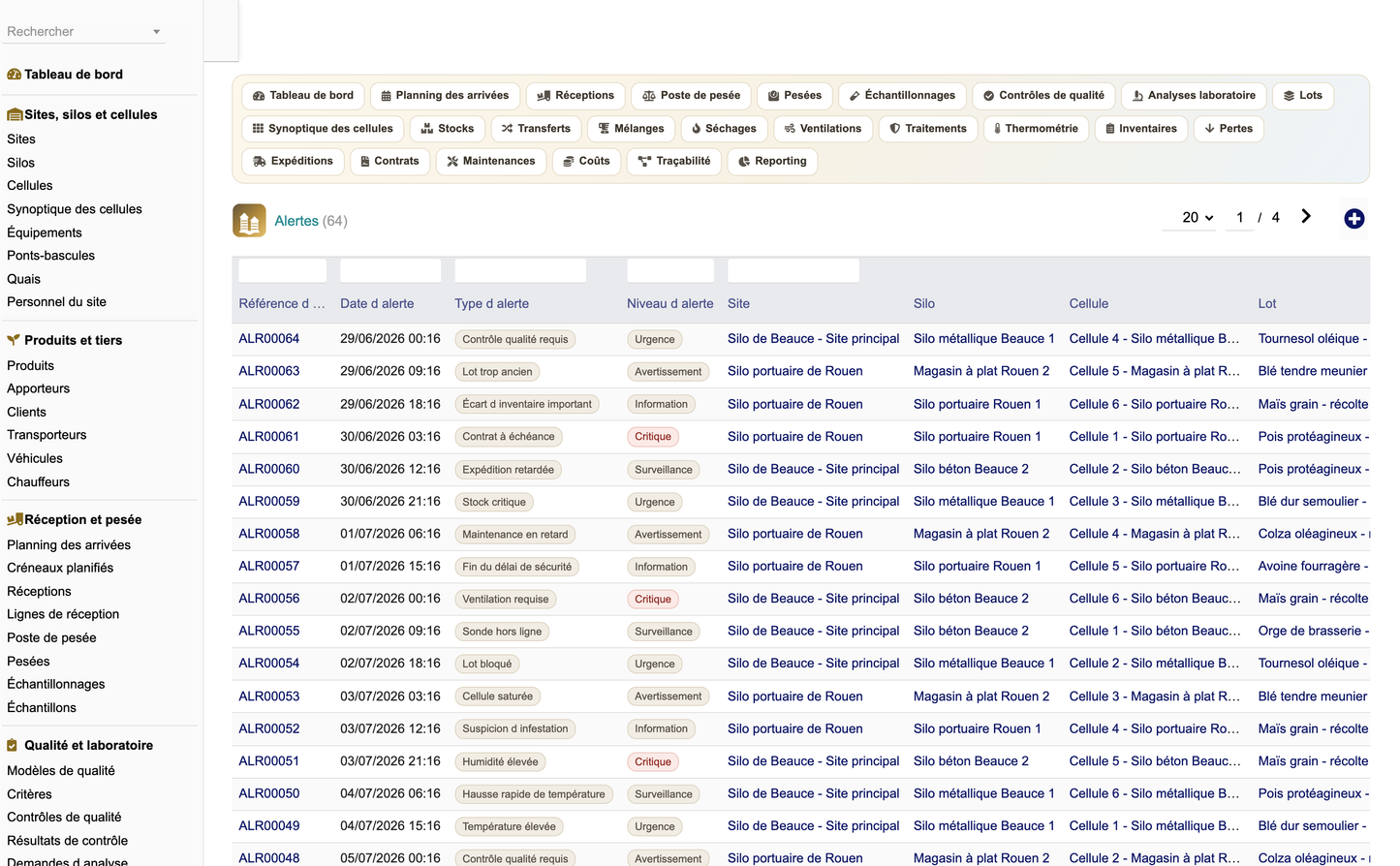
The Silo Control Tower gathers the whole site on one screen: capacity, traffic of the day, lots and quality, conservation, economics, alerts, the 2D cell synoptic, the grain flow from the gate to the shipment, and four charts.
· Over forty indicators, each one asserted non-zero on the demonstration dataset
· A ten-step flow synoptic, each step linking to its own list
· Twelve alert tiles turning green when the count is zero
· Per-site map cards and a site filter
27. Reporting
Eighteen reports in nine families, each with its own summary tiles, table, total row and chart, all exportable.
· Stock by site, cell, product and lot ageing
· Deliveries by supplier, monthly receptions, quality of the deliveries
· Shipments by customer and by month
· Results by quality criterion, temperatures by cell
· Conservation operations, losses by cause and by product, inventory gaps
· Maintenance by equipment, costs by category, profitability by site
28. Notifications and alerts
A daily scheduled job recomputes the aggregates and raises the alerts, de-duplicating on the type and the object so the same hot cell does not produce a new row every morning.
· Seventeen alert types, five severity levels, seven states with acknowledgement and escalation
· High temperature, rapid rise, high moisture, saturated cell, blocked lot, probe offline
· Treatment safety delay ending, maintenance overdue, contract expiring, lot stored too long
29. Security
Permissions are granular and least privilege by default: read and write are granted on activation so the module is usable, while every decision right is off.
· Thirty-three permission groups plus dashboard, reporting, traceability, export, demo and admin
· Accept a delivery, correct a weighing, validate a control, authorise a fumigation, validate an inventory gap
· Multi-entity aware, CSRF protected, HTML escaped, no secret stored in clear
30. Multilingual support
Five complete language files of 2 274 keys each: French, English, Spanish, Italian and German. Every visible key is prefixed so it cannot collide with another module.
· Field labels assembled by a localisation composer with gender agreement
· Controlled vocabularies translated term by term, 817 business glosses
· No literal percent sign, no HTML entity and no empty value in any catalogue
31. Dolibarr integration
The module never modifies the Dolibarr core. It uses hooks, triggers, extra fields, tabs, menus, business classes, the API and events.
· Third parties, contacts, products, warehouses and stock
· Customer orders, shipments, invoices, supplier orders and invoices
· Projects, interventions, agenda, document management and accounting links
· A missing optional module is detected and the feature is disabled cleanly
32. API
A secured REST API exposes the whole model: 300 CRUD routes, five per object, and eight business routes.
· Cell occupancy, stock by product, lot traceability chain, open receptions and shipments
· Open alerts, temperature hot spots and the dashboard figures
· A write route lets a supervision system push a temperature reading, refresh the probe and update the cell
· An invalid key is rejected with 401 before any query runs
33. Demo data
The demonstration dataset builds a complete site over twelve months and is removable in one click without touching a single real record.
· 2 sites, 4 silos, 24 cells, 32 equipment items, 4 weighbridges, 18 staff members
· 8 bulk products, 10 growers, 8 customers, 4 carriers, 16 vehicles, 12 drivers
· 204 receptions, 204 weighings, 204 samplings, 156 quality controls, 96 analyses
· Lots, stock, movements, transfers, blends, dryings, ventilations, treatments
· Inventories, losses, shipments, contracts, services, purchases, sales, maintenance, costs and alerts
· Roughly 7 500 rows, every one tagged so the purge can find it again
34. Installation
Home, Setup, Modules and Applications, Deploy an external module, then upload module_gestionsilos-1.0.zip. The archive extracts straight to htdocs/custom/gestionsilos with no extra folder level.
· Dolibarr 16 or above, validated on 17.0.3
· PHP 7.1 or above, validated on PHP 8.1
· Requires the native Third parties and Products modules
· Activation creates the tables, permissions, menus, constants, scheduled jobs and demo data
35. Technical architecture
Business classes extend CommonObject, the list and card engines are generated from a single object registry, and the SQL schema is self-healed on upgrade.
· 60 generated classes, one registry, generic list and card engines
· Schema self-heal adds a missing column on upgrade, since Dolibarr only ever creates tables
· Controlled vocabularies generated from one source, feeding both the PHP map and the language files
· Two scheduled jobs: daily monitoring and weekly cost consolidation
36. Copyright information
Developed and copyrighted by DoliResources - www.doliresources.com. Released under the GNU General Public License version 3 or later.
· Publisher: DoliResources
· Website: www.doliresources.com
· Version 1.0.0, 22 July 2026
· Licence: GNU GPL v3 or later
Developed and copyrighted by DoliResources - www.doliresources.com


