
Discover powerful Dolibarr extensions designed to automate your business processes
Talent Management is a complete, ready-to-use Human Resources application that turns Dolibarr ERP/CRM into a full talent-management platform. Published by DoliResources, it covers the entire...
Couldn't load pickup availability


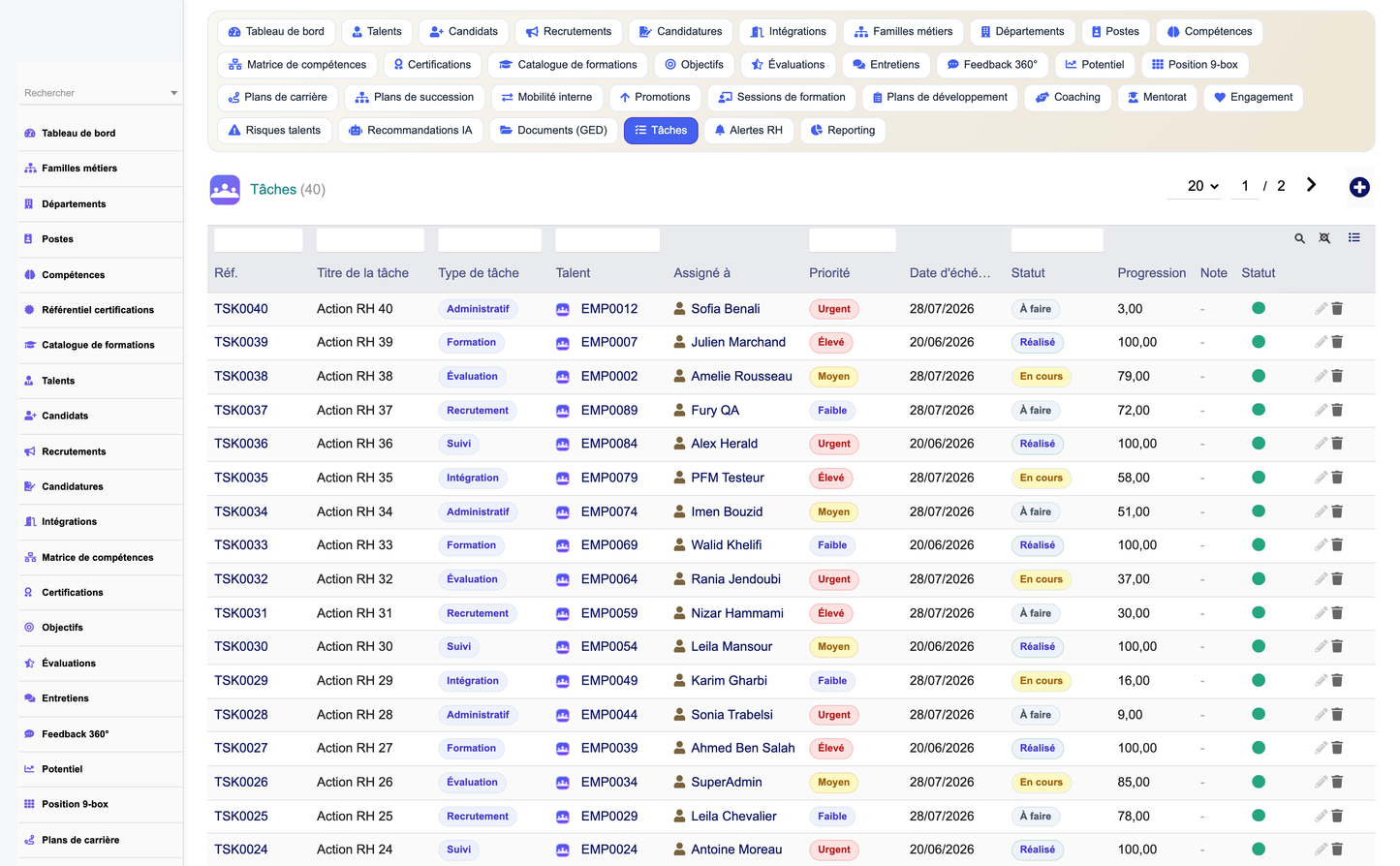
Talent Management is a complete, ready-to-use Human Resources application that turns Dolibarr ERP/CRM into a full talent-management platform. Published by DoliResources, it covers the entire employee lifecycle - from acquisition and onboarding to skills and GPEC, performance and potential, careers and succession, learning and development, engagement and People Analytics - behind a single top-level menu and a dedicated premium dashboard, the "Talent Management Cockpit".
The module is built entirely on native Dolibarr foundations. It reuses the users, third-party (Societe), project and document repositories and the multi-company (entity) framework, so an HR team benefits from a purpose-built vertical solution without leaving the familiar Dolibarr environment and without duplicating master data already held in the core.
· Talent acquisition & recruitment: job requisitions, candidates, applications and onboarding
· HR referentials: job families, departments, positions, skills, certification and training catalogues
· Complete talent (employee) records with performance, potential, engagement and skills scores
· Skills management & GPEC: skill matrix, gaps, certifications
· Performance: SMART/OKR objectives, evaluations and lines, interviews, 360 feedback and potential reviews
· Career & succession: career plans, succession of critical positions, successors, internal mobility, promotions
· Learning & development: training sessions, registrations, individual development plans, coaching, mentoring
· Engagement, talent-risk detection and an HR AI-recommendation engine
· Documents, operational tasks and HR alerts
· A premium cockpit dashboard, an interactive 9-Box grid and a decisional People Analytics reporting suite
|
Property |
Value |
|
Product name |
Gestion des Talents (Talent Management) |
|
Technical name |
gestiontalents |
|
Table prefix |
llx_gtal_ |
|
Module number (numero) |
994000 |
|
Version |
1.0.0 |
|
Family |
Human Resources (hr) |
|
Editor / Publisher |
DoliResources - https://www.doliresources.com |
|
Copyright |
(C) 2026 DoliResources |
|
License |
GNU General Public License v3 or later (GPL v3+) |
|
Compatibility |
Dolibarr 16.0+, PHP 7.1+, MySQL/MariaDB |
|
Dependencies |
modSociete (Third parties), modUser (Users) |
The module follows the standard Dolibarr external-module architecture. A single descriptor class (modGestionTalents) registers the module with the ERP, and a generic object engine drives all business entities from a central registry, which keeps the code base compact, consistent and easy to maintain.
The descriptor modGestionTalents (core/modules/) declares the module to Dolibarr. On activation its init() method loads the SQL schema, rebuilds the menu tree, provisions the permission set, invokes a schema self-heal routine (gtalEnsureSchema) that reconciles the live tables with the expected columns on every upgrade, and finally generates the demonstration dataset when none is present. Deactivation is handled by remove().
All thirty-five business objects extend Dolibarr's CommonObject base class and are described declaratively in a single registry (lib/gestiontalents_objects.php). Each entry defines the PHP class, the physical table, an icon, a menu label, whether the object is a navigation "hub", its line/parent relationship where relevant, and the full field list. A shared list/card engine renders every object's list view and record card from this metadata, so the presentation layer is uniform across the whole module while individual per-object PHP entry points remain thin wrappers.
Every table uses the llx_gtal_ prefix (for example llx_gtal_employee, llx_gtal_recruitment, llx_gtal_evaluation). Tables carry the standard Dolibarr technical columns - rowid primary key, entity for multi-company isolation, status, creation and modification timestamps, author and modifier user references, and an import_key column used to tag and later safely remove seeded demonstration records. Foreign keys link module objects to one another and to native Dolibarr objects (User, Societe).
The module ships thirty-five business objects, organised into functional areas. The table below lists each object with its physical table and a one-line purpose.
|
Object |
Table |
Purpose |
|
Job family |
llx_gtal_jobfamily |
Job family / metier reference with category and number of positions |
|
Department |
llx_gtal_department |
Organisation unit (direction/department/service/pole/team), manager & headcount |
|
Position |
llx_gtal_position |
Job position: level, grade, salary band, criticality, filled vs open seats |
|
Skill |
llx_gtal_skill |
Skill reference (soft/hard/digital...), strategic/future/critical flags, max level |
|
Certification catalog |
llx_gtal_certificationref |
Certification reference: issuer, domain, validity, mandatory flag |
|
Training catalog |
llx_gtal_trainingcat |
Training course reference: category, modality, provider, duration, cost |
|
Talent (employee) |
llx_gtal_employee |
Central talent record: profile, department/position, all HR scores & 9-box |
|
Candidate |
llx_gtal_candidate |
Applicant: source, target position, experience, expected salary, rating, status |
|
Recruitment |
llx_gtal_recruitment |
Job requisition: position, openings, priority, status, budget, applications |
|
Application |
llx_gtal_application |
Candidate application to a recruitment with stage, status, score, interview |
|
Onboarding |
llx_gtal_onboarding |
New-hire onboarding: buddy, manager, checklist progress and status |
|
Skill matrix |
llx_gtal_employeeskill |
Talent x skill: current vs target level, gap, certification flag |
|
Certification |
llx_gtal_certification |
Certification held by a talent: obtained/expiry date, status, score |
|
Objective |
llx_gtal_objective |
SMART/OKR/KPI objective per talent: weight, target, progress, status |
|
Evaluation |
llx_gtal_evaluation |
Performance review: type, scores, recommendation and status |
|
Evaluation line |
llx_gtal_evaluation_line |
Per-skill line of an evaluation: expected vs rated level and score |
|
Interview |
llx_gtal_interview |
HR interview (annual/career/exit...): date, interviewer, outcome |
|
360 feedback |
llx_gtal_feedback |
Multi-source feedback: peer/manager/upward/customer, rating, competency |
|
Potential |
llx_gtal_potential |
Potential assessment: performance x potential axes, 9-box, readiness |
|
Career plan |
llx_gtal_careerplan |
Career path: current & target position, horizon, readiness, review date |
|
Succession |
llx_gtal_succession |
Succession plan for a critical position: criticality, bench, vacancy risk |
|
Successor |
llx_gtal_successor |
Ranked successor for a succession plan: readiness, fit score, risk |
|
Mobility |
llx_gtal_mobility |
Internal move: type, from/to position & department, effective date, reason |
|
Promotion |
llx_gtal_promotion |
Promotion: grade/position change, salary before/after, status, reason |
|
Training session |
llx_gtal_trainingsession |
Scheduled session: dates, trainer, modality, seats, cost, status |
|
Training registration |
llx_gtal_training_reg |
Talent enrolment: attendance, quiz score, satisfaction, completion |
|
Development plan (IDP) |
llx_gtal_idp |
Individual development plan: target skill, actions, progress, due date |
|
Coaching |
llx_gtal_coaching |
Coaching engagement: coach, type, sessions planned/done, objective |
|
Mentoring |
llx_gtal_mentoring |
Mentoring pair: mentee, mentor, program, frequency, objective, status |
|
Engagement |
llx_gtal_engagement |
Engagement survey: eNPS, satisfaction, wellbeing, category, status |
|
Talent risk |
llx_gtal_talentrisk |
Retention/burnout/poaching risk: level, probability, impact, mitigation |
|
AI recommendation |
llx_gtal_airecommendation |
HR AI suggestion: type, confidence, priority, score, rationale |
|
Document |
llx_gtal_document |
HR document tied to a talent: type, version, confidentiality, status |
|
Task |
llx_gtal_task |
Operational HR task: type, assignee, priority, due date, progress |
|
Alert |
llx_gtal_alert |
HR alert (contract end, cert expiry, high risk, skill gap...), severity |
The Talent (Gtalemployee) is the hub of the whole model. Beyond identity (matricule, name, gender, birth date, contact, photo) it carries the employment profile (contract type, hire date, seniority, department, position, manager, job level, grade, salary) and, crucially, the analytical scores that drive the whole cockpit: performance, potential, engagement and skills scores, the computed 9-box cell, talent category, risk level, and the high-potential / key-talent flags. It optionally links to a native Dolibarr user (fk_user) and third party (fk_soc), and is referenced by skills, certifications, objectives, evaluations, career plans, successions, mobilities, promotions, training, coaching, mentoring, engagement, risks, AI recommendations, documents, tasks and alerts.
The module installs one top-level menu that opens the Talent Management Cockpit dashboard. Its left-hand menu exposes every functional area; each entry is guarded by the relevant permission so users only see what they are entitled to. Every menu URL is module-local, so the entries never collide with another module's shared native pages, and icons are Font Awesome glyphs rendered in the module's signature violet (#6C5CE7). The left menu is organised as follows:
|
Area |
Menu entries |
|
Cockpit |
Dashboard |
|
Referentials |
Job families, Departments, Positions, Skills, Certification catalog, Training catalog |
|
Talents |
Talents |
|
Recruitment |
Candidates, Recruitments, Applications, Onboardings |
|
Skills / GPEC |
Skill matrix, Certifications |
|
Performance |
Objectives, Evaluations, Interviews, Feedbacks, Potential, 9-Box |
|
Career & Succession |
Career plans, Successions, Successors, Mobilities, Promotions |
|
Development |
Training sessions, Training registrations, Development plans, Coachings, Mentorings |
|
Analytics / AI |
Engagements, Talent risks, AI recommendations, Documents, Tasks, Alerts |
|
Analytics |
Reporting |
|
Administration |
Setup |
Access is governed by nine functional right groups plus a module administration right. Read and write are granted by default so the module is immediately usable after activation, while delete and administration remain disabled until an administrator grants them. This yields 26 discrete permission lines: read, write and delete for each of the eight operational groups (24 lines), a single read permission for reporting, and one module administration right.
|
Right group |
Covers |
Read |
Write |
Delete |
|
referential |
Job families, departments, positions, skills, certification & training catalogs |
Yes |
Yes |
Off |
|
talent |
Talent (employee) records |
Yes |
Yes |
Off |
|
recruitment |
Candidates, recruitments, applications, onboarding |
Yes |
Yes |
Off |
|
skills |
Skill matrix and certifications |
Yes |
Yes |
Off |
|
performance |
Objectives, evaluations, interviews, feedback, potential |
Yes |
Yes |
Off |
|
career |
Career plans, successions, successors, mobilities, promotions |
Yes |
Yes |
Off |
|
development |
Training sessions, registrations, IDP, coaching, mentoring |
Yes |
Yes |
Off |
|
analytics |
Engagement, talent risks, AI recommendations, documents, tasks, alerts |
Yes |
Yes |
Off |
|
reporting |
People Analytics reporting suite (read-only) |
Yes |
- |
- |
|
admin |
Administer the module (setup) |
- |
- |
- |
· Every page enforces the relevant permission through gtalCan()/hasRight(); the dashboard, 9-Box and reporting require the corresponding read rights, and the setup page requires administrator status.
· All data is entity-scoped: multi-company installations are isolated by the native Dolibarr entity mechanism on every query.
· The REST API guards each route against the rights of the authenticated caller (DolibarrApiAccess::$user), returning HTTP 403 on insufficient rights.
· Demonstration data is isolated by the GTALDEMO import key so it can be removed without affecting production records.
The dashboard (dashboard.php) is the module's landing page, titled "Talent Management Cockpit" and styled in a premium blue / violet / turquoise theme. It opens with a hero banner carrying a global HR score, then presents a strip of eight strategic indices, a grid of KPI cards, a set of analytical charts, an interactive 9-Box grid with a top-performers ranking, and closing HR-alerts and AI-recommendation panels.
A single Global HR Score summarises talent health as the average of eight indices, each drawn from the seeded scores and activity of the active workforce:
|
Index |
Definition |
|
Performance |
Average performance score of active talents |
|
Engagement |
Average engagement score of active talents |
|
Potential |
Average potential score of active talents |
|
Skills |
Average skills score of active talents |
|
Training |
Share of active talents having completed a training |
|
Leadership |
Average performance of lead / manager / director / executive levels |
|
Mobility |
Career-plan coverage relative to headcount |
|
Succession |
Share of critical positions covered by at least one successor |
Around twenty-six KPI cards quantify the workforce, talent pipeline and development activity, including:
|
KPI |
KPI |
KPI |
|
Headcount |
Key talents |
High potentials |
|
Candidates |
New hires (90 days) |
Open positions |
|
Critical positions |
Successors |
Career plans |
|
Objectives achieved (rate) |
Interviews done |
Evaluations |
|
Skills acquired |
Critical skills |
Training hours |
|
Valid certifications |
Mobilities |
Promotions |
|
Mentors |
Coachings |
Talents at risk |
|
Turnover rate |
Engagement |
Performance |
|
Training budget |
Training ROI |
Time-to-hire |
· Hiring trend - new hires per month over the last 12 months (bar)
· Headcount by department - active talents per organisation unit (bar)
· Skills distribution - skill-matrix entries by skill type (pie)
· Risk by level - active talents by risk level (pie)
· Engagement trend - average engagement score per month over 12 months (line)
· Evaluation recommendation distribution - reviews by recommendation (pie)
· Promotions trend - promotions per month over 12 months (bar)
· Certifications distribution - certifications by status (pie)
· Interactive 9-Box grid - active talents by performance x potential cell
· Top performers - the ten highest performance/potential talents (ranked table)
Two closing panels complete the cockpit: an HR alerts panel that surfaces interviews to hold, late objectives, career reviews due, expiring certifications, critical skill gaps and high-risk talents; and an AI-recommendations panel listing the top HR AI suggestions with their confidence and priority.
The dedicated 9-Box page (ninebox.php) plots active talents on the classic performance x potential grid. Each talent is assigned to one of nine cells (nbox1 to nbox9) from its stored nine_box value; the grid renders potential on the vertical axis and performance on the horizontal axis. Cells are colour-coded from low performers up to the top-right "star" cell, and each cell lists its talents as clickable chips (truncated to twelve, with a "+N" overflow indicator) that link straight to the talent record. The cockpit dashboard embeds a compact, count-only version of the same grid.
The People Analytics suite (reporting.php) offers nine decisional reports selectable from a tabbed bar. Each report shows a detailed data table and can be exported to CSV or Excel, or sent to the printer. Exports decode all HTML entities so accented labels and values export cleanly.
|
Report |
What it shows |
|
Headcount by department |
Headcount vs target, high potentials and at-risk talents per department |
|
Recruitment performance |
Requisitions, openings and applications by recruitment status |
|
Performance & potential |
Average performance, potential, engagement and skills scores per department |
|
Skills mapping |
Coverage, average level and gap per skill (with skill type) |
|
Training & budget |
Sessions, enrolments, hours and cost per training category |
|
Succession coverage |
Criticality, bench strength, vacancy risk and successor count per critical position |
|
Mobility & promotions |
Internal moves counted by mobility type |
|
Engagement & risks |
Average engagement, eNPS, satisfaction and wellbeing per department |
|
Turnover & retention |
Headcount, departures and turnover rate per department |
A REST API (class/api_gestiontalents.class.php) exposes the module to external systems (ATS, HRIS, BI). The base URL is /api/index.php/gestiontalents/. Authentication uses the standard Dolibarr DOLAPIKEY mechanism, and every route is guarded against the module rights of the authenticated caller, returning HTTP 403 on insufficient rights. Sort fields are whitelisted against the real table columns to prevent SQL injection.
|
Method & route |
Purpose |
Right group |
|
GET talents |
List talents, with optional department / high-potential / risk filters |
talent (read) |
|
GET talents/{id} |
One talent with skills, certifications, objectives and evaluations |
talent (read) |
|
GET candidates |
List candidates, with optional status filter |
recruitment (read) |
|
GET recruitments |
List recruitments (requisitions), with optional status filter |
recruitment (read) |
|
POST applications |
Create an application (e.g. pushed from an external ATS) |
recruitment (write) |
|
GET evaluations |
List evaluations, with optional talent filter |
performance (read) |
|
GET skillmatrix |
List skill-matrix rows, with optional talent / skill filters |
skills (read) |
|
GET successions/{id} |
One succession plan with its ranked successors |
career (read) |
|
GET dashboard/kpis |
Consolidated HR KPIs (headcount, high potentials, risk, open positions...) |
reporting (read) |
The module supports the end-to-end talent-management cycle.
Recruiters open a recruitment (requisition) against a position, with a number of openings, priority, budget and channel. Candidates are registered with their source, experience and expected salary, and linked to the requisition through applications that progress across stages (applied, phone screen, interview, technical test, final interview) with a score and interview date. A hired candidate flows into an onboarding record that tracks the buddy, manager and checklist progress to completion.
Skills are defined in the referential (soft, hard, digital, metier...) with strategic, future and critical flags. The skill matrix records, per talent and skill, the current versus target level and the resulting gap, feeding both the skills index and the skill-gap alerts. Certifications held by talents are tracked with their obtained and expiry dates and status.
SMART/OKR objectives are set per talent with a weight, target and progress. Evaluations capture the performance and potential scores, an overall score and a recommendation (promote, maintain, develop, monitor, exit); evaluation lines detail the rating per skill. Interviews (annual, career, professional, exit...) and 360 feedback from peers, managers, reports and customers complete the picture, and potential reviews assign each talent a 9-box cell and readiness level.
Career plans map a talent from a current to a target position over a defined horizon with a readiness percentage. Succession plans protect critical positions by ranking successors with their readiness and fit score, and by tracking bench strength and vacancy risk. Internal mobilities (vertical, horizontal, international, transfer) and promotions (grade/position and salary change) record the actual moves.
Training sessions are scheduled from the training catalogue, with seats, cost and modality; talents register and their attendance, quiz score, satisfaction and completion are recorded. Individual development plans target specific skills with actions and progress, while coaching and mentoring engagements pair talents with coaches and mentors around defined objectives.
Engagement surveys capture eNPS, satisfaction and wellbeing per talent and department. Talent risks (departure, burnout, disengagement, retirement, poaching) are logged with a probability, impact and mitigation plan. An HR AI-recommendation engine surfaces suggested actions - promote, train, mobilise, nominate a successor, retain, coach, adjust salary - each with a confidence and priority, ranked on the cockpit.
Rather than duplicating core data, the module integrates with native Dolibarr objects and modules:
|
Native object / module |
Integration |
|
Users (User) |
Managers, recruiters, evaluators, coaches, buddies and assignees reference Dolibarr users; a talent can link to a user account (fk_user) |
|
Third parties (Societe) |
Talents and candidates can attach to a native third party (fk_soc) - site, employer or agency |
|
Projects |
HR initiatives and campaigns can be organised alongside native Dolibarr projects |
|
Documents / ECM |
HR documents integrate with the Dolibarr document / ECM framework |
|
Multi-company (entity) |
Every table is entity-aware for multi-company / multi-site isolation |
|
Rights framework |
Permissions plug into Dolibarr's standard user / group rights model |
The module declares hard dependencies on modSociete and modUser, ensuring those repositories are available before activation. It is multi-entity, multi-currency and multi-language aware.
The interface is fully translatable through Dolibarr's native language system, with no hard-coded strings, and ships in five languages: French, English, Italian, German and Spanish. Labels are resolved through the standard translation layer, so the module respects each user's language preference.
Business enumerations (statuses, types, categories, levels, 9-box cells...) are stored as short, language-neutral codes and rendered on the fly by the coded-vocabulary helper (gtalVocabLabel). The underlying data therefore stays identical regardless of interface language, while every label is displayed correctly localised. The same mechanism keeps charts, tables and exports consistent and correctly decoded across all supported languages.
To let evaluators explore a fully populated cockpit from the first login, the module can generate a coherent demonstration dataset in a single click from the setup page ("Install demonstration data"), and remove it just as easily ("Remove demonstration data"). Generation also runs automatically on first activation when no data is present.
· Roughly 2,700 realistic, FK-coherent rows are generated across all thirty-five tables.
· Departments, positions, job families, skills and certification / training catalogues form the referential backbone.
· A full population of talents with performance, potential, engagement and skills scores and 9-box positions.
· Recruitments, candidates, applications and onboardings covering the acquisition funnel.
· Skill-matrix rows, certifications, objectives, evaluations, interviews, feedback and potential reviews.
· Career plans, successions, successors, mobilities and promotions.
· Training sessions, registrations, development plans, coaching and mentoring engagements.
· Engagement surveys, talent risks, AI recommendations, documents, tasks and alerts.
All seeded records are tagged with the import key GTALDEMO, so removal is safe: only GTALDEMO rows are deleted and real data is never touched. Around a year of history is seeded so that every monthly chart and trend is meaningful from the outset.
· Copy the gestiontalents folder into the htdocs/custom directory of the Dolibarr installation, or install the packaged ZIP through Home > Setup > Modules > Deploy/install external module.
· Enable the module from Home > Setup > Modules (Human Resources family). Activation automatically creates the llx_gtal_* tables, builds the menus, provisions the rights, self-heals the schema and seeds the demonstration dataset.
· Assign the desired read / write / delete permissions to user groups from Home > Users & Groups.
|
Requirement |
Value |
|
Dolibarr |
16.0 or higher |
|
PHP |
7.1 or higher |
|
Database |
MySQL / MariaDB |
|
Required modules |
Third parties (modSociete), Users (modUser) |
The configuration page (admin/setup.php) exposes the module settings and an About tab, and provides the one-click actions to install or remove the demonstration dataset, with a confirmation prompt before removal.
Q. Does the module modify native Dolibarr tables?
A. No. All data lives in dedicated llx_gtal_* tables. The module reuses native users and third parties by reference only, never altering core schema.
Q. Can I remove the demonstration data safely?
A. Yes. Only rows tagged with the import key GTALDEMO are deleted; any real records you have created are left untouched.
Q. Is the module usable immediately after activation?
A. Yes. Read and write permissions are granted by default for the eight operational right groups, so the module is operational as soon as it is enabled; delete and administration stay off until granted.
Q. Which languages are supported?
A. French, English, Italian, German and Spanish, through Dolibarr's native translation system. Coded vocabulary is rendered in the active user language.
Q. Can external systems read talent data?
A. Yes, through the REST API under /api/index.php/gestiontalents/, authenticated with DOLAPIKEY and guarded by the module's right groups.
Q. Does it work in a multi-company setup?
A. Yes. Every table is entity-aware, so multi-company and multi-site installations are isolated by the native Dolibarr entity mechanism.
Q. What happens to my data when I upgrade?
A. On activation the schema self-heal routine (gtalEnsureSchema) reconciles the live tables with the expected columns, adding any missing column without touching existing data.
Gestion des Talents (Talent Management) is published by DoliResources, a provider of vertical business modules for the Dolibarr ERP/CRM platform.
|
Item |
Value |
|
Product |
Gestion des Talents (Talent Management) |
|
Technical name |
gestiontalents |
|
Module number |
994000 |
|
Version |
1.0.0 |
|
Editor / Publisher |
DoliResources |
|
Website |
https://www.doliresources.com |
|
License |
GNU General Public License v3 or later (GPL v3+) |
|
Copyright |
(C) 2026 DoliResources |
|
Family |
Human Resources |
|
Compatibility |
Dolibarr 16.0+, PHP 7.1+, MySQL/MariaDB |
This document describes version 1.0.0 of the module and is provided for functional and technical reference. Copyright (C) 2026 DoliResources - https://www.doliresources.com. Distributed under the GNU GPL v3 or later.


