
Discover powerful Dolibarr extensions designed to automate your business processes
Terroir Product Management (Gestion des Produits de Terroir) turns Dolibarr into a specialised ERP...
Couldn't load pickup availability


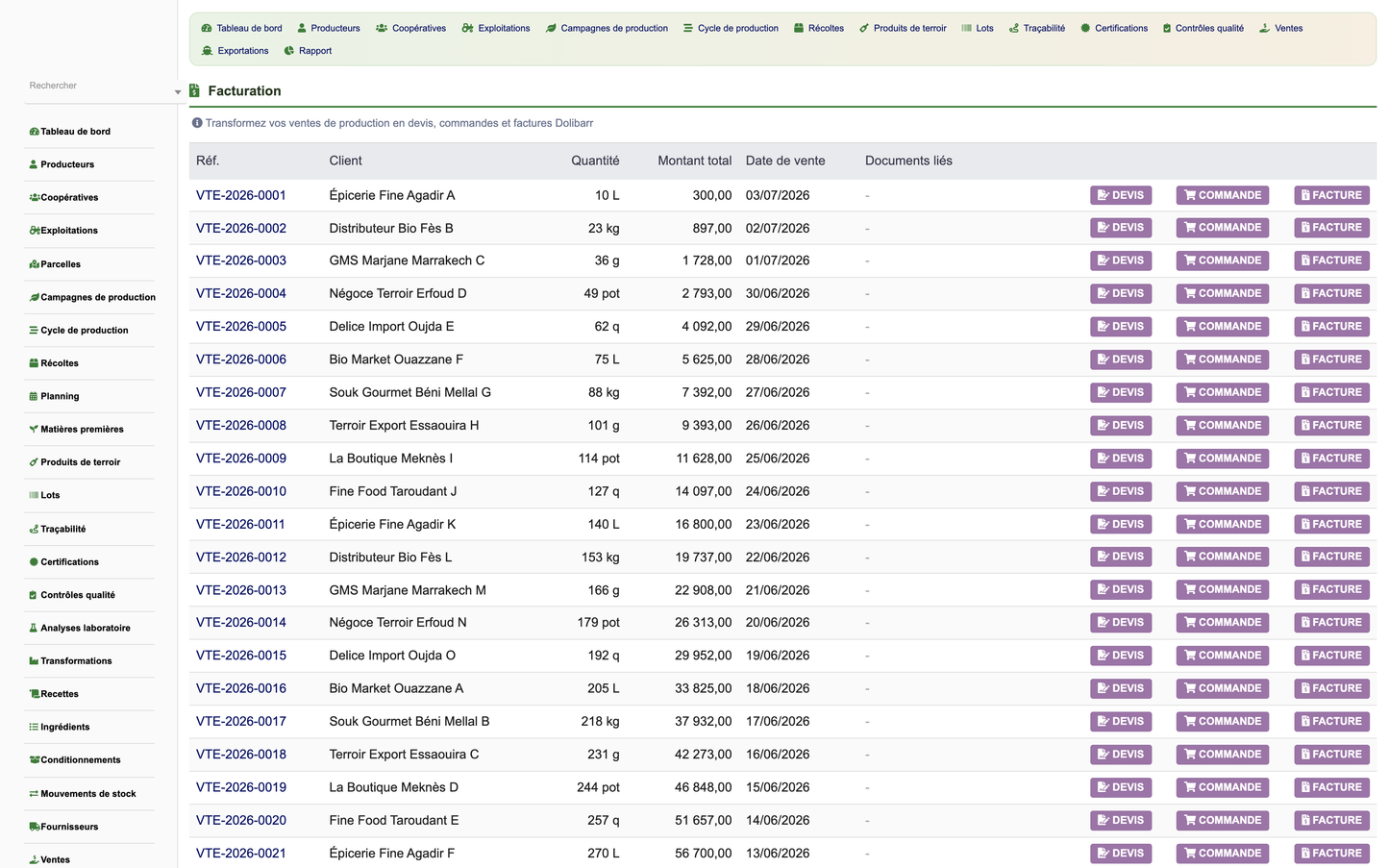
Terroir Product Management (Gestion des Produits de Terroir) turns Dolibarr into a specialised ERP for producers, cooperatives and distributors of terroir and regional products. It manages the entire value chain — from field and producer to certified, packaged, sold and exported product — while natively reusing and enriching the standard Dolibarr objects (third parties, products, projects, quotes, orders, invoices and payments).
The module is flexible enough to cover every terroir sector, including: olive oil, argan oil, saffron, honey, dates, almonds, walnuts, dried figs, aromatic and medicinal plants, couscous, spices, artisanal jams, natural juices, traditional cheeses, dairy products, olives, capers, organic products, labelled products and any other regional specialty.
Key figures:
· 24 dedicated business objects with full create / read / update / delete lists and cards.
· A modern real-time cockpit dashboard with 6 smart alert tiles, 4 KPI zones, 4 dynamic charts and a production-cycle board.
· Full farm-to-fork traceability engine and a drag-and-drop production-cycle Kanban.
· 17 decision-making reports exportable to CSV, Excel and PDF.
· A rule-based automation engine and native Dolibarr invoicing bridge.
· 21 permission groups, 5 languages, MultiCompany compatibility.
The dashboard is an entirely original, terroir-inspired cockpit (olive-green, gold and wood-brown identity). It gives a real-time overview from production to marketing and is fully responsive (desktop, tablet, mobile) with dark-mode compatibility.
Six clickable tiles highlight items that need attention and turn red when a threshold is exceeded:
· Lots nearing their use-by date (DLC) within 30 days
· Certifications to renew within 60 days
· Quality non-conformities
· Harvests in progress
· Critical stock (net quantity ≤ 0)
· Exports in preparation
Twenty-plus indicators grouped into four zones:
· Production & harvests: Producers, cooperatives, products, harvests in progress, lots produced, average yield.
· Quality & certifications: Active certifications, certified lots, organic products, quality conformity rate, non-conformities.
· Lots & traceability: Lots produced, products in stock, critical stock, traceability steps, exports.
· Commercial & finance: Revenue, production cost, margin, orders in progress, orders delivered, active customers, suppliers.
Four DolGraph charts render live data: harvested output by month, product breakdown by category, revenue by month, and certification breakdown. A production-cycle board at the bottom summarises campaign counts and quantities per stage.
The module ships 24 business objects (SQL prefix llx_terroirproduct_). Each object has a searchable, column-configurable list, a detailed card with related-record panels, status badges and, for hub objects, dedicated KPI cards.
|
Object |
Description |
|
Producer |
Full grower profile: reference, photo, first/last name, cooperative, region, province, address, GPS coordinates, phone, email, products grown, certification level and linked Dolibarr third party. |
|
Cooperative |
Cooperative profile: manager, number of members, region, contact details, main products and linked third party. |
|
Farm (Exploitation) |
Farm holding: linked producer, surface (ha), location, region, GPS and altitude. |
|
Parcel |
Land parcel: linked farm, surface, crop, planting year, tree count, estimated yield and GPS. |
|
Production Campaign |
Hub with Kanban stage: product type, season, producer, parcel, stage, start and planned-harvest dates, expected quantity, estimated value and linked Dolibarr project. |
|
Harvest |
Harvest record: campaign, producer, parcel, product type, quantity, quality, moisture, storage, value and date. |
|
Raw Material |
Incoming raw material: category, producer, harvest, quantity, linked Dolibarr product, unit cost and origin. |
|
Terroir Product |
Finished product: category, subcategory, origin, region, producer, cooperative, certification/label, terroir label, photo, packaging, weight, sale price, organic flag and linked Dolibarr product. |
|
Lot / Batch |
Hub batch: terroir product, producer, harvest, production date, use-by date (DLC), quantity, certification flag and reference, lot status. |
|
Traceability Step |
Each field-to-fork step (producer, harvest, processing, packaging, storage, shipping) with order, location, operator and timestamp. |
|
Certification |
Hub: type (Organic, PGI, PDO, regional label, Fair Trade, ISO, HACCP), certifying body, producer, product, issue and expiry dates, certificate number, scope and status. |
|
Quality Control |
Control type, laboratory, result, conformity, corrective action and date, linked to a lot and product. |
|
Lab Analysis |
Measured parameter, value, unit, threshold/norm, conformity, laboratory and date. |
|
Processing (Fabrication) |
Hub: product, recipe, input/output quantity, yield %, cost, operator and date. |
|
Recipe |
Product recipe: category, yield, unit, preparation time and description. |
|
Ingredient |
Recipe line linking a raw material with quantity and unit. |
|
Packaging |
Packaging type (bottle, jar, sachet, pot, carton, pallet, tin), capacity, material, product, barcode and unit cost. |
|
Stock Movement |
In/out movement per product and lot, quantity, warehouse, reason and date. |
|
Supplier |
Supplier profile with its own name, category, linked third party, products supplied and contact. |
|
Sale |
Hub: product, lot, customer, quantity, unit price, total, sales channel, linked order/invoice and date. |
|
Export |
Hub: customer, country, incoterm, customs document, certificate, transport mode, quantity, value, date and status. |
|
Document (DMS) |
Document repository: type, producer/product link, file path, version and date. |
|
Activity Log |
Chronological activity journal: type, producer/product link, date and user. |
|
Automation |
Automation rule: trigger event, conditions, action type and parameters, active flag, run count and last run. |
Every lot carries a complete traceability journal. Each step is time-stamped and geo-located so the full history of a batch can be reconstructed at any time:
· Producer
· Parcel / field
· Harvest
· Processing / transformation
· Packaging
· Storage
· Shipping / delivery
· Final customer
This supports food-safety requirements, recall management and the story-telling of origin that terroir products rely on.
Manage all certifications with their certifying body, issue and expiry dates, certificate number and scope. Types covered include Organic Agriculture, PGI (IGP), PDO (AOP), regional labels, Fair Trade, ISO and HACCP. Renewal alerts surface on the dashboard.
Record quality controls (organoleptic, physico-chemical, microbiological, labelling, packaging), laboratory analyses with measured values against thresholds, conformity status, non-conformities and corrective actions.
Campaigns are piloted through a drag-and-drop Kanban board with six stages: Planning, Harvest, Processing, Packaging, Marketing and Closed. Moving a card updates the campaign stage and status instantly (AJAX), giving an at-a-glance operational view of the whole production pipeline.
Sales are recorded per product, lot, customer and channel (direct sale, retail, export, wholesale, e-commerce, fine grocery). Each sale can be turned into a native Dolibarr quote, order or invoice in one click, reusing the Dolibarr product linked to the terroir product.
Exports are managed with country, incoterm, customs documents, certificates, transport mode, quantity, value and shipping status.
The module integrates natively with Dolibarr third parties, contacts, products, stock, purchases, suppliers, quotes, orders, invoices, payments, bank, accounting, projects, agenda, DMS/ECM, e-mails, shipments and contracts. All commercial operations use native Dolibarr objects.
The Reporting hub offers 17 ready-made reports, each with optional KPI cards and one-click export to CSV, Excel and PDF, plus printing. Reports are organised by theme:
|
Category |
Reports |
|
Production & traceability |
Production by product type, harvests by campaign, yield by parcel, processing & yields, lots produced, lot traceability. |
|
Quality & certifications |
Quality controls, laboratory analyses, certifications and expiries. |
|
Sales & stock |
Sales by product, sales by channel, exports by country, stock status, stock movements. |
|
Financial |
Revenue, margin & profitability, producer breakdown. |
A daily scheduled job evaluates alert and automation rules. Out-of-the-box triggers include:
· Lots nearing their use-by date
· Certifications expiring soon
· Quality non-conformities
· Critical stock levels
· Automatic closing of marketed campaigns
An administration screen configures general parameters (default currency, lot prefix, expiry alert threshold). Two dedicated buttons let administrators install a realistic demonstration dataset (producers, cooperatives, products, lots, certifications, quality controls, sales, exports and native Dolibarr third parties, products, quotes and invoices) or remove it. The removal only deletes demonstration data, identified by its import key — real data is never touched.
Security follows Dolibarr best practices: CSRF protection, XSS escaping, prepared SQL statements, fine-grained permissions across 21 right groups (read / write / delete), logging, audit trail and MultiCompany compatibility.
The module follows the official Dolibarr module architecture (class/, core/modules, core/triggers, core/boxes, sql/, langs/, css/, js/, img/, lib/, admin/, doc/). All tables use the llx_terroirproduct_ prefix. The code is object-oriented, documented, modular and maintainable, with an automatic schema self-heal on activation so upgrades add new columns transparently.
User interface: modern, elegant and responsive across desktop, tablet and mobile, with global and multi-criteria search, column-configurable dynamic tables, interactive widgets, a Kanban view, a campaign timeline, status badges, modern icons and dark-mode compatibility.
|
Item |
Value |
|
Dolibarr versions |
v16, v17, v18, v19, v20, v21, v22, v23+ (forward-compatible) |
|
PHP |
7.1 minimum (PHP 8 compatible) |
|
Languages |
English, French, Italian, German, Spanish (official langs system) |
|
Dependencies |
Third parties (modSociete) and Products (modProduct) |
|
Multi-entity |
MultiCompany compatible |
© 2026 DoliResources — www.doliresources.com


