
Discover powerful Dolibarr extensions designed to automate your business processes
Textile Management (technical name: textilemanagement) is a professional, secure, responsive and multilingual Dolibarr module that transforms Dolibarr into a genuine industrial ERP-MES...
Couldn't load pickup availability


Textile Management (technical name: textilemanagement) is a professional, secure, responsive and multilingual Dolibarr module that transforms Dolibarr into a genuine industrial ERP-MES specialised in textiles and apparel. It covers the entire value chain — from fiber to finished product — across spinning, weaving, knitting, dyeing, printing, ennobling, cutting, sewing, finishing, quality, maintenance, stock, subcontracting, costing and sustainability.
It is designed for spinning mills, weavers, knitters, dye houses, printers, finishers, garment makers, home-textile and technical-textile manufacturers, cut-make-trim workshops, subcontractors, multi-site plants and brands managing collections and their suppliers. All 34 business objects are interconnected and integrated with native Dolibarr objects (third parties, products, variants, lots, stock, orders, shipments, invoices, projects, agenda).
· Pilot the full textile production chain inside a single ERP, without a separate industry tool.
· Master product development: collections, models, size/color matrix, versioned technical files, patterns and prototypes.
· Industrialise: multi-level bills of materials, operation routings and a textile costing engine.
· Control production in real time: manufacturing, cutting, sewing, dyeing, printing, finishing.
· Guarantee quality: control plans, defect classification, rework/scrap, cost of non-quality.
· Optimise materials, stock and full traceability from supplier lot to customer shipment.
· Measure cost of goods (planned vs real) and margins; reduce waste and environmental impact.
· Provide decisional dashboards, reporting, a REST API and realistic demo data.
The module ships 34 interconnected business objects grouped into six functional domains, each governed by granular permissions and surfaced through a grouped navigation menu and an in-page tab bar.
|
Domain |
Objects |
|
Product development |
Collections, Models, Variants (size/color matrix), Technical files, Patterns, Prototypes |
|
Materials |
Fibers, Yarns, Fabrics & knits, Rolls, Accessories & trims, Chemicals |
|
Industrialisation |
Bills of materials & lines, Routings & operations, Quotations (costing) |
|
Production |
Manufacturing orders, Cutting, Sewing, Dyeing, Recipes, Printing/Embroidery, Finishing |
|
Quality |
Quality controls, Defects & non-conformities, Rework & scrap |
|
Operations |
Subcontracting, Machines, Maintenance (CMMS), Stock & lots, Shipments, Cost of goods, Waste |
Eight permission groups (read / create-modify / delete) plus an administration right — 23 rights in total — let you build role profiles such as: administrator, management, plant manager, collection manager, stylist, pattern maker, industrialisation manager, production manager, planner, workshop/line supervisor, cutter, sewing operator, dye-house manager, quality manager, quality controller, maintenance technician, warehouse keeper, purchasing manager, logistics manager, sales, accountant and read-only user.
|
Right group |
Governs |
|
referential |
Fibers, yarns, fabrics, rolls, accessories, chemicals, machines |
|
productdev |
Collections, models, variants, technical files, patterns, prototypes, BOMs, routings, quotations |
|
production |
Manufacturing orders, cutting, sewing, dyeing, recipes, printing, finishing |
|
quality |
Quality controls, defects, rework |
|
maintenance |
Machine maintenance (CMMS) |
|
subcontract |
Subcontracting operations |
|
logistics |
Stock, shipments, cost of goods, waste |
|
reporting |
Access to the decisional reporting suite |
A modern dashboard evoking the textile world (fibers, yarns, rolls, ateliers). A central flow strip renders the eight production stages — Material, Yarn, Fabric, Cutting, Sewing, Finishing, Control, Packing — each as an interactive card with a live count. Colour codes distinguish normal production, preparation, delay, incident, maintenance and quality control.
KPIs include: production today / this month, planned quantity, completion rate, orders running / late, average efficiency (OEE), cutting/fabric yield, defect / rework / scrap rates, pending controls, critical stock, water and energy consumption, production cost, average margin, active collections, models and late subcontracting. Charts cover planned vs produced (12 months), defects by family, production by workshop and cost structure.
Manage collections with season, year, brand, customer, segment, theme, status, manager, launch and market dates, budget, development cost, expected sales, number of models and overall progress. Lifecycle statuses span idea, study, development, prototype, sampling, validation, production, commercialised, closed and abandoned.
Each model carries a reference, designation, collection, brand/customer, category (t-shirt, shirt, trousers, jacket, dress, home linen, technical textile, and more), gender, style, main fabric, silhouette, weight, status, version, target price, standard cost and image. Models link to a native Dolibarr product and drive variants, BOMs, routings and production.
A variant matrix combines model x size x color x length/cut with SKU, barcode, unit price, ordered/produced quantities and stock. Each combination can map to a native Dolibarr product variant.
Versioned technical dossiers hold the measure chart, tolerances, stitch type and density, assembly, finishing, labeling and packing instructions, CAD files and the version history. Previous versions are never overwritten.
Manage base patterns, pieces, size range, grading rule, seam allowance, grain line, pattern match, fabric width, marker length, layers, marker efficiency, waste percentage, theoretical consumption, CAD file, version and validation — enabling theoretical fabric consumption and material cost per model.
A full prototype workflow: request, assignment to the pattern maker, cutting, sewing, fitting, measures, deviations, corrections, new version, internal validation, send to client and client validation — recording cost, time, materials, comments and decisions.
· Fibers: type, origin, composition, staple length, fineness, certification, supplier, lot, price, stock, recycled flag.
· Yarns: composition, count, twist, color, tenacity, elasticity, package, weight, length, lot, supplier, price, stock.
· Fabrics & knits: type, composition, construction, weight (gsm), width, thickness, color, pattern, stretch, shrinkage, colorfastness, finishing, supplier, certification, price, stock.
· Rolls: unique code, barcode, fabric, supplier/internal lot, dye bath, width, initial/remaining length, weight, defects, location, quality status, reception date and cost.
· Accessories & chemicals: trims, buttons, zippers, labels, threads and dyestuffs/auxiliaries with lots, hazard class, expiry and alert thresholds.
Multi-level bills of materials list every component (fabric, lining, thread, buttons, zipper, label, packing) with quantity, unit, size/color, waste percentage, substitution flag, preferred supplier and cost. Routings define ordered operations with workshop, line, machine, stitch type, standard time, cadence, skill level, operator count, control flag and cost per minute/operation.
The textile costing engine computes fabric, yarn, trims, cutting, sewing, dyeing, printing, finishing, subcontracting, packing and transport costs plus overhead, then applies a target margin to derive the final price. Quotations simulate by quantity and can be converted into a native Dolibarr commercial proposal.
Manufacturing orders tie a model/collection/customer to BOM, routing, planned/produced/conform quantities, size and color breakdowns, workshop, line, team, priority, planned/start/end/due dates and progress. Statuses span draft, planned, cutting, sewing, finishing, control, done and cancelled, driving the dashboard kanban.
Cutting orders record rolls, layers, marker length, planned/cut quantities, fabric used, waste, cutting efficiency, machine, operator, timing and incidents.
Sewing declarations track workshop, line, workstation, operation, operator, team, size, color, declared/conform/rework/scrap quantities, standard vs real time and efficiency — supporting real-time follow-up and line balancing.
· Dyeing / ennobling orders: treatment type, lot, bath, machine, batch weight, temperature, duration, pH, liquor ratio, water and energy consumption, operator, result and status.
· Versioned dyeing recipes: dyestuffs, auxiliaries, target color and Pantone reference, Delta-E tolerance, temperature ramp, duration and pH.
· Printing & embroidery: technique, design file & version, colors, position, dimensions, machine, frame, thread, stitch count, cost, client approval.
· Finishing & packing: pressing, folding, labeling, cartons, pallets, assortment and status.
Control plans and controls at reception, in production and final, with target values, tolerances, sample size, checked/defect counts and conformity. Defects are classified by family and severity (minor / major / critical) with root cause, corrective action and cost impact. Rework records decision, time, cost and status. The dashboard derives defect, rework and scrap rates and the cost of non-quality.
Manage operations entrusted to third parties (cutting, sewing, dyeing, washing, embroidery, printing, finishing): quantities sent/received/conform/rejected, materials sent, unit and transport cost, send/due/return dates, status and a supplier rating.
A built-in CMMS for looms, knitting, cutting, sewing, embroidery, dyeing, washing and finishing equipment: preventive/corrective/conditional maintenance, technicians and external providers, spare parts, downtime, labor and parts cost, plus MTBF, MTTR and operational availability per machine.
Stock of fibers, yarns, fabrics, rolls, accessories, chemicals, semi-finished and finished goods with warehouses, locations, lots, FIFO/FEFO, min/max thresholds, valuation and alerts. Full traceability chains supplier to fiber/yarn lot to fabric lot to roll to dye bath to cutting to sewing to line to finished lot to carton to pallet to shipment to customer.
Purchase needs derive from customer orders, manufacturing orders, minimum stock and collections, linking to native price requests, supplier orders, receptions and invoices. On the sales side the module links to prospects, customers, quotations, orders, contracts, shipments, invoices and payments; a customer order can spawn a manufacturing order, generate variants, reserve materials and drive production through to shipment and invoicing.
Cost of goods aggregates material, labor, machine, energy, water, subcontracting, quality, rework, packing and logistics costs plus overhead, comparing planned vs real cost, unit cost, sale price and margin. Sustainability tracks fabric scrap, thread, chemical and packaging waste with destination, disposal cost, recycling income and CO2 estimate, plus water and energy consumption.
An eight-tab decisional reporting suite — production by period, production by workshop, quality & defects, costs & margins, material consumption, subcontracting, maintenance and sustainability — with multi-criteria data and CSV export / print.
A secure, right-gated REST API exposes the main textile objects (collections, models, variants, fabrics, rolls, fibers, yarns, accessories, BOMs, routings, orders, cutting, sewing, dyeing, quality, defects, subcontracting, maintenance, machines, stock, cost, shipments) with list, get, create and delete endpoints, token authentication, pagination, sort-field whitelisting and structured errors.
CSRF tokens on every form, escaped/prepared SQL, entity-scoped queries, per-page and per-API right checks, sort-field whitelisting against the schema, output escaping, indexed foreign keys and paginated lists. Computed monetary values and rates are rounded before display.
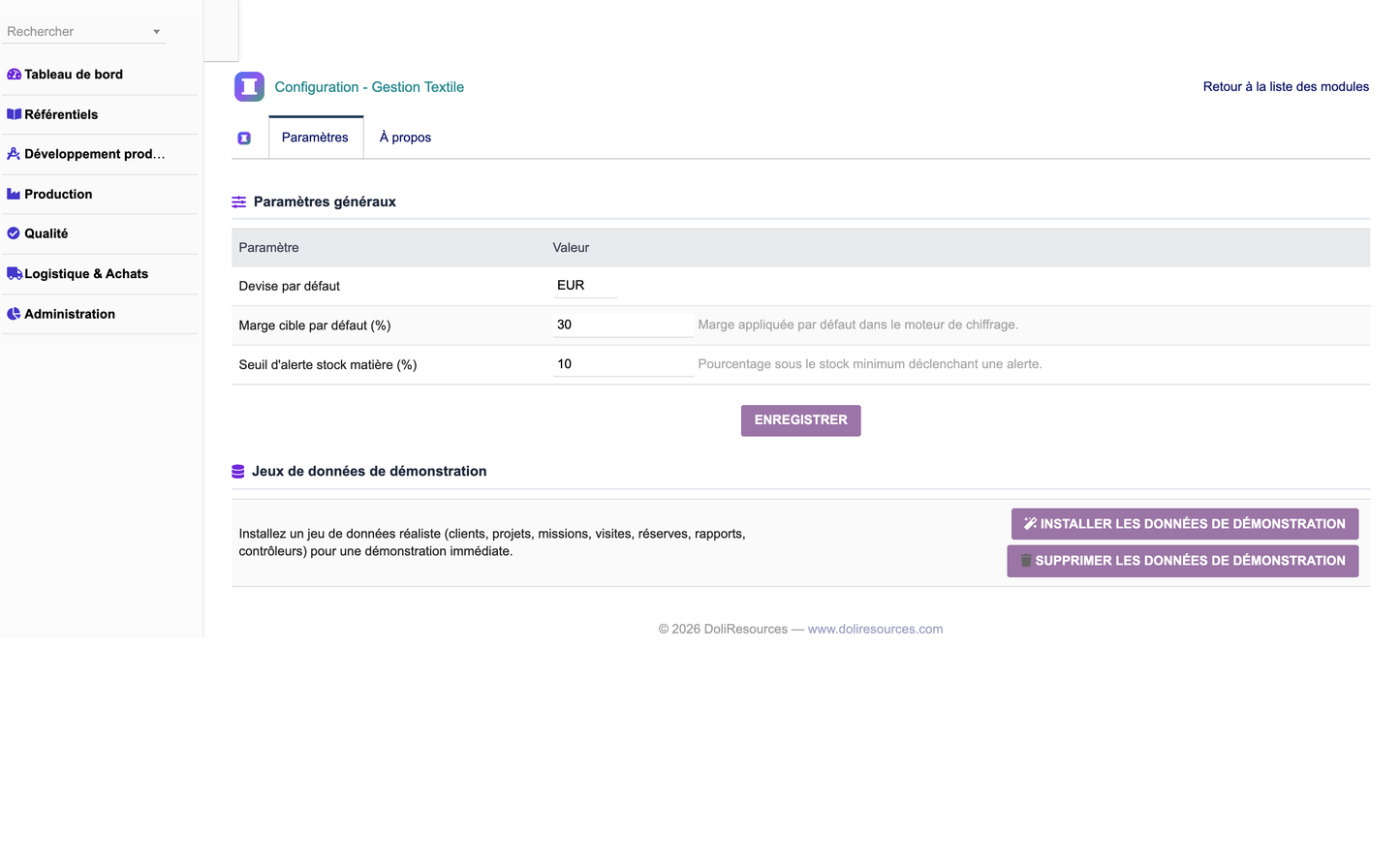
A one-click demo dataset generator (and purge) creates a realistic, FK-coherent textile dataset — collections, models, variants, materials, BOMs, routings, about 40 manufacturing orders with their cutting/sewing/dyeing/finishing/quality/defect/rework/cost/waste children, subcontracting, machines, maintenance, stock and shipments, plus native customers and suppliers. Every generated row is tagged so the purge removes only demo data, never real data; a strong confirmation guards the purge.
· Deploy the ZIP via Home, Setup, Modules, Deploy external module, or copy textilemanagement/ into htdocs/custom/.
· Activate Textile Management. Tables, menus, rights and demo data are created automatically.
· Configure via Setup, Textile Management (default margin, stock alert threshold).
· Compatible with Dolibarr 16 to 23+, PHP 8.0+, MySQL / MariaDB.
· module_textilemanagement-1.0.zip - the installable module (extracts to textilemanagement/).
· screenshots/ - 42 illustrated screens (dashboard, collections, models, materials, production, quality, reporting, configuration).
· Textile_Management_User_Training_Manual_FR.pdf - illustrated French training manual.
· Textile_Management_Complete_Features_EN.docx - this functional documentation.
· Textile_Management_Technical_Documentation_EN.md - technical documentation.
© 2026 DoliResources — www.doliresources.com


