
Discover powerful Dolibarr extensions designed to automate your business processes
1. Product Overview & Value Proposition
Wet Networks...
Couldn't load pickup availability


1. Product Overview & Value Proposition
Wet Networks Management — Advanced (Gestion Réseaux Humides Avancée) is a complete, natively integrated Dolibarr module that turns the ERP into a professional operating platform for the whole world of wet networks: drinking-water (potable) distribution, wastewater and sewerage collection, stormwater drainage, and pressurised or gravity irrigation networks. It brings the geographic knowledge of the assets, the day-to-day operation of the field, the regulatory obligations and the financial management of the activity into a single, coherent system, running entirely under custom/gestionreseauxhumides/ without altering the Dolibarr core.
Water and sanitation operators typically juggle a GIS on one side, a spreadsheet-based asset register on another, a work-order tool for the field crews, a separate hydraulic-yield calculator, a document server for reports and a disconnected accounting package. Wet Networks Management — Advanced replaces this fragmented tool-chain with one solution that already speaks the language of Dolibarr — third parties, contacts, quotes, orders, invoices, projects, stock, contracts and accounting are native — so asset data, field activity and money are never out of sync again.
The value proposition is simple: one source of truth for the network, from the buried pipe to the customer invoice.
· Replace several disconnected tools (GIS viewer, asset spreadsheets, CMMS, yield calculators, document servers) with a single Dolibarr-integrated platform.
· Give every user — from the dispatcher to the CFO — a shared, up-to-date picture of the network and its performance.
· Cut the cost of network losses by turning scattered field data into measurable water-yield and leak-response indicators.
· Shorten the time between a reported leak or incident and a closed, invoiced intervention.
· Keep the operator continuously ready for regulatory audits (water quality, network performance, asset renewal plans).
· Protect the investment: the module installs cleanly, upgrades safely and never touches the customer's real accounting data without an explicit action.
2. Target Users
The module is designed for every organisation that owns, operates, maintains or builds wet networks, whatever the contractual model (direct public management / régie, delegated public service / DSP, or private contracting).
· Water and sanitation utilities operating drinking-water, wastewater and stormwater networks at municipal, inter-municipal or regional scale.
· Local authorities and municipalities (communes, intercommunalités, syndicats des eaux) managing their networks directly.
· Publicly owned operators / régies (régie directe, régie à autonomie financière, SPL/EPIC) running water and sanitation as a public service.
· Delegated operators and concessionaires under a public-service delegation (DSP, affermage, concession) accountable to a delegating authority.
· Public-works and civil-engineering contractors (travaux publics, VRD, canalisateurs) building, extending, renewing and rehabilitating networks.
· Engineering and design firms (bureaux d'études, maîtrise d'œuvre) producing studies, diagnostics and renewal master-plans.
· Asset managers responsible for the long-term value, condition and renewal strategy of the buried heritage.
· Maintenance and specialised service companies (leak detection, CCTV inspection, jetting/curage, pumping-station servicing).
3. Business Benefits
Wet Networks Management — Advanced is built around measurable operational and financial gains for a water business.
· Fewer tools and licences: a single Dolibarr platform absorbs the asset register, the CMMS, the field app, the reporting layer and the billing link, reducing software cost and double data entry.
· Asset knowledge: a permanent, geolocated inventory of pipes, connections, structures and equipment — with material, age, condition and history — replaces tribal knowledge and lost spreadsheets.
· Faster leak response: leak declarations, localisation, prioritisation, dispatch and repair are chained in one workflow with full SLA timestamping, cutting the run-time of water loss.
· Better network yield: distributed vs billed volumes, estimated losses and leak rates are computed continuously so managers can drive network efficiency (rendement de réseau) upward.
· Regulatory compliance: water-quality conformity, network-performance indicators and asset-renewal planning are tracked and exportable for the annual report to the authority (RPQS) and audits.
· Cost control: cost per km, per connection, per leak and per intervention, plus the financial cost of water losses, make the true economics of the network visible and actionable.
· Accountability to the delegating authority: complete, dated, exportable records support DSP reporting, penalty avoidance and contract renegotiation.
4. Hydro Network Control Center — Steering Dashboard
The home of the module is the Hydro Network Control Center, an interactive steering dashboard that presents the whole network estate on a live map alongside operational, hydraulic, regulatory and financial KPIs. Global filters (period, network type, sector/zone, operator, contract, criticality) recompute every indicator, and each KPI tile links straight to its underlying list.
Interactive network map
· Layered map of all networks (drinking water, wastewater, stormwater, irrigation) with pipes, structures and equipment.
· Colour-coding by material, diameter, age, condition, criticality or open-incident status.
· Click-through from any map object to its full record; draw-a-zone filtering of KPIs.
· Overlay of open leaks, active incidents, ongoing work orders and worksites in progress.
Asset & inventory KPIs
· Total network length and length split by type — drinking water (AEP), wastewater, stormwater, irrigation.
· Counts of pipes/sections, service connections, pumping stations, reservoirs and water towers, valves, meters and manholes/chambers.
Operational KPIs
· Open leaks, active incidents, ongoing work orders, urgent/priority work orders and pending customer complaints.
· Cleaning/jetting and preventive-maintenance completion rates; worksite progress.
Hydraulic & performance KPIs
· Network availability and network yield / efficiency (rendement).
· Distributed volume vs billed volume, and the resulting estimated water loss.
· Leak rate (e.g. leaks per km per year), average pressure and average flow.
· Water-quality conformity rate against sampled parameters.
Regulatory & financial KPIs
· Water-quality conformity and outstanding corrective actions.
· Budget consumption vs plan and worksite financial progress.
5. Asset Management & GIS Mapping
The module maintains a structured, geolocated asset repository organised as Network -> Sector/Zone -> Pipe/Section -> Service connection and structures, each object carrying its geometry, attributes, condition and complete history. A built-in GIS layer displays and edits the network on an interactive map with configurable thematic layers.
· Hierarchical asset model: networks, sectors/DMAs, pipes and sections, service connections, structures and equipment.
· Geometry for every object (points, lines, polygons) with coordinates, length, depth and linked attributes.
· Configurable thematic layers (by network type, material, diameter, age, condition, criticality, sector).
· Import and export of geographic data in GeoJSON and KML, plus CSV attribute import/export, for round-trips with external GIS (QGIS, ArcGIS) and the delegating authority.
· Full change history and soft-delete so the asset record is auditable over the decades of a network's life.
6. Drinking-Water Network Management (AEP)
Dedicated management of the potable-water distribution network — from production/storage to the customer connection — with the objects and indicators specific to drinking water.
· Distribution and transmission (feeder) mains, distribution sectors and district metered areas (DMA).
· Storage and boosting assets (reservoirs, water towers, boosting/pumping stations) linked to the served sector.
· Pressure and flow monitoring points, chlorination/treatment points and sampling points.
· Service connections, meters and hydrants attached to the network for a complete drinking-water picture.
· Yield, loss and quality indicators computed at network and sector level.
7. Wastewater / Sewerage Network Management
Management of foul and combined sewerage — the collection network that carries wastewater to treatment — with its gravity and pressurised specifics.
· Gravity collectors, pressurised/force mains and vacuum sewers, with slope, invert level and flow direction.
· Manholes, inspection chambers, lift/pumping stations and overflow/relief structures.
· Service connections (branchements) from properties to the collector, with commissioning and conformity status.
· Structural and functional condition tracking (infiltration, blockage, collapse risk) feeding renewal priorities.
· Jetting/curage campaigns and CCTV inspection programmes attached to the sewerage assets.
8. Stormwater Network Management
Management of the rainwater drainage network, whether separate or combined, including the structures that store, convey and discharge runoff.
· Storm drains, ditches, culverts and outfalls, with catchment and discharge-point references.
· Gullies, grids, retention/detention basins and infiltration structures.
· Regulation and flow-control devices, screens and separators.
· Cleaning and de-silting campaigns, and flood-risk-oriented inspection rounds.
· Combined-network handling where stormwater and wastewater share collectors.
9. Irrigation & Other Wet Networks
Beyond the three public networks, the module manages pressurised and gravity irrigation networks and other fluid networks operated by the same organisations.
· Primary, secondary and tertiary irrigation mains, hydrants/bornes, and distribution sectors.
· Pumping, filtration and regulation stations serving agricultural or green-space irrigation.
· Volumetric allocation and metering per off-take, with seasonal operation calendars.
· Raw-water, reuse (REUT) and industrial-water networks handled with the same asset and workflow model.
10. Pipes & Sections
The pipe/section is the backbone object of the network. Each section carries a complete technical and condition record and can be transformed as the network evolves.
Technical characteristics
· Material: ductile iron (fonte ductile), PEHD/HDPE, PVC, steel, reinforced concrete, and legacy asbestos-cement, cast iron and PVC-bonded.
· Nominal diameter (DN), pressure class (PN/PFA), wall/series, and lining/coating.
· Depth of cover, invert and ground levels, length and geometry.
· Hydraulic data: nominal/observed flow, velocity, roughness, and for gravity sewers the slope.
· Age (laying year), expected service life, remaining life and structural/functional condition grade.
Lifecycle operations
· Split a section, merge adjacent sections, and replace/renew a section while preserving the historical trace.
· Re-attach connections, valves and fittings automatically when a section is transformed.
· Condition scoring and renewal-priority ranking based on age, material, break history and criticality.
11. Service Connections (Branchements)
Every property connection to a network is managed as a first-class object with its own end-to-end commercial and technical workflow, so no request is lost between the front desk and the field.
Standard workflow: request -> feasibility study -> site visit -> quotation -> order -> works -> commissioning -> invoicing.
· Connection request captured from the counter, portal, e-mail or API, linked to the applicant (native third party).
· Feasibility study and technical site visit with survey, photos and constraints.
· Quotation and customer order generated as native Dolibarr proposal and order documents.
· Works execution linked to a worksite/work order, with materials, labour and route.
· Commissioning: meter fitting, pressure/leak test, conformity check and activation.
· Automatic invoicing and hand-over of the as-built connection record into the asset repository.
· Full status tracking, SLA timers and per-connection cost and history.
12. Pumping Stations & Pumps
Pumping and lift stations (drinking-water boosting, wastewater lifting, stormwater and irrigation pumping) are managed as structured facilities with their embedded equipment.
· Station record: type, served sector, capacity, wet-well/tank, power supply and telemetry link.
· Pump inventory: pump sets, motors, variable-speed drives, valves, non-return and control gear, with rated flow and head.
· Running-hours, start counts and energy consumption tracking for preventive planning.
· Alarms (high level, dry-run, power loss, overflow) feeding incidents and on-call response.
· Preventive plans, spare parts and intervention history per station and per pump.
13. Reservoirs & Water Towers
Storage structures are managed with their capacity, hydraulic role and inspection obligations.
· Reservoirs, water towers (châteaux d'eau), tanks and basins with capacity, levels and served sector.
· Level, overflow and turnover monitoring; chlorination/treatment points where applicable.
· Structural inspection, cleaning/disinfection campaigns and watertightness checks.
· Maintenance plans, valves and equipment attached to each storage structure.
14. Manholes / Chambers & Annex Structures
The many buried structures that give access to and control the network are inventoried and inspected individually.
· Manholes, inspection and junction chambers, valve chambers, meter pits and sampling chambers.
· Annex structures: overflows, siphons, drop shafts, screens, separators and regulation works.
· Cover type, depth, condition, access and safety (confined-space) attributes.
· Inspection rounds, cleaning and rehabilitation actions linked to each structure.
15. Valves & Regulation
Network appurtenances that isolate, control and protect the network are tracked for both operation and emergency response.
· Isolation valves (gate/butterfly), air valves, pressure-reducing and sustaining valves, check valves and regulators.
· Position (open/closed), operability, torque/turns and last-manoeuvre record.
· Sectorisation support: which valves isolate which sector for shutdowns and repairs.
· Manoeuvre campaigns and preventive exercising to keep critical valves operable.
16. Meters & Measurement Devices
Metering assets — from the customer meter to the sector flow-meter — are managed for inventory, reading and yield calculation.
· Customer/connection meters, sector and DMA flow-meters, bulk/import-export meters and pressure loggers.
· Meter attributes: calibre, type, index, installation date, replacement due date and warranty.
· Reading capture (manual, portal, import or API/telemetry) feeding billed and distributed volumes.
· Meter fleet renewal planning and metrological follow-up.
17. Fire Hydrants
Fire-protection appurtenances are inventoried and periodically checked, both as network assets and as a regulated public-safety obligation.
· Pillar hydrants (poteaux) and underground hydrants (bouches) with location, flow and pressure rating.
· Periodic flow/pressure testing (contrôle débit-pression) with results and conformity status.
· Availability status and defect tracking, with reporting to the fire service (SDIS/DECI).
· Maintenance, replacement and painting/marking campaigns.
18. Inspections & Diagnostics
A dedicated inspection module plans, records and exploits every kind of network diagnostic, structural or functional.
· CCTV / ITV pipe inspection (inspection télévisée) with coding of observations, severity grading and video/photo attachments.
· Acoustic leak surveys and pre-localisation campaigns on drinking-water mains.
· Structural diagnostics (condition grading, corrosion, deformation, joint and collapse assessment).
· Smoke and dye testing for wrong-connection detection on sewerage/stormwater.
· Diagnostic results feed condition scores, renewal priorities and non-conformity workflows.
19. Leak Management
Leak handling is a core workflow, from detection to a quantified saved-volume outcome, so water-loss reduction becomes a managed process rather than a firefight.
· Detection sources recorded: customer report, night-flow analysis, acoustic survey, correlator, satellite/DMA analysis, field observation.
· Localisation, prioritisation and dispatch, with severity, safety flag and affected sector.
· Estimated lost volume before repair, based on flow, pressure and running time.
· Repair intervention linked to a work order, with materials, section repaired and root cause.
· Saved volume after repair and contribution to network yield, plus the financial cost of the loss avoided.
· Leak-rate and run-time KPIs per sector to target detection effort where it pays.
20. Incidents & Emergencies
Major events — main bursts, pollution, pumping-station failure, flooding, supply interruption — are handled through an incident workflow with a crisis-cell capability.
· Incident declaration with type, severity, impacted sector, affected population and safety classification.
· Crisis-cell management: stakeholders, action log, decisions, timeline and communication.
· Linked shutdowns, valve manoeuvres, tankering, work orders and customer notifications.
· Full SLA timestamping (detection, acknowledgement, mobilisation, resolution, closure) and post-incident report.
21. Complaints & Requests (Usagers)
Customer/user contacts are captured through multiple channels and driven to resolution under service-level commitments.
· Multi-channel intake: counter, phone, e-mail, web portal, API — linked to the user (native third party/contact).
· Typology: water quality (taste, colour, odour), pressure, no supply, leak on the public network, billing, connection request, sewer smell/blockage.
· SLA timers, acknowledgement, assignment, response and closure with satisfaction feedback.
· Automatic linkage to leaks, incidents, work orders and interventions when a complaint triggers field action.
22. Work Orders / Interventions
The work order is the operational heart of the field. Every action — planned or urgent — runs through a complete lifecycle and is usable on a mobile-friendly field interface.
· Creation from a leak, incident, complaint, preventive plan, connection request or worksite.
· Lifecycle: draft -> scheduled -> assigned -> dispatched -> on site -> in progress -> completed -> validated -> invoiced/closed.
· Assignment to a team/agent with required skills, route, materials and equipment.
· Full SLA timestamping and geolocation; make-safe, lockout and permit handling where required.
· Field app usage: read the task, capture photos, consumed materials, measurements and signatures, close the order on site.
· Automatic KPIs (MTTR, first-visit-fix, SLA compliance) and cost roll-up per work order.
23. Preventive Maintenance
A planning engine generates recurring preventive work from asset type, criticality, regulation and manufacturer recommendations, so obligations are never missed.
· Maintenance plans per asset family (pumping stations, reservoirs, valves, hydrants, meters, structures).
· Job plans defining operations, control points, required skills, PPE, tools and recommended parts.
· Checklists executed and stored per round, with pass/fail and observations.
· Rounds and route optimisation grouping assets geographically; holidays and absences respected.
· Frequency by calendar, running-hours, counter or condition; automatic work-order generation and completion tracking.
24. Cleaning / Jetting Campaigns (Curage)
Preventive and curative cleaning of sewerage and stormwater assets is managed as planned campaigns with measurable completion.
· Jetting/hydro-cleaning (curage) and de-silting campaigns scoped by sector, collector or structure.
· Scheduling of hydrocleaner vehicles, crews and disposal of extracted material.
· Before/after condition and CCTV linkage to justify and target cleaning effort.
· Completion-rate KPI feeding the dashboard and the annual performance report.
25. Construction Sites & Works (Chantiers)
Network construction, extension, renewal and rehabilitation are tracked as worksites (chantiers) linked to native Dolibarr projects, with a full site log and financial follow-up.
· Worksite types: extension, renewal/replacement, rehabilitation (trenchless/relining), reinforcement, connection works.
· Phase breakdown: studies, permits/DICT, procurement, earthworks, laying, connections, testing, backfill, reinstatement, acceptance.
· Site log (journal de chantier), attendance, weather, incidents and photos.
· Progress statements (situations de travaux) and attachments (attachements), initial and revised budgets, real cost and margin.
· Provisional and definitive acceptance, reserve lifting, warranty start and as-built hand-over into the asset repository.
26. Planning
A unified planning layer schedules every kind of activity across calendar, Gantt, Kanban and map views.
· Views: day/week/month calendar, Gantt for worksites and campaigns, Kanban for work-order flow, and map-based dispatch.
· Drag-and-drop assignment with conflict detection, availability, skills and travel time.
· On-call and shift planning integrated with emergency response.
· SLA-aware scheduling that surfaces at-risk interventions before they breach.
27. Teams & Agents
Field and office human resources are managed with the competencies and availability that dispatching needs.
· Teams and individual agents with roles, skills, certifications and authorisations (e.g. confined-space, network operation).
· Skill-based assignment: the right qualification for the right task, with unqualified assignments flagged.
· On-call rotas, availability, absences and workload balancing.
· Per-agent and per-team productivity and intervention history.
28. Vehicles & Equipment
The operational fleet and specialised equipment are inventoried, assigned and maintained.
· Vehicles and specialised units: hydrocleaner/jetting trucks, CCTV inspection vans, leak-detection kits (correlators, loggers), gensets, pumps.
· Assignment to work orders and campaigns, availability and location.
· Calibration and maintenance follow-up for measuring instruments and safety equipment.
· Usage, running-hours and cost tracking per vehicle/equipment.
29. Materials & Inventory
Network materials and consumables are managed through the native Dolibarr stock, with wet-network specifics.
· Catalogue of pipes, fittings, couplings, valves, meters, repair collars, hydrants, manhole components and consumables.
· Warehouses, lots and multi-store stock, with automatic movements on reservation, consumption, return and receipt.
· Minimum-stock alerts, purchase requests and supplier orders for replenishment.
· Material consumption rolled up to work orders, worksites and cost analysis.
30. Suppliers & Subcontractors
The external supply chain is managed with performance scoring to support sourcing decisions.
· Supplier and subcontractor records linked to native Dolibarr suppliers, with specialities (leak detection, CCTV, jetting, civil works).
· Framework and job orders, subcontracted work orders and worksites.
· Performance scoring on responsiveness, quality, deadline and cost.
· Insurance, qualification and certificate expiry tracking with alerts.
31. Contracts & Tenders
Commercial and public-service contracts are managed across their full lifecycle, including the delegated-management specifics.
· Contract and public-service-delegation (DSP, affermage, concession) management with scope, term and obligations.
· Public tenders / marchés, framework agreements and their lots.
· Amendments (avenants), renewals, indexation and invoice schedules (échéanciers de facturation).
· Warranties (perfect-completion, sound-operation, decennial where applicable) and their expiry alerts.
· Per-contract profitability (revenue, cost, margin) and obligation/penalty tracking toward the delegating authority.
32. Budgets & Costs
The module turns operational data into the true economics of the network, so decisions can be justified financially.
· Unit costs: cost per km of network, per service connection, per leak, and per intervention.
· Water-loss cost: the financial value of unbilled/lost water, per sector and network-wide.
· Lifecycle cost of assets (acquisition, operation, maintenance, renewal) to support renewal arbitrage.
· Budget consumption vs plan for maintenance, campaigns and worksites, feeding the dashboard.
· Margin and profitability by activity, contract and worksite.
33. Water Quality Control
Drinking-water and discharge quality are managed from sampling point to corrective action, ready for the health authority.
· Sampling points and campaigns across the network, reservoirs and treatment points.
· Parameters: pH, turbidity, residual chlorine, nitrates, coliforms/E. coli, and further physico-chemical and bacteriological measures.
· Conformity assessment against thresholds, with non-conformity detection and gravity.
· Corrective actions (flushing, re-chlorination, boil-water notice, investigation) tracked to closure.
· Conformity-rate KPI and exportable records for the annual water-quality report.
34. QHSE — Quality, Health, Safety & Environment
Field risk and environmental obligations are managed alongside the work, not as an afterthought.
· Risk analysis per activity and worksite, with prevention plans and method statements.
· Permits to work and confined-space entry authorisations for manholes, chambers and wet wells.
· HSE incident and near-miss reporting with corrective and preventive actions.
· Waste and by-product management (excavated spoil, jetting sludge, sediment) with disposal traceability.
35. Reporting & Business Intelligence
A full reporting and BI layer turns the operational base into filterable, exportable, decision-grade information.
· Report families: asset/inventory, hydraulic performance and yield, leaks and incidents, maintenance and campaigns, water quality, contracts and DSP, finance and costs, workforce and fleet.
· A custom report generator: choose objects, columns, filters, grouping and output, then save and schedule the report.
· Predictive risk scoring for renewal prioritisation, ranking pipes by break/failure risk to target renewal budget. This scoring is rules-based (age, material, break history, criticality, condition) and transparent — it is not AI/machine-learning and can be inspected and tuned.
· Export to PDF, Excel and CSV, with saved filters, templates and scheduled e-mail delivery.
36. Alerts & Notifications
The module watches thresholds and deadlines and pushes the right signal to the right user.
· Alerts on open leaks, SLA breaches, quality non-conformity, station alarms, stock minimums and contract/warranty/certificate expiries.
· In-app, e-mail and API/webhook notification channels.
· Per-user, per-role and per-object subscription so notifications stay relevant.
37. Workflows & Validations
Configurable status workflows and validation steps keep processes consistent and auditable.
· Status models for connections, work orders, worksites, complaints, incidents and non-conformities.
· Validation and approval steps (quote, order, worksite acceptance, non-conformity closure) with permissions.
· Automatic actions on status change (create invoice, update asset, notify user).
38. Document Management & PDF Templates
All documents are stored, linked and generated natively.
· Attachment of plans, reports, CCTV videos, photos and certificates to any object via the Dolibarr ECM/GED.
· Configurable PDF templates for quotes, orders, work orders, inspection and quality reports, and intervention sheets.
· Versioning, soft-delete and full-text search of the linked document base.
39. QR Codes
Every field asset can carry a unique QR code that opens its record instantly.
· Unique QR code per pipe, structure, station, valve, meter and hydrant.
· On-site scan opens the asset record and lets the agent declare a leak, log an inspection or start a work order.
· Printable QR labels for physical asset marking.
40. Imports & Exports
Data moves in and out of the module in the formats a water operator actually uses.
· Attribute import/export in CSV, XLSX and JSON for assets, connections, meters and readings.
· Geographic import/export in GeoJSON and KML for round-trips with GIS and the delegating authority.
· Mapping, validation and error reporting on import; template files provided.
41. REST API & Webhooks
A secure REST API and outbound webhooks open the module to mobile apps, SCADA/telemetry gateways and third-party systems.
· REST endpoints for assets, connections, leaks, incidents, work orders, planning, meters/readings and dashboard data.
· Inbound telemetry (flow, pressure, level, station alarms) from SCADA/IoT gateways.
· Dolibarr authentication and permissions, per-route access control and request logging.
· Configurable outbound webhooks on business events (new leak, SLA breach, work-order closure).
42. Security
The module follows Dolibarr security practice and adds an operational audit trail.
· CSRF tokens enforced on all state-changing actions.
· Fine-grained, role-based permissions per object and per sensitive capability (costs, API, administration).
· SQL safety: parameterised queries and escaped output throughout.
· Multi-entity (MultiCompany) separation so operators/authorities never see each other's data.
· Audit log of key actions and soft-delete so nothing is silently or irreversibly lost.
43. Multilingual Support
The interface and documents are fully localised for cross-border and multi-team deployment.
· Five languages delivered: French, English, Italian, German and Spanish.
· All labels, menus, statuses and PDF templates translatable, with per-user language selection.
44. Dolibarr Native Integrations
The module is not a silo bolted onto Dolibarr — it drives and is driven by the native modules, so business, stock and money stay in one system.
· Third parties & Contacts: users, applicants, subcontractors and authorities.
· Proposals/Quotes, Sales orders and Purchase/Supplier orders for connections, works and procurement.
· Customer & Supplier invoices, including recurring billing for contracts and DSP.
· Projects & Tasks for worksites and campaigns; Agenda for planning and events.
· Products, Stock & Warehouses for materials and meter fleets.
· Contracts for maintenance and delegation agreements.
· ECM/GED for documents; Bank & Accounting for financial posting.
· Timesheets and Expense reports for field labour and costs.
45. Demo Data
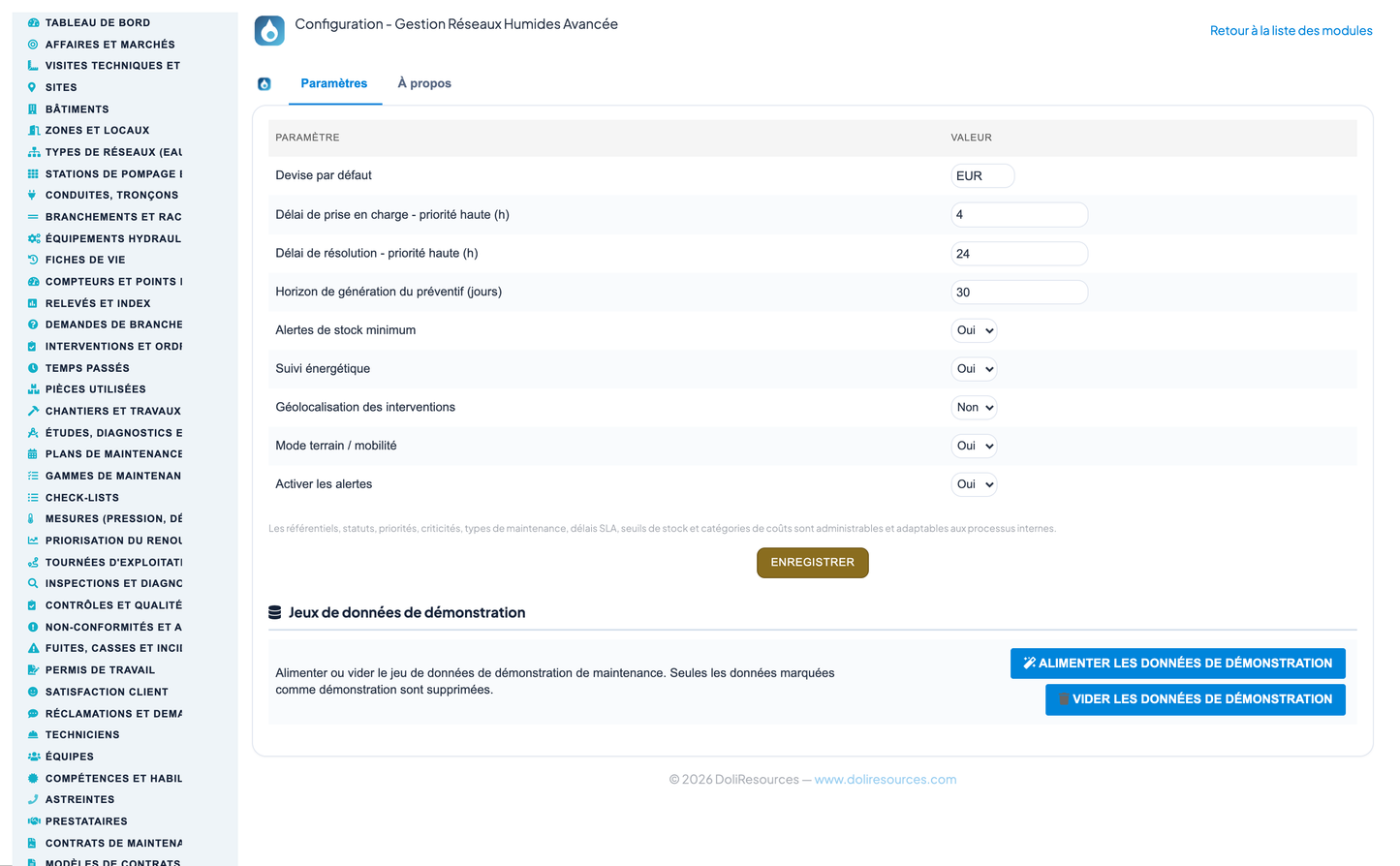
The module ships with a one-click demo generator so every feature can be evaluated immediately, and a safe purge that never touches production data.
· One click populates a realistic dataset: networks, sectors, pipes and connections, stations, reservoirs, valves, meters, hydrants, structures, leaks, incidents, complaints, work orders, worksites, contracts, agents and readings.
· All demo records are marker-based (tagged) so they are unambiguously identifiable.
· A one-click purge removes only the marked demo data, with confirmation, permission check and a deletion report — real customer data is never affected.
46. Installation & Requirements
· Dolibarr 17.0 or higher.
· PHP 8.1 or higher.
· MariaDB or MySQL database.
· Native modules Third parties (Societe) and Products enabled.
· Install by unzipping the module into htdocs/custom/ (or via Home -> Setup -> Modules -> Deploy/install external module) and enabling 'Wet Networks Management — Advanced' in the module list.
· Dedicated tables with keys, indexes, entity fields and extrafields support; clean install/uninstall and safe version migration.
· Configure currency, numbering, SLA, billing, alerts and API from the module Setup page, then grant permissions to users.
47. Licensing & Copyright
Wet Networks Management — Advanced (Gestion Réseaux Humides Avancée) is edited and published by DoliResources. Copyright © 2026 DoliResources — www.doliresources.com. All rights reserved. Version 1.0. For Dolibarr 17+ / PHP 8.1+.
Copyright © 2026 DoliResources — www.doliresources.com — All rights reserved.


