
Discover powerful Dolibarr extensions designed to automate your business processes
GPEC & Talent Management turns Dolibarr into an integrated Human Capital Management (HCM) platform. It covers the full HR lifecycle - from the job...
Couldn't load pickup availability


GPEC & Talent Management turns Dolibarr into an integrated Human Capital Management (HCM) platform. It covers the full HR lifecycle - from the job and competency referentials to talent reviews, succession planning and strategic HR reporting - without requiring any external HR software.
The module is designed to be comparable to SAP SuccessFactors, Workday HCM, Oracle Talent Management, Cornerstone OnDemand, Talentsoft, Lucca, Cegid Talent, UKG Pro and PeopleSoft HCM, while remaining fully native to Dolibarr: same permissions model, same multi-entity isolation, same look and feel.
· Workforce planning (GPEC): job families, job referential, position descriptions, competency referential, competency mapping and gap analysis.
· Employee management: employee records, professional background, skills held, certifications, evaluations.
· Evaluation: annual interviews, professional interviews and 360 degree feedback, driven by an HR workflow.
· Talent management: talent pool, Nine Box grid, high potential detection, succession planning for critical positions.
· Career management: individual career plans and internal mobility with a matching score.
· Training: needs, annual plans, sessions, before/after competency levels and training ROI.
· HR AI assistant: competency analysis, recommendations, attrition and recruitment prediction, talent detection.
· Steering: HR KPI, HR workflows and strategic reporting exportable to PDF, Excel, Word and CSV.
|
Item |
Value |
|
Business objects |
21 |
|
Permissions |
23, in 8 groups |
|
Menu entries |
27 plus the top menu |
|
Languages |
French, English, Spanish, Italian, German |
|
Module number |
517900 |
|
Dolibarr version |
16.0 and above |
|
PHP version |
7.1 and above (PHP 8 compatible) |
|
Licence |
GPL v3 or later |
The module follows the standard Dolibarr external-module layout and is organised around six functional engines sharing one object registry.
|
Engine |
Responsibility |
Main objects |
|
Talent Core |
Employees, talents, professional background |
gpecemployee, gpecdepartment, gpeccareerhistory, gpectalent |
|
Competency Management |
Referentials, levels, assessment, job/skill matching |
gpecskill, gpecemployeeskill, gpecjobskill, gpecjob, gpecjobfamily, gpecposition |
|
Career Management |
Careers, mobility, development plans |
gpeccareerplan, gpecmobility, gpecsuccession |
|
Learning Integration |
Training needs, plans, sessions, ROI |
gpectrainingneed, gpectrainingplan, gpectrainingsession |
|
Analytics |
HR KPI, analysis, forecasting, reporting |
gpeckpi, reporting.php |
|
AI Talent |
Predictive analysis, recommendations, talent detection |
ai.php |
|
Path |
Content |
|
core/modules/modGpecTalentManager.class.php |
Module descriptor: number, rights, menus, activation |
|
class/*.class.php |
21 CommonObject business classes + the demo data generator |
|
sql/llx_gpec_*.sql |
Table definitions and indexes |
|
lib/gpectalentmanager.lib.php |
Shared helpers, vocabularies, schema self-healing |
|
lib/gpectalentmanager_objects.php |
Object registry (fields, pictos, relations) |
|
lib/gpectalentmanager_menu.php |
Menu activation, in-page tab bar, label enforcement |
|
objectlist.inc.php / objectcard.inc.php |
Generic list and card engines driven by the registry |
|
dashboard.php, matrix.php, ninebox.php, ai.php, reporting.php |
Bespoke pages |
|
admin/setup.php, admin/about.php |
Configuration and about pages |
|
langs/<lang>/gpectalentmanager.lang |
Translations (5 languages) |
|
css/, js/, img/ |
Stylesheet, scripts and pictograms |
Every table follows the Dolibarr conventions: an auto-increment rowid, an entity column for multi-entity isolation, a status column, creation/modification audit columns (date_creation, tms, fk_user_creat, fk_user_modif) and an import_key used to tag and purge demonstration data.
|
Table |
Purpose |
|
llx_gpec_department |
Departments and services, headcount and target headcount |
|
llx_gpec_job_family |
Job families / professional sectors |
|
llx_gpec_job |
Job referential: missions, activities, responsibilities, scarcity |
|
llx_gpec_position |
Position descriptions attached to a job and a department |
|
llx_gpec_employee |
Employee records, scores and attrition risk |
|
llx_gpec_skill |
Competency referential and mastery-level descriptions |
|
llx_gpec_employee_skill |
The competency matrix cell: current level, target level, gap |
|
llx_gpec_job_skill |
Competencies required by a job and their expected level |
|
llx_gpec_career_history |
Professional background events |
|
llx_gpec_evaluation |
Interviews and evaluations with their workflow state |
|
llx_gpec_evaluation_item |
Evaluation lines (objectives, skills, behaviour) |
|
llx_gpec_feedback |
360 degree feedback responses |
|
llx_gpec_talent |
Talent pool, Nine Box cell, readiness, retention risk |
|
llx_gpec_career_plan |
Individual career plans |
|
llx_gpec_mobility |
Internal mobility requests and matching score |
|
llx_gpec_succession |
Succession plans for critical positions |
|
llx_gpec_training_need |
Training needs derived from evaluations and career plans |
|
llx_gpec_training_plan |
Annual training plans and budget |
|
llx_gpec_training_session |
Training sessions, level before/after, ROI |
|
llx_gpec_workflow |
HR process definitions |
|
llx_gpec_kpi |
HR indicators with target, actual, variance and trend |
· Users: employees can be linked to a Dolibarr user; evaluators and managers are Dolibarr users.
· Third parties and contacts: available for external trainers and training organisations.
· Projects and tasks: development actions and training projects can be tracked with the native project module.
· Agenda: interview and review dates are dated objects that can be surfaced in the agenda.
· Business Intelligence: HR KPI are stored in a dedicated table, ready to be consumed by a BI module.
· The module declares its own CSS and JS, its own box widget, and self-heals its schema on upgrade (ALTER TABLE ADD COLUMN for any column added to the SQL definition).
The competency engine is the backbone of the module: it defines what the organisation needs, measures what it holds, and exposes the gap.
· Five families: technical, behavioural, digital, language and management skills.
· Each competency describes its beginner, intermediate and expert levels and its assessment criteria.
· Competencies are flagged as critical and/or strategic, and carry a market scarcity indicator.
· The number of holders and the average level are maintained from the assessed data.
|
Level |
Meaning |
|
0 |
Not held |
|
1 |
Notions |
|
2 |
Beginner |
|
3 |
Intermediate |
|
4 |
Advanced |
|
5 |
Expert |
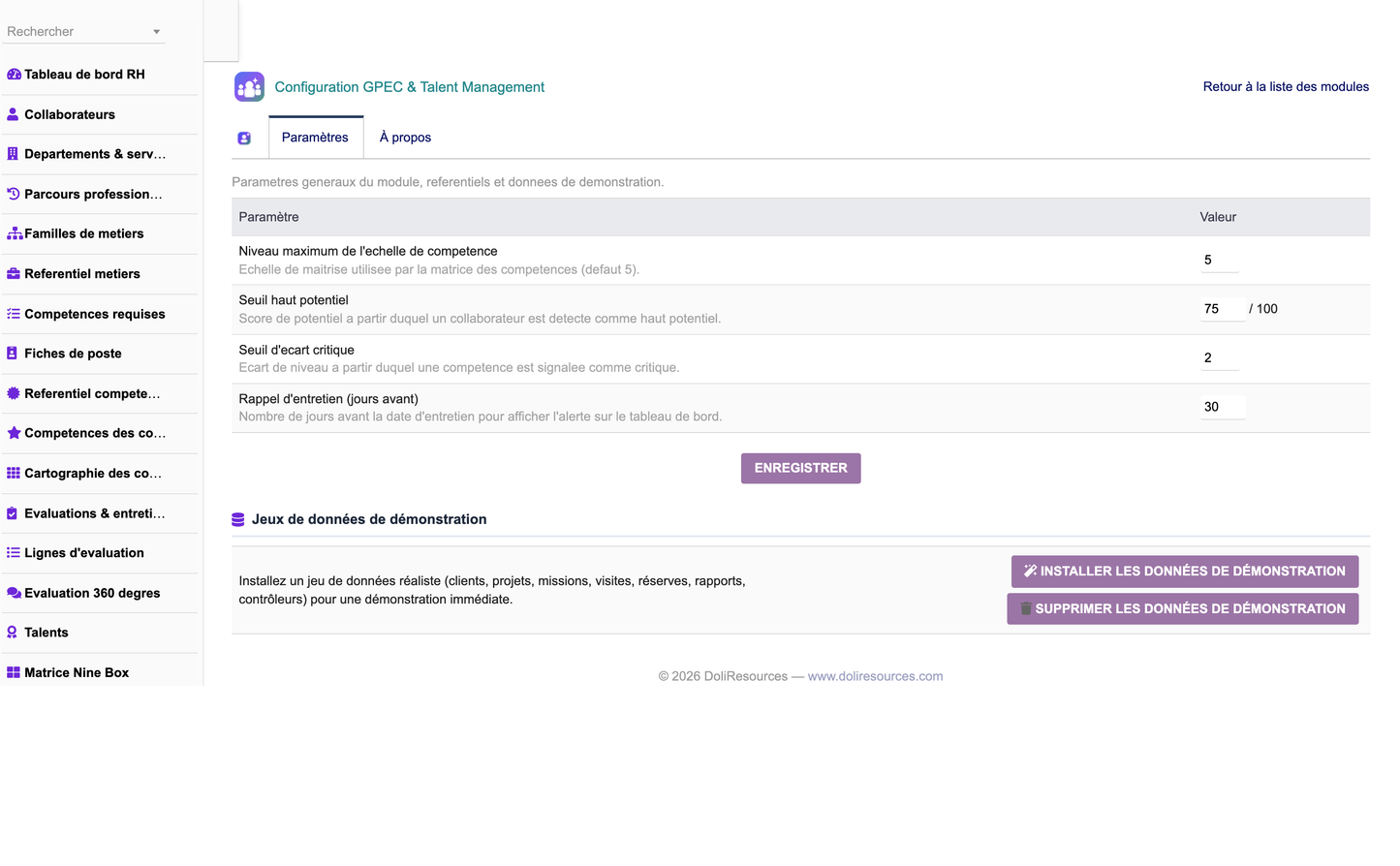
The scale maximum is configurable from the module setup page.
· The map crosses employees and competencies into a colour-coded heatmap.
· Each cell shows the current level, coloured by the mastery scale; a red outline and a marker signal a gap against the target level; a tick marks a certified competency.
· A per-employee total gap column and a level legend complete the grid.
· Columns are ordered by actual coverage so the matrix shows the competencies that matter, not an alphabetical sample.
· Filters restrict the analysis to one department or one competency family.
· Two analysis tables rank the widest gaps per competency and per department.
· Five categories: identified talent, high potential, expert, leader and successor.
· Each talent record carries performance and potential levels, the Nine Box cell, readiness, retention risk, key strengths, development areas and a target role.
The Nine Box grid positions every active employee on two axes: performance (X) and potential (Y). Bands are derived live from the scores, so the grid stays correct even if a talent record's stored cell is stale.
|
Performance / Potential |
Low |
Medium |
High |
|
High |
Enigma |
Growth employee |
Future leader |
|
Medium |
Dilemma |
Core employee |
High performer |
|
Low |
Under performer |
Effective employee |
Trusted professional |
Scores below 50 are Low, below 75 Medium, and 75 or above High.
· Critical positions are flagged on the position record and feed the succession plans.
· Each plan links a critical position, its incumbent and ranked successors.
· Readiness (ready, short term, medium term) and readiness in months quantify the bench strength.
· The incumbent's departure risk and a risk score prioritise the reviews; gaps to close and a development plan make the succession actionable.
· An individual career plan links the current position to a target position over a horizon in months.
· It lists the competencies to develop and the training needed, and tracks a progress percentage.
· Mobility requests can be functional, geographic, a promotion or transversal.
· Each request records the origin and destination position and department, who initiated it, a matching score and the HR decision.
Every career event (hiring, promotion, mobility, mission) is historised with its period, duration, position, department and salary evolution, building the employee's professional path.
The HR AI assistant scores the module's own data with deterministic, explainable heuristics. It runs offline, costs nothing per execution and always justifies each suggestion - which matters for HR decisions that must be defensible.
· Strengths: the best-mastered competencies with real coverage (at least two holders).
· Weaknesses: the competencies with the lowest average mastery.
· Critical gaps: competencies whose aggregated gap exceeds the configurable threshold, weighted by their critical and strategic flags.
· Recommended training: employee x competency pairs ranked by gap, weighted by the criticality of the competency (score = gap x 18 + 25 if critical, capped at 100).
· Suggested mobility: high performers whose profile fits a wider role (matching score = 0.6 x performance + 0.4 x potential).
The attrition model combines three explainable drivers:
|
Driver |
Contribution |
Rationale |
|
Engagement deficit |
(70 - engagement) x 0.9 |
Low engagement is the dominant leaving signal |
|
Seniority plateau |
+12 if seniority >= 6 years |
A long plateau without evolution raises the risk |
|
Top performer |
+10 if performance >= 75 |
High performers are actively approached |
· The resulting 0-100 risk score is reported with the drivers that produced it, so HR can act on the cause.
· Recruitment need lists the departments below their target headcount, ranked by the gap.
· Future skill shortage combines the demand gap with the scarcity of holders on strategic or rare competencies.
Employees whose potential exceeds the configurable high-potential threshold are surfaced with their computed Nine Box cell, an AI score (0.6 x potential + 0.4 x performance) and a rationale stating whether they are already tracked in the talent pool.
|
Report |
Content |
|
Employees |
Headcount, average performance, potential and seniority per department |
|
Competencies |
Holders, average level, target level and gap per competency |
|
Talents |
Talent pool with category, scores, readiness and retention risk |
|
Succession |
Critical positions, incumbents, successors, readiness and risk |
|
Careers |
Internal mobility with matching score and status |
|
Training |
Sessions, participants, cost, level before/after and ROI |
|
Management |
One-page strategic summary of the human capital |
Every report exports to PDF, Excel, Word and CSV from the export bar.
The module's objects extend CommonObject and are exposed through Dolibarr's native REST API layer once the API module is enabled. Authentication, throttling and API-key management are handled by Dolibarr itself.
|
Operation |
Method |
Example endpoint |
|
List employees |
GET |
/api/index.php/gpectalentmanager/employees |
|
Read one employee |
GET |
/api/index.php/gpectalentmanager/employees/{id} |
|
Create an employee |
POST |
/api/index.php/gpectalentmanager/employees |
|
Add a competency to an employee |
POST |
/api/index.php/gpectalentmanager/employeeskills |
|
Update an evaluation |
PUT |
/api/index.php/gpectalentmanager/evaluations/{id} |
|
Export data |
GET |
reporting.php?report=<code>&export=csv|excel|word|pdf |
Endpoints are subject to the same permission checks as the user interface: a caller without the matching read permission receives an access-denied response.
The module declares 23 permissions in 8 groups. Read and write are granted by default so the module is usable immediately after activation; delete and administration are not.
|
Group |
Covers |
Read |
Write |
Delete |
|
employee |
Employees, departments, career history |
yes |
yes |
no |
|
referential |
Job families, jobs, job skills, positions |
yes |
yes |
no |
|
skill |
Competency referential and matrix |
yes |
yes |
no |
|
evaluation |
Evaluations, items, 360 feedback |
yes |
yes |
no |
|
talent |
Talents and succession planning |
yes |
yes |
no |
|
career |
Career plans and internal mobility |
yes |
yes |
no |
|
training |
Needs, plans and sessions |
yes |
yes |
no |
|
reporting |
HR reporting, KPI and workflows |
yes |
- |
- |
A ninth 'admin' permission gates the module administration.
· Every page checks the permission of its object group before rendering; the API enforces the same checks.
· Multi-entity isolation is applied on every query through Dolibarr's getEntity() mechanism.
· All write forms are CSRF-protected with Dolibarr tokens; output is escaped with dol_escape_htmltag().
· User input is filtered through GETPOST() with an explicit type on every parameter.
Every record stores its author and creation date (fk_user_creat, date_creation) and its last modifier and modification timestamp (fk_user_modif, tms). Demo data generation and purge are written to the Dolibarr syslog.
· The module stores personal data: identity, birth date, contact details, salary, evaluations, scores and attrition risk. This processing falls under the GDPR.
· Purpose limitation: the data is collected for workforce planning and talent development only.
· Access restriction: grant the talent, evaluation and career groups to HR profiles only. Performance, potential and attrition risk are particularly sensitive and should never be broadly readable.
· Retention: define a retention period for archived evaluation campaigns consistent with your internal policy and purge beyond it.
· Right of access and rectification: every employee record is directly readable and editable from its card, which supports subject access requests.
· Demo data is tagged with the import key GPECDEMO and the purge deletes only those rows, never real records.
The demo dataset is versioned. The guard constant stores the installed dataset version, so a module upgrade that improves the dataset re-seeds automatically, while a plain boolean guard would have silently kept the old content. The setup page offers an explicit load and remove action.
Editor: DoliResources - https://www.doliresources.com
Licence: GNU General Public License v3 or later.
Module number: 517900 - Version 1.0.0 - 2026.


